
Table of contents
A full cost-per-kcal breakdown, a step-by-step guide to switching, a real savings example, and every trade-off you need to weigh before choosing between biomass pellets and LPG for home or small-business heating.
Who Wins on Cost
If your LPG bill has been creeping up every month, you’ve probably wondered whether biomass pellets could heat your home or small workshop for less. Here’s the short version before we get into the full math.
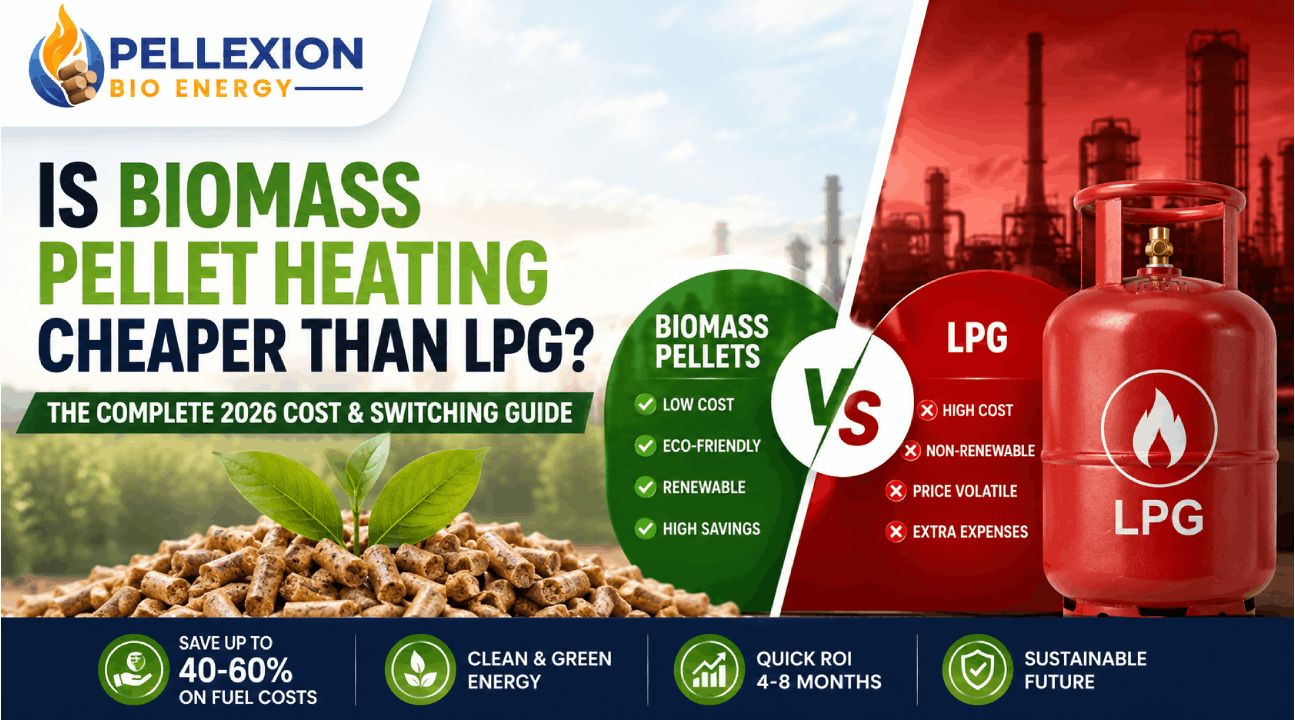
Biomass pellets are typically 55–65% cheaper than LPG per unit of usable heat. LPG still wins on convenience, upfront appliance cost, and indoor cleanliness. The right choice depends on how much heat you actually use and whether you can afford the initial equipment investment.
Understanding the Two Fuels
Before comparing prices, it helps to know what you’re actually paying for.
What is LPG heating?
Liquefied Petroleum Gas is a refined fossil fuel, mostly a propane-butane mix, stored under pressure in steel cylinders. It’s the default fuel for Indian kitchens and is also used in some water heaters and space heaters. LPG burns clean, ignites instantly, and needs almost no maintenance — the tradeoff is that its price is tied to global crude oil markets and is revised by state-run oil companies every month, so it can climb quickly during periods of high demand or geopolitical disruption.
What are biomass pellets?
Biomass pellets are small, dense cylinders made by compressing agricultural residue — rice husk, mustard husk, sawdust, cotton stalks, sugarcane bagasse — under high pressure. No chemical binder is needed; the natural lignin in the plant material holds each pellet together. They’re burned in a purpose-built pellet stove or boiler that automatically feeds pellets from a hopper into a combustion chamber, giving a controllable, ash-producing but relatively steady flame. Because the raw material is farm waste rather than an imported, refined product, pellets are inherently cheaper to produce.
The core reason pellets are cheaper: LPG’s price reflects crude oil extraction, refining, and imported logistics. Biomass pellets are made from residue that would otherwise be burned in fields or discarded, so the raw material cost is a fraction of LPG’s, even after accounting for pelletizing and transport.
Full Cost-Per-kcal Breakdown
Comparing fuels by price-per-kilogram is misleading, because LPG and pellets don’t carry the same amount of energy per kilogram, and your appliance doesn’t convert 100% of that energy into usable heat. The only fair comparison is cost per unit of delivered heat — here, cost per 1,000 kcal actually reaching your room or water tank.
LPG, step by step
| Variable | Value |
|---|---|
| 14.2 kg domestic cylinder price (Gujarat, mid-2026) | ₹920–950 |
| Price per kg | ≈ ₹65–67 |
| Calorific value | ≈ 11,900 kcal/kg |
| Typical appliance efficiency | 85% |
| Useful heat delivered per kg | ≈ 10,100 kcal |
| Cost per 1,000 useful kcal | ₹6.5–7 |
Biomass pellets, step by step
| Variable | Value |
|---|---|
| Retail price (small-quantity, various feedstock) | ₹7–10.5/kg |
| Bulk price (per-tonne purchase) | ₹7,500–10,500/tonne |
| Calorific value | ≈ 3,500–4,500 kcal/kg |
| Typical appliance efficiency | 80% |
| Useful heat delivered per kg | ≈ 2,800–3,600 kcal |
| Cost per 1,000 useful kcal | ₹2–3 |
Run the two side by side and pellets come out at roughly a third to a half of LPG’s running cost for the same heat output. That gap has been widening rather than narrowing, since domestic LPG has trended upward over the past year while bulk pellet prices have stayed comparatively flat, supported by India’s large agricultural residue surplus and government incentives for pellet manufacturing.
Why the raw calorific value gap doesn’t matter as much as it looks
Switching From LPG to Biomass Pellet Heating
Moving from an LPG appliance to a pellet stove or boiler is a real project with a defined sequence — here’s how it typically goes, whether you’re doing a supplemental install for a single room or a full water/space-heating changeover.
01. Size your heat load first
Work out the space or water-heating demand you actually need to cover, usually expressed in BTUs or kcal/hour. An undersized stove won’t keep up on cold days; an oversized one burns pellets faster than necessary and overheats the space. A heating professional can estimate this from room size, insulation, and ceiling height in a short site visit.
02. Choose freestanding, wall-mounted, or insert style
Freestanding stoves are the most flexible and easiest to retrofit. Wall-mounted units suit smaller spaces with limited floor area. Inserts fit into an existing fireplace opening if you already have one, cutting down on new venting work.
03. Plan the venting route
Pellet appliances don’t need a full chimney, but they do need a dedicated flue to vent combustion gases outdoors — typically a 3–4 inch twin-wall pipe run through an exterior wall or up through the roof. Plan the shortest route with minimal bends, keeping clearance from combustible materials as specified in the appliance manual.
04. Prepare a non-combustible hearth pad
Most pellet stoves need to sit on a fire-resistant surface — tile, stone, or a manufactured hearth pad — extending several inches beyond the stove’s footprint on all sides.
05. Arrange the electrical connection
Pellet stoves use an electric auger and blower to feed fuel and circulate heat, so you’ll need a standard grounded power outlet nearby. A backup plan (or a stove with battery backup) is worth considering if your area has frequent power cuts, since the auger and blower stop without electricity.
06. Install the vent, thimble, and cap
Cut the wall opening to the manufacturer’s specified diameter, insert the insulated wall thimble, connect the vent pipe from the stove through the thimble, and fit an exterior cap with a screen to keep out rain, debris, and animals. This step benefits most from a qualified installer — incorrect venting is both a safety risk and the most common cause of voided warranties.
07. Set up dry pellet storage
Pellets must stay bone dry — moisture drops calorific value fast and can cause pellets to swell and disintegrate. A dedicated storage bin, bag rack, or small silo in a covered, ventilated area keeps your fuel supply usable.
08. Run a test fire and tune the feed rate
Once installed, most stoves have an adjustable auger feed rate and air intake. A first test burn lets you (or your installer) dial in the right pellet feed for your specific fuel batch, since calorific value and moisture vary slightly between suppliers.
09. Keep LPG for what it does best
Most households don’t fully remove their LPG connection — they keep it for cooking, where instant flame control matters, and shift the larger, steadier heating loads (space heating, water heating) to pellets, where the savings actually accumulate.
Environmental & Efficiency Comparison
Cost isn’t the only axis worth comparing. Here’s how the two fuels stack up on efficiency and environmental impact.
| Factor | LPG | Biomass Pellets |
|---|---|---|
| Fuel source | Fossil (crude oil / natural gas byproduct) | Renewable (agricultural residue) |
| Combustion cleanliness | Very clean, no ash | Clean-burning but produces ash for disposal |
| Typical appliance efficiency | 80–90% | 70–85% |
| Carbon footprint | Fixed fossil emissions per kg burned | Largely carbon-neutral (recently absorbed CO₂) |
| Local air quality impact (well-maintained appliance) | Minimal | Low, but requires flue maintenance to stay low |
Biomass pellets have an additional systemic benefit in the Indian context: they give farmers a market for crop residue that would otherwise often be burned in the field, a major contributor to regional air pollution during harvest season. Choosing pellets, at scale, supports a supply chain that reduces that practice rather than adding to fossil fuel demand.
Pros and Cons, Side by Side
Real Savings Example
Numbers are easier to trust with a worked example. Take a household using LPG for water heating and supplemental space heating through the winter, averaging roughly 15,000 useful kcal per day.
| Scenario | Monthly heat used | Cost per 1,000 kcal | Monthly fuel cost |
|---|---|---|---|
| LPG | 450,000 kcal | ₹6.6 | ≈ ₹2,970 |
| Biomass pellets | 450,000 kcal | ₹2.5 | ≈ ₹1,125 |
| Monthly savings | ≈ ₹1,850 |
Ongoing Maintenance & Running Costs
The fuel-cost comparison above is the headline number, but a fair comparison should also account for upkeep.





 Total views : 6826