
Table of contents
The chemical industry runs on heat — and it runs on it constantly. Reactors, distillation columns, dryers, and thermic fluid heaters depend on a steady, predictable thermal supply, often 24 hours a day, 365 days a year. A single batch of inconsistent fuel can throw off reaction temperatures, damage product quality, or trigger an unplanned shutdown that costs lakhs of rupees in lost production.
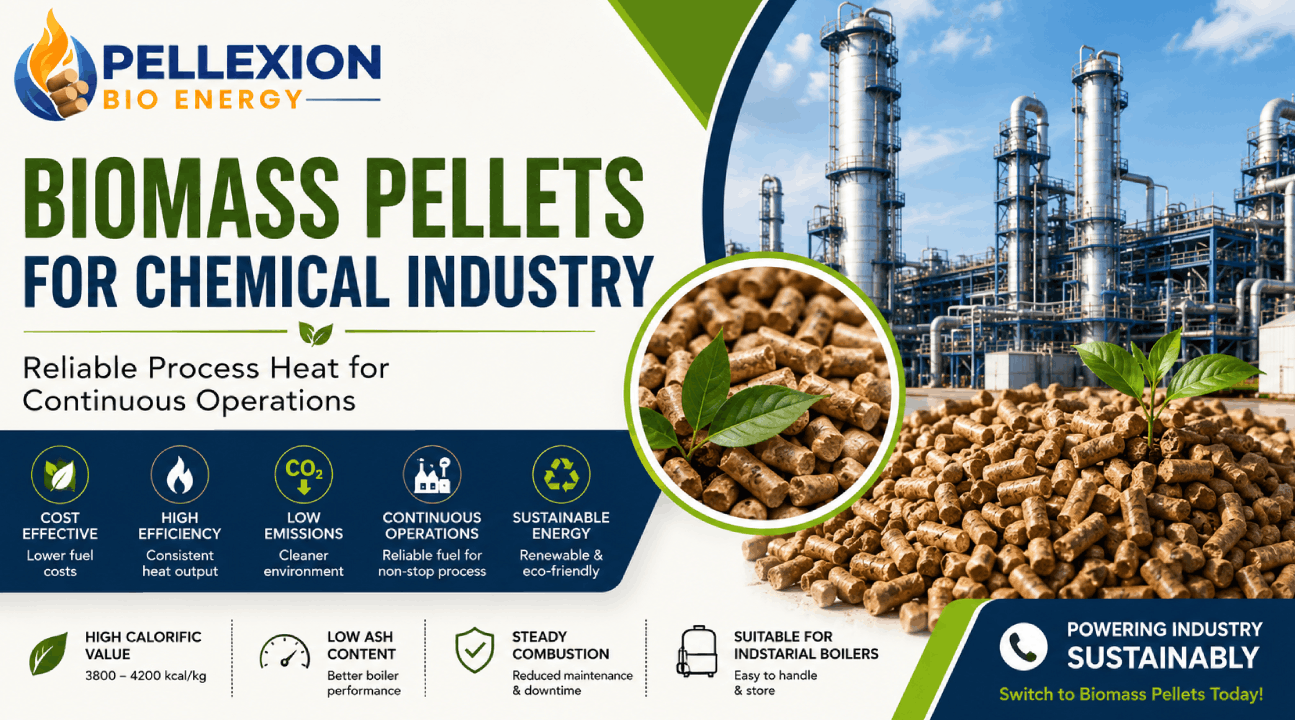
This is exactly why more chemical manufacturers across Gujarat — from Jamnagar to Vapi, Ankleshwar, and Dahej — are switching their boilers and thermic fluid heaters from coal to biomass pellets. At Pellexion Bio Energy, we manufacture high-calorific, low-ash, low-sulphur biomass pellets engineered specifically for the demanding, always-on nature of chemical process heating.
In this guide, we’ll walk through why biomass pellets are becoming the preferred fuel for chemical plants, how they compare to coal, what to look for in a supplier, and how to plan a smooth transition for continuous operations.ti
Why the Chemical Industry Needs a Different Kind of Fuel
Most industrial fuels are judged on cost per tonne. Chemical plants have to judge fuel on something else first: consistency.
Chemical processes are engineered around tight thermal tolerances. When a boiler or thermic fluid heater is fed fuel with a fluctuating gross calorific value (GCV), the result isn’t just inefficiency — it’s a chain reaction:
- 1Steam or oil temperature drifts outside the process window
- 2Reaction rates and yields shift, sometimes outside specification
- 3Operators compensate manually, increasing fuel consumption
- 4Equipment experiences thermal stress from constant adjustment
- 5In the worst case, an off-spec batch has to be discarded entirely
Coal, by nature, is a mined and blended commodity — its GCV, moisture, and ash content can vary noticeably even within the same delivery. Biomass pellets, because they’re manufactured under controlled conditions from processed agricultural residues, offer a level of batch-to-batch uniformity that’s difficult for raw coal to match.
Step-by-Step: How Biomass Pellets Solve the Chemical Plant’s Fuel Problem
Step 1: Consistent, Engineered Calorific Value
Biomass pellets are produced through a controlled process — drying, grinding, and high-pressure compression — rather than extracted from the ground in variable seams. This means every batch can be manufactured to a target GCV range and verified before dispatch, giving plant engineers a fuel they can actually design their thermal calculations around.
Step 2: Dramatically Lower Sulphur Content
Chemical plants frequently use stainless steel and other corrosion-sensitive alloys in their heat exchangers, flue ducts, and boiler tubing. When coal burns, its sulphur content forms sulphur dioxide, which combines with condensed moisture in the flue gas to form sulphuric acid — a major cause of corrosion below the acid dew point.
Biomass pellets contain a small fraction of the sulphur typically found in coal. Lower sulphur means less acidic flue gas, less corrosion, and a longer service life for expensive heat exchanger and boiler components.
Step 3: Lower Ash, Less Maintenance
High ash content in fuel translates directly into more frequent de-ashing, fouling of heat transfer surfaces, and reduced boiler efficiency over time. Biomass pellets are manufactured from selected agricultural residues with naturally low ash content, which keeps combustion chambers cleaner for longer and reduces unplanned maintenance stops — critical for plants that can’t afford downtime.
Step 4: Stable Combustion for Thermic Fluid Heaters
Thermic fluid (oil) heaters are widely used across chemical plants for indirect heating in the 150°C–300°C range, where tight, stable temperature control is essential. The dense, uniform shape of biomass pellets allows for steady, predictable combustion and consistent feed rates — qualities that make pellet-fed systems well suited to thermic fluid heater operation when converted from coal or oil firing.
Step 5: Renewable, Compliance-Friendly Fuel Sourcing
Biomass pellets are made from agricultural waste — groundnut shell, agro residue, and other regionally available biomass — rather than fossil fuel. For chemical manufacturers facing increasing scrutiny on emissions and sustainability reporting, switching to a renewable, low-emission fuel source supports both environmental compliance and ESG goals, without requiring a full equipment overhaul in most boiler retrofits.
Step 6: Predictable, Regionally Sourced Supply
Because biomass pellets are manufactured from regionally available agricultural residue, supply chains can be kept short and dependable — particularly valuable for Gujarat-based chemical clusters where consistent, large-volume deliveries are essential to keeping continuous operations running without interruption.
Biomass Pellets vs. Coal vs. Diesel for Chemical Plant Heating
| Factor | Biomass Pellets | Diesel |
|---|---|---|
| Emissions | Low | High |
| Renewable Source | Yes | No |
| Sulphur Content | Very Low | Low–Moderate |
| Ash Content | Low | Very Low |
| Batch Consistency | High (manufactured) | High |
| Equipment Corrosion Risk | Low | Moderate |
| Cost Stability | More Stable | Highly Volatile |
| Suitable for Continuous Operation | Yes | Limited by cost |
What to Look For in a Biomass Pellet Supplier for Chemical Applications
Not every biomass pellet supplier is built for the precision a chemical plant needs. When evaluating a supplier, chemical procurement teams should ask about:
At Pellexion Bio Energy, every batch of our biomass pellets and biomass briquettes goes through quality testing before dispatch, with high calorific value, low ash, and low moisture content built into our manufacturing process — not added as an afterthought.
Converting Your Boiler or Thermic Fluid Heater: What to Expect
Switching a chemical plant’s heating system from coal to biomass pellets typically involves:
- 1Fuel and combustion assessment — Reviewing your current boiler or thermic fluid heater specifications against pellet fuel characteristics.
- 2Feed system evaluation — Pellets generally feed more uniformly than lump coal, often simplifying automated feed systems.
- 3Trial burn — Running a controlled trial batch to validate temperature stability and combustion efficiency before full conversion.
- 4Supply agreement — Establishing a dependable, ongoing supply volume matched to your plant’s continuous operating schedule.
- 5Full transition — Moving to biomass as the primary fuel source, with monitoring during the initial operating period.
Most chemical plants find that with the right fuel partner, this transition causes minimal disruption to ongoing operations.
Industries We Serve
Beyond the chemical sector, Pellexion Bio Energy’s biomass pellets and briquettes power industrial boilers across food processing, textile, pharmaceutical, ceramic and tile, paper and pulp, brick kilns, dairy, rubber, steel re-rolling, hospitality, and power generation industries throughout Gujarat and beyond.
FAQs
Ready to Power Your Chemical Plant with Reliable Biomass Fuel?
Pellexion Bio Energy manufactures premium biomass pellets and briquettes engineered for industries that can’t afford inconsistency. Get a free consultation and bulk pricing for your chemical plant’s process heating needs.





 Total views : 6879