
Table of contents
Everything a plant manager, procurement officer or boiler operator needs before switching to biomass fuel — pricing, quality checks, industry use cases, and where to buy biomass pellets near you in Gujarat.
What Are Biomass Pellets?
Biomass pellets are small, cylindrical pieces of compressed agricultural or wood residue — groundnut shell, agro-waste, coriander waste, sawdust and similar byproducts — used as a renewable energy fuel in place of coal, diesel and firewood. Instead of being burned or dumped, farm and processing residue is dried, ground and pressed under high pressure into a dense, uniform fuel with a high calorific value and low ash content.
Search interest in biomass fuel pellets India and industrial biomass pellets India has grown quickly as factories look for a stable, lower-emission alternative to imported coal. Unlike coal, biomass pellets are made from domestic agricultural residue, which means supply is tied to India’s own harvest cycles rather than international shipping routes and import duties.
How Biomass Pellets Are Made
Every batch of biomass pellets manufacturers India produce follows roughly the same four-stage process, though quality varies a great deal depending on how tightly each stage is controlled. This is the process Pellexion Bio Energy follows for every order — you can see the live version on our Our Process page.
- 1Raw material selection. Agricultural and wood waste — groundnut shell, crop residue, coriander waste and similar material — is sourced and sorted so the final fuel burns consistently, batch after batch.
- 2Crushing & grinding. Raw material passes through crushing systems to reach the particle size the pellet press needs. Uneven particle size is one of the most common causes of a poor-quality pellet.
- 3Pelletizing & briquetting. Ground material is compressed under high pressure and heat, which binds it into a dense pellet or briquette using the material’s own natural lignin — no added chemicals or binders.
- 4Quality testing & supply. Each batch is checked for moisture, ash content and calorific value before packaging and dispatch, so what you receive matches what you were quoted.
Biomass Pellets vs Coal, Diesel & Firewood
Are biomass pellets actually cheaper and cleaner than coal, diesel or firewood?
This is the comparison every procurement team runs before switching fuel. Coal and diesel are globally traded commodities, so their landed cost in India moves with international shipping rates, currency and import policy — often with little warning. Biomass pellets, made from local agricultural residue, are far less exposed to that volatility.
Biomass fuel vs coal vs diesel — key operating factors
| Feature | Biomass Fuel | Coal | Diesel |
|---|---|---|---|
| Emissions | Low | High | High |
| Renewable | Yes | No | No |
| Ash content | Low | High | Very low |
| Cost stability | More stable | Fluctuating | Highly volatile |
| Sourcing | Domestic, agricultural | Mostly imported | Imported crude |
| Environmental impact | Eco-friendly | Polluting | Polluting |
Against firewood, biomass pellets have a clear edge on consistency: firewood’s moisture content and calorific value change with the season and the source tree, which makes boiler tuning difficult. Pellets are pressed to a controlled moisture level, so combustion is far more predictable, and their higher density means less storage space per unit of energy delivered.
Biomass Pellet Price in India (2026)
How much do biomass pellets cost in India?
There is no single fixed number for biomass pellets price India — rates depend on four factors, and any supplier quoting a flat, fixed price without asking about these hasn’t actually priced your order:
- 1Raw material. Groundnut shell and mixed agro-waste pellets are usually the most cost-effective. Single-source or specialty pellets (like coriander waste) can carry a premium depending on availability that season.
- 2Calorific value required. Higher-calorific pellets cost more per tonne but can reduce total fuel consumption, so compare on a per-kcal basis rather than per-kg.
- 3Order quantity. Bulk, contracted supply typically prices lower than small, one-off orders.
- 4Delivery distance. Freight is a real cost component — a manufacturer near your plant, or near the agricultural belt that supplies the raw material, will usually beat a distant supplier once transport is factored in.
Pricing also has a seasonal pattern tied to harvest cycles: raw material is generally most available (and cheapest) just after harvest, and tighter in the off-season. If your consumption is predictable, locking in a supply agreement after harvest is usually the better commercial move than buying spot, month to month.
Biomass Pellet Suppliers Near You in Gujarat
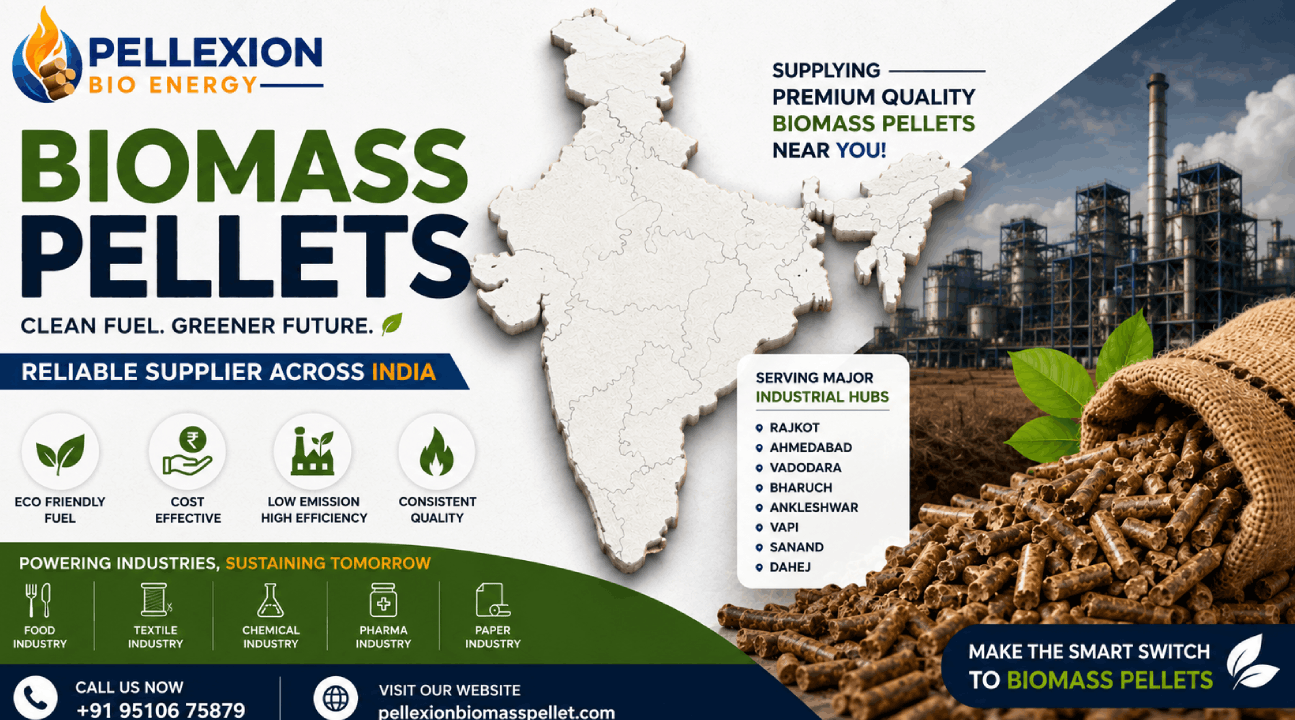
Freight is one of the biggest hidden costs in biomass fuel — so “near me” genuinely matters when you’re comparing biomass pellets suppliers near me. Pellexion Bio Energy manufactures at Kharedi, Kalavad, in Jamnagar district, placing us close to Saurashtra’s groundnut and agricultural belt, and within efficient delivery range of Gujarat’s major industrial clusters.
See full delivery coverage and dispatch points on our Our Locations page, or view the product range available for each region on our Products page.
Biomass pellets in Rajkot
Rajkot’s engineering, casting and ceramic units sit close to Saurashtra’s agricultural belt, which keeps raw-material and freight costs down for biomass pellets in Rajkot. Groundnut shell pellets in particular are a natural fit here, since Saurashtra is one of India’s largest groundnut-producing regions and the shell is a direct, local byproduct rather than material trucked in from elsewhere.
Biomass pellets in Ahmedabad
Ahmedabad and the surrounding industrial estates run a dense mix of textile, chemical and food-processing boilers, all strong candidates for a coal-to-biomass switch. For biomass pellets in Ahmedabad, the main variable is delivery scheduling — plants running continuous shifts need a supplier who can commit to a fixed delivery calendar, not just a one-off bulk drop.
Biomass pellets in Vadodara
Vadodara’s chemical and process industries typically need a stable, high-calorific fuel for continuous operations. Biomass pellets in Vadodara sourced from a Gujarat-based manufacturer avoid the longer freight runs associated with pellets trucked in from outside the state, which matters when boiler uptime depends on predictable delivery.
Biomass pellets in Vapi, Ankleshwar & Bharuch
This industrial belt is one of Gujarat’s densest clusters of chemical, pharmaceutical and processing units, and demand for biomass pellets in Vapi, biomass pellets in Ankleshwar and biomass pellets in Bharuch has grown as more plants look to cut coal-linked emissions and costs simultaneously. Because these clusters run heavy, continuous boiler loads, contracted monthly supply is generally a better fit than spot purchasing.
Coal-to-Biomass ROI: How to Calculate It
Is switching from coal to biomass actually worth it financially?
Most plants evaluate a fuel switch on landed cost alone, which understates the real picture. A more accurate comparison weighs four factors together:
- 1Cost per delivered kcal, not cost per kilogram — divide the price per tonne by the calorific value to get a true like-for-like figure between fuels.
- 2Price volatility exposure — coal’s landed cost swings with international shipping and currency movements; biomass, sourced domestically, is comparatively steady. Fewer surprise cost spikes mean easier budgeting across a financial year.
- 3Ash-handling and maintenance cost — biomass pellets’ lower ash content typically means less downtime cleaning grates and ash-handling systems, which has a real labour and lost-production cost that rarely appears in a simple fuel-price comparison.
- 4Emissions-linked cost avoidance — as environmental compliance requirements tighten, a lower-emission fuel profile can reduce exposure to future carbon-related costs or reporting obligations, particularly for exporters whose overseas customers increasingly ask about supply-chain emissions.
Run the comparison over a full year of consumption, not a single delivery, since biomass pricing (like coal) has its own seasonal pattern. A supplier who can walk you through this calculation against your own boiler’s numbers, rather than just quoting a rate per tonne, is generally the more serious partner to work with.
Industries That Use Biomass Pellets
Any facility running a coal- or diesel-fed boiler, furnace or dryer is a candidate for biomass pellets for boiler India conversion. The industries below make up the bulk of demand for industrial biomass pellets India today:
Biomass Pellets for Industrial Boilers & Steam Generation
Boiler conversion is the single biggest driver behind demand for biomass fuel in India. Most coal-fired boilers can run on biomass pellets with modest changes to the fuel feeding and grate system rather than a full replacement — which is why many plants start by blending biomass with coal, then move to a full biomass fuel supply once the boiler is tuned.
Two numbers matter most when sizing pellets to a boiler:
How to Choose a Reliable Biomass Pellet Supplier
How do I find a reliable biomass pellet supplier near me?
Use this checklist before signing a supply agreement — it applies whether you’re evaluating a local supplier or comparing multiple biomass pellet suppliers India for a multi-site contract:
Common Mistakes to Avoid When Buying Biomass Pellets
Most complaints about biomass fuel underperforming trace back to a handful of avoidable buying mistakes:
Benefits of Biomass Pellets for Industries & the Environment
Beyond cost, the case for biomass fuel rests on a few concrete advantages:
Storage & Handling: Are Biomass Pellets Safe to Store?
Yes — biomass pellets are compact, stable and low-risk to store, provided a few basics are followed:
Biomass Fuel Glossary
A few terms worth knowing before you compare quotes:
2026 Outlook: Biomass Fuel Demand in India
Demand for renewable energy fuel India industries can source locally continues to climb as environmental compliance expectations tighten and coal price volatility remains a recurring budgeting headache. Export-facing manufacturers in particular are seeing more pressure from overseas buyers to document supply-chain emissions, which is pushing boiler-fuel decisions higher up the priority list rather than treating it as a back-office procurement detail.
Why Choose Pellexion Bio Energy
Pellexion Bio Energy manufactures and supplies biomass pellets and biomass briquettes — including groundnut shell, agriculture waste, coriander waste and mixed-material variants — from our facility in Kharedi, Kalavad, Jamnagar, Gujarat. Every batch goes through the same four-stage process outlined above, with quality testing before dispatch.





 Total views : 6851