
Table of contents
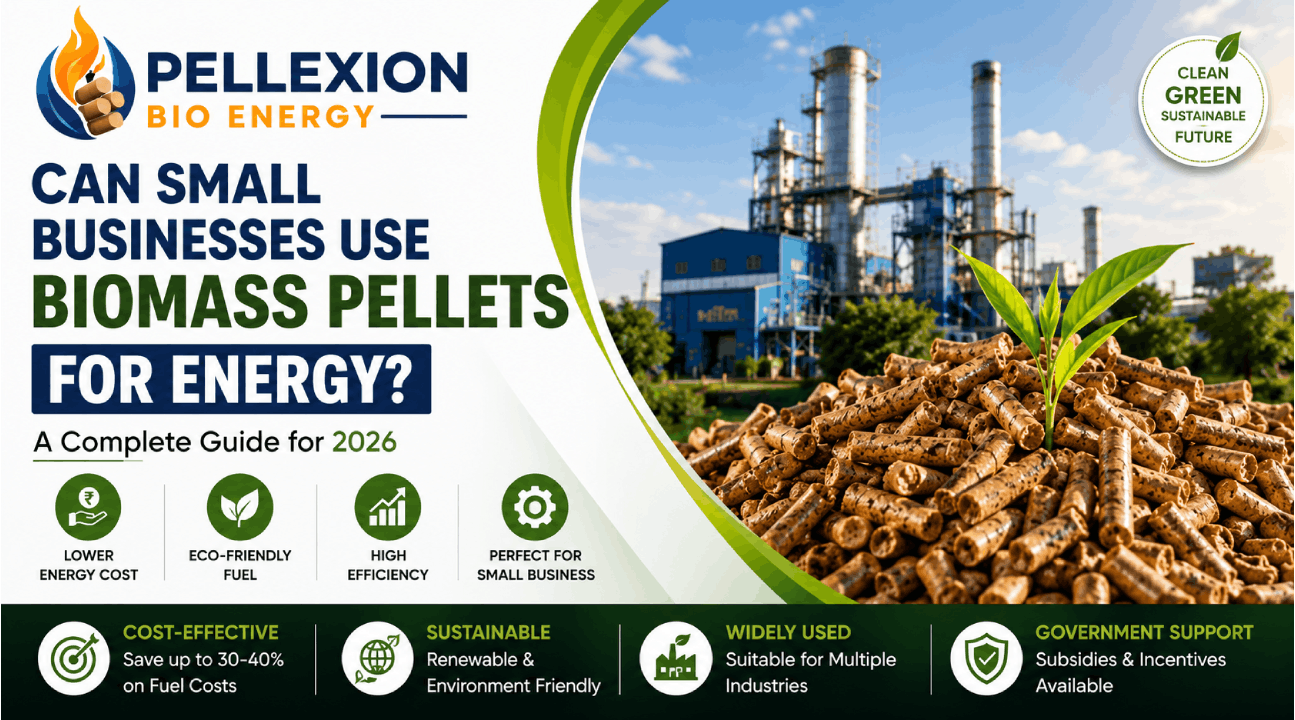
yes — and a growing number already do. Here’s the full, research-backed breakdown of costs, equipment, incentives and a step-by-step plan for switching your small business over to biomass pellet energy.
Energy bills are one of the few costs a small business can actually redesign rather than just absorb. Biomass pellets — small, dense, cylindrical fuel made from compressed sawdust, wood residue, and agricultural waste — have quietly moved from farms and large power plants into workshops, restaurants, salons, breweries, and small manufacturing units. This guide walks through exactly how, why, and whether it makes sense for your business.
What Are Biomass Pellets, Exactly?
Biomass pellets are a manufactured solid fuel made by compressing organic material — most commonly sawdust and wood shavings, but also agricultural residue, husk, straw, and other plant waste — into small, uniform cylinders, typically 6 to 8 millimeters in diameter. The standard fuel pellet shape is cylindrical, with a diameter of 6 to 8 millimeters and a length of no more than 38 millimeters. No glue or chemical binder is needed; the natural lignin in the wood fibers binds the pellet together under high pressure and heat.
What makes pellets useful for a business rather than just a household is consistency. Unlike unprocessed wood, a biomass pellet has a uniform shape and density, which ensures high combustion efficiency and reliable heat output, and pellets work seamlessly with automated feeding systems. That automation is the real unlock for commercial use — a hopper can feed a boiler continuously without a person shoveling fuel every hour, which is what makes pellets practical at a business scale rather than just a cozy fireplace scale.
6–8mm
Standard pellet diameter
<1%
Ash content, premium grade
Renewable
Sourced from wood & crop waste
Why Small Businesses Are Turning to Biomass Pellets
Three forces are pushing small business owners toward pellet fuel at the same time: rising and unpredictable energy costs, tightening sustainability expectations from customers and regulators, and equipment that has gotten smaller and more automated. None of these forces are unique to large industry anymore.
On the cost side, conventional energy sources are volatile in a way that makes budgeting difficult for a small operation. Rising prices of conventional energy sources are pushing businesses and consumers to explore alternative energy solutions to mitigate expenses, and biomass pellets offer a cost-effective and stable energy source that is particularly appealing where energy prices are volatile. A small bakery, laundromat, or workshop that relies on oil or LPG for heat is exposed to global price swings every winter; a pellet-fed boiler sourcing fuel from a regional supplier is comparatively insulated from that.
On the sustainability side, customers increasingly notice how a business powers itself, and so do landlords, insurers, and local authorities offering green business certifications. Switching part of your energy load to a renewable fuel is one of the few operational changes a small business can make that is both visible and verifiable.
Where Pellets Actually Fit in a Small Business
Not every business has an obvious use for solid fuel. Pellets make the most sense wherever a business already needs heat, hot water, or steam as part of its operations. The most common small-business applications include:
Businesses that use gas, oil, LPG, or resistive electric heating today are the most natural candidates, because the pellet boiler simply replaces the heat source while the rest of the distribution system — radiators, pipework, air handlers — can often stay the same.
Step-by-Step: Switching a Small Business to Biomass Pellets
01. Audit your current energy use
Pull twelve months of energy bills and separate out how much is spent on heating, hot water, and process heat versus lighting and equipment. Biomass pellets replace thermal energy, not electricity for machinery or lighting.
02. Size the load correctly
Work out peak and average heat demand in kilowatts. Undersizing a boiler leaves you cold on the worst day of winter; oversizing wastes capital. A supplier or installer can calculate this from floor area, insulation, and current fuel consumption.
03. Choose stove, boiler, or CHP
A single pellet stove suits a small retail space or workshop corner. A pellet boiler connected to existing radiators or a hot water system suits most small businesses. A CHP unit is only worth considering once heat demand is large and constant enough to justify the extra equipment cost.
04. Plan fuel storage
Decide between bagged pellets on pallets, a bin-style hopper, or a bagged silo delivered by blown delivery. Bagged pellets are typically best for homes and smaller businesses, while blown deliveries direct into storage silos suit larger commercial users. Storage needs to stay dry — moisture is the fastest way to ruin pellet fuel.
05. Get quotes and check certification
Compare at least two or three installers. Ask about ENplus or equivalent local quality certification for both the boiler and the pellets you plan to buy — certification is a proxy for how consistently the equipment will perform.
06. Check incentives before you commit capital
Confirm any applicable grants, tax credits, or renewable heat incentives in your region before signing a purchase order — some schemes require pre-approval before installation begins.
07. Install, commission, and train staff
A qualified installer should commission the system, set controls, and walk staff through refilling the hopper, basic ash removal, and who to call for servicing.
08. Set a fuel supply contract
Lock in a regular delivery schedule with a pellet supplier so fuel stock never runs low during peak season — this is the step most small businesses underestimate.
Cost and ROI: What to Actually Expect
The honest answer on cost is that biomass pellet systems usually cost more to install than a like-for-like gas or electric system, but less to run. The payback period depends heavily on how much heat your business uses and what fuel you’re replacing.
Upfront costs include the boiler or stove, flue and installation labor, and a fuel store. Ongoing costs are the pellets themselves, plus routine servicing and occasional ash disposal. Operating costs for pellet fuel more broadly include the cost of feedstock, energy, labor, and maintenance, with pellet dies needing replacement roughly every 1,000 to 1,500 hours of operation at the manufacturing end — a cost that is baked into the price you pay per bag or ton, not something you manage directly as a buyer.
Rule of thumb
Businesses replacing oil or LPG heating tend to see the fastest payback, often three to five years, because those fuels are typically the most expensive per unit of heat. Businesses replacing an efficient gas system may see a longer payback but still gain price stability and emissions reduction.
Two variables matter more than any single number you’ll find online: how many hours a year your heating system actually runs, and how close and reliable your local pellet supplier is. A business that heats year-round, like a bakery or a laundromat, gets a much faster return than one that only heats for a few winter months.
Grants, Incentives, and Support Schemes
Governments in many regions actively support the switch to biomass heating because it reduces reliance on imported fossil fuels and cuts emissions from commercial buildings. Support can take the form of capital grants toward equipment cost, tax credits, low-interest green business loans, or ongoing renewable heat payments based on how much energy the system produces.
Programs and their value change frequently and vary widely by country and even by state or province, so this is worth checking directly with your local energy department, small business development agency, or a biomass equipment supplier before budgeting — don’t assume last year’s scheme still applies.
Pros and Cons for a Small Business
| Consideration | Biomass Pellets | Gas / Oil / Electric |
|---|---|---|
| Fuel price stability | Generally stable, locally sourced | Exposed to global price swings |
| Upfront equipment cost | Higher | Lower |
| Running cost per unit heat | Typically lower | Typically higher |
| Carbon footprint | Low, renewable feedstock | Higher for fossil fuels |
| Space required | Boiler + dry fuel store | Boiler only, no fuel store |
| Maintenance | Periodic ash removal, annual service | Annual service only |
The trade-off is fairly clean: pellets ask for more space and slightly more hands-on maintenance in exchange for lower and more predictable running costs and a genuine sustainability story. For a business with the physical space and a real heat load, that trade tends to pay off; for a business in a cramped city-center unit with light heat needs, it may not be worth the disruption.
Choosing Quality Pellets and a Reliable Supplier
Not all pellets perform the same, and low-quality fuel is the most common reason a business ends up unhappy with a biomass system. Quality depends on the ash content, moisture content, and consistency of the raw material used to make the pellet. Certification proves a pellet meets strict standards for calorific value, ash content, and durability, giving buyers confidence about quality and consistency. Premium wood pellets generally keep ash content below roughly one percent, which matters directly to a small business because higher-ash pellets clog feed systems and need more frequent cleaning.
When evaluating a supplier, ask about the feedstock source, moisture content on delivery, whether pellets are certified, and — just as important for a small operation — delivery reliability during peak winter demand. A slightly higher price from a supplier who never misses a delivery window is usually worth it.
Common Mistakes Small Businesses Make
Small businesses absolutely can use biomass pellets for energy, and a meaningful number already do — from bakeries and breweries to salons, workshops, greenhouses, and small hotels. The technology has scaled down enough that automated pellet boilers now fit spaces once served only by a gas or oil system. The businesses that benefit most are the ones with a genuine year-round heat load, room for a dry fuel store, and access to a reliable local pellet supplier. For everyone else, it’s worth at least running the numbers — the audit in step one of this guide takes an afternoon and tells you almost everything you need to know.




 Total views : 6879