
Table of contents
If you run a steam boiler, thermic fluid heater, or hot air generator in an Indian factory, fuel is very likely the single largest recurring cost on your plant’s books — bigger than labour, bigger than maintenance, sometimes bigger than everything else combined. And in 2026, plant managers across Gujarat, Maharashtra, Tamil Nadu, and Punjab are asking the same question: which fuel actually costs less to run — biomass pellets, LPG, or diesel?
The honest answer is: it depends on how you calculate it. Comparing fuels by price per kg or price per litre alone is misleading, because biomass, LPG, and diesel release very different amounts of heat per unit, and your boiler doesn’t convert all of that heat into usable steam. The only fair comparison is cost per unit of useful heat delivered — and once you run that number, the gap between these three fuels becomes very clear.
This guide walks through the complete math, current 2026 market prices, a step-by-step calculation method you can apply to your own boiler, and a real-world savings example for a mid-sized industrial unit.
Why This Comparison Matters More in 2026 Than Ever Before
Three things have converged this year to make fuel choice a board-level decision rather than a purchasing-department footnote:
Put together, this means the fuel-cost conversation has shifted from “is biomass good enough?” to “how much are we losing every month by not switching?”
The Three Fuels at a Glance
| Biomass Pellets | Commercial LPG | Diesel (HSD) | |
|---|---|---|---|
| Type | Renewable, agro-residue based | Fossil fuel (bulk/cylinder) | Fossil fuel |
| Typical GCV | 3,800–4,200 kcal/kg | ~11,900 kcal/kg | ~10,700 kcal/kg (~9,000 kcal/litre) |
| Typical boiler efficiency | 78–85% | 88–92% | 86–90% |
| Price stability | Comparatively stable | Revised monthly, crude-linked | Revised daily, crude-linked |
| Storage | Needs a dry, covered store | Bulk tank or cylinder bank | Underground/above-ground tank |
| Emissions | Low, carbon-neutral | Cleaner combustion, still fossil | Higher particulate & SOx |
| Govt push | Actively encouraged (National Biofuel Policy) | Neutral | Being discouraged for industrial heat |
Biomass loses on raw calorific value per kilogram — that’s simply chemistry, agro-residue can’t match a hydrocarbon molecule for energy density. But it wins decisively on price per kilogram, and that’s the variable that actually decides your monthly fuel bill.
Step 1: Understand the Only Number That Actually Matters — Cost Per Lakh Kcal
Every industrial boiler exists to do one job: turn fuel into usable heat (steam, hot water, or thermic fluid heat). So the real comparison isn’t “price per kg of fuel” — it’s:
Cost to deliver 1,00,000 (one lakh) kcal of usable heat into your process.
The formula is:
Cost per lakh kcal = (Fuel price per kg or litre ÷ (GCV × Boiler efficiency)) × 1,00,000
Where:
This single formula is why “biomass is cheaper per kg” and “LPG has more heat per kg” are both true statements — and why neither one tells you what you’re actually paying for a tonne of steam.
If you haven’t measured your own boiler’s efficiency, our detailed walkthrough on how to calculate boiler efficiency covers both the Direct and Indirect Method with worked examples — it takes about 20 minutes with a fuel meter and a flue gas reading.
Step 2: Current 2026 Market Prices (India)
Fuel prices move constantly, so treat these as a working baseline — always confirm current local rates before finalising a fuel budget.
Biomass Pellets (industrial bulk supply)
Commercial LPG (industrial bulk / cylinder)
Diesel (HSD, bulk industrial)
Step 3: Run the Cost-Per-Lakh-Kcal Calculation
Here’s the same formula applied to each fuel, using representative mid-range figures and typical industrial boiler efficiencies.
Biomass Pellets
Diesel
The Comparison Table
| Fuel | Price | GCV | Efficiency | Usable kcal/unit | Cost per lakh kcal |
|---|---|---|---|---|---|
| Biomass Pellets | ₹9/kg | 4,000 kcal/kg | 82% | 3,280 | ₹274 |
| Commercial LPG | ₹95/kg | 11,900 kcal/kg | 90% | 10,710 | ₹887 |
| Diesel (HSD) | ₹95/litre | ~9,000 kcal/l | 88% | 7,920 | ₹1,199 |
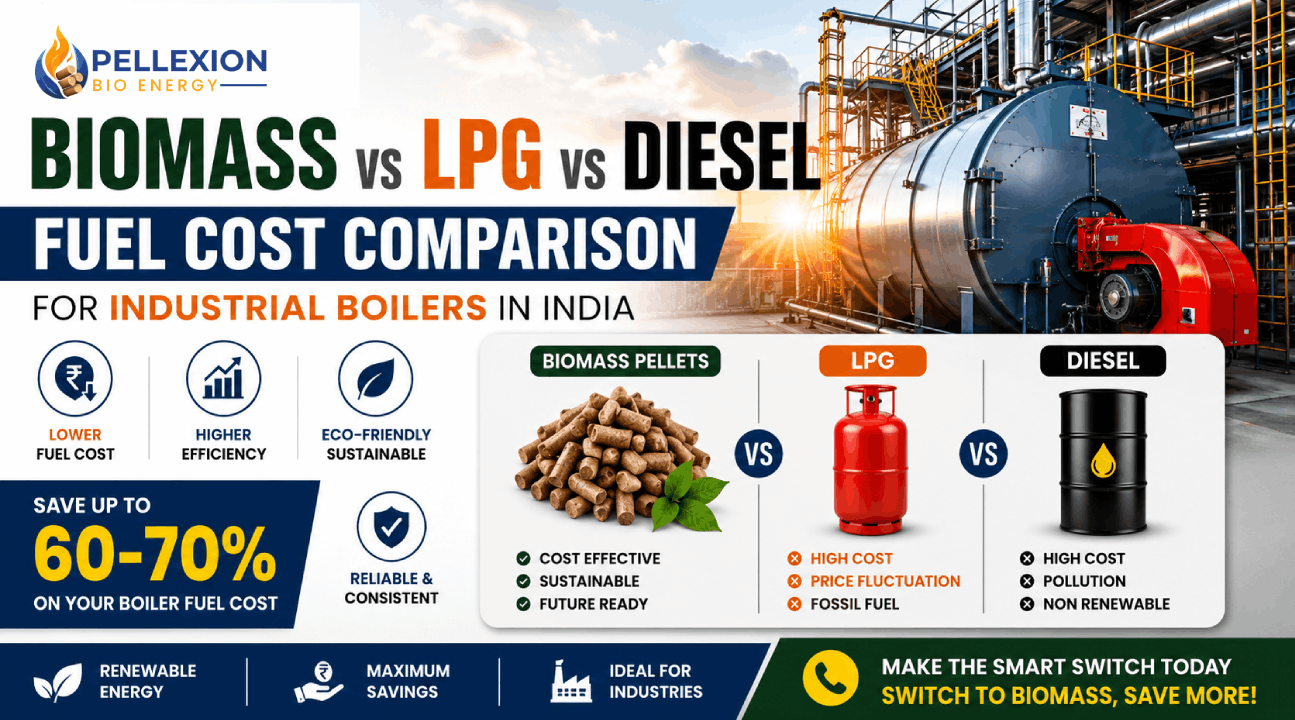
At these representative rates, biomass pellets cost roughly 69% less than LPG and roughly 77% less than diesel for the same amount of usable heat. Even accounting for regional price swings of 10–15% in either direction, biomass stays the clear low-cost option — the gap is simply too large for normal fuel-price fluctuation to close.
Want the numbers specific to your own boiler and fuel rate? Plug your actual fuel price, your boiler’s efficiency, and your fuel’s GCV into the formula above — the structure doesn’t change, only the inputs do.
Step 4: A Real-World Example — 500 kg/hr Steam Boiler, 300 Working Days
Numbers on a page are useful, but plant managers think in monthly fuel bills. Here’s a worked example for a mid-sized industrial boiler.
Assumptions:
Annual fuel cost at the cost-per-lakh-kcal rates above:
| Fuel | Cost per lakh kcal | Annual useful heat (lakh kcal) | Estimated annual fuel cost |
|---|---|---|---|
| Biomass Pellets | ₹274 | 975 | ≈ ₹26.7 lakh |
| Commercial LPG | ₹887 | 975 | ≈ ₹86.5 lakh |
| Diesel | ₹1,199 | 975 | ≈ ₹1.17 crore |
For this single boiler, switching from diesel to biomass pellets represents a potential annual fuel-cost saving in the range of ₹90 lakh, and switching from LPG to biomass represents a saving in the range of ₹60 lakh. Scale that across multiple boilers, thermic fluid heaters, or a multi-plant operation, and the numbers move from “worth considering” to “hard to ignore.”
These are illustrative figures based on representative rates — your actual savings depend on your fuel price, boiler efficiency, steam demand, and operating hours. For a number specific to your plant, our team can run this calculation against your actual fuel bills.
Step 5: Factors Beyond Price That Affect the Real Comparison
Cost per lakh kcal tells you which fuel is cheaper. It doesn’t tell you the whole operational picture. Here’s what else plant managers should weigh before switching.
Storage and handling
LPG needs pressurised storage — a bullet tank or cylinder bank with safety clearances, fire-fighting infrastructure, and periodic statutory inspection. Diesel needs a licensed storage tank with spill containment. Biomass pellets need a dry, covered, ventilated store — simpler infrastructure, but you do need floor space and a system to prevent moisture pickup during monsoon months.
Feeding system and automation
LPG and diesel burners are naturally suited to fully automatic, modulating firing — useful where load varies constantly through the shift. Biomass-fired boilers can also run automatically with a screw-feed or pneumatic dosing system, but the retrofit or new-boiler cost is a factor worth budgeting for. Most fire-tube boilers already running on coal or husk can be adapted to pellets with comparatively minor modification; boilers currently running purely on LPG or diesel burners typically need a biomass-compatible furnace or a parallel biomass unit.
Combustion consistency and ash
Good-quality biomass pellets — low moisture, consistent particle size, low ash content — burn cleanly and predictably. Inconsistent biomass (wet, mixed-quality, high-ash) causes clinkering, incomplete combustion, and unpredictable steam output. This is why sourcing from a quality-controlled manufacturer matters as much as the fuel-cost math; a cheap pellet with unreliable GCV can erase the savings you calculated on paper.
Emissions and compliance
Biomass combustion is broadly treated as carbon-neutral for regulatory purposes, since the CO₂ released was absorbed by the crop during its growing cycle. Diesel combustion produces higher particulate matter and SOx emissions relative to biomass and LPG, which is increasingly relevant as State Pollution Control Boards tighten stack-emission norms for process-heat industries.
Price stability
This is the factor most plant managers underweight. LPG and diesel prices are directly tied to international crude benchmarks and the rupee-dollar rate — both moved substantially over the past year. Biomass pellet pricing is tied primarily to local agricultural residue supply and transport cost, which historically moves in a narrower band. A lower and more predictable fuel cost makes annual budgeting significantly easier.
Step 6: How to Actually Switch — A Practical Checklist
If the numbers above make a switch worth exploring, here’s the sequence most industrial buyers follow:
- 1Measure your current boiler efficiency and monthly fuel consumption. You need a real baseline, not an estimate, before you can measure savings accurately.
- 2Get your boiler assessed for biomass compatibility. Many fire-tube and water-tube boilers already running on solid fuel need only a feeding-system upgrade; boilers built purely for oil/gas firing may need a furnace modification or a parallel biomass unit.
- 3Request pellet samples and GCV test reports from prospective suppliers — never buy on price alone. A pellet priced ₹1/kg cheaper but with 300 kcal/kg lower GCV can cost you more per lakh kcal delivered.
- 4Plan your storage space — a dry, covered area sized for at least 15–20 days of consumption gives you a buffer against monsoon-season supply disruption.
- 5Run a trial batch on a partial load before committing to full-volume monthly supply, to confirm combustion behaviour and ash output on your specific boiler.
- 6Lock in a supply agreement with a manufacturer who can guarantee consistent GCV, moisture content, and monthly volume — supply consistency is what actually protects your calculated savings over the full year.
For a deeper walkthrough of this exact process, our guide on switching from diesel to biomass for textile and process-heat units covers the transition timeline in more detail.





 Total views : 6811