
Table of contents
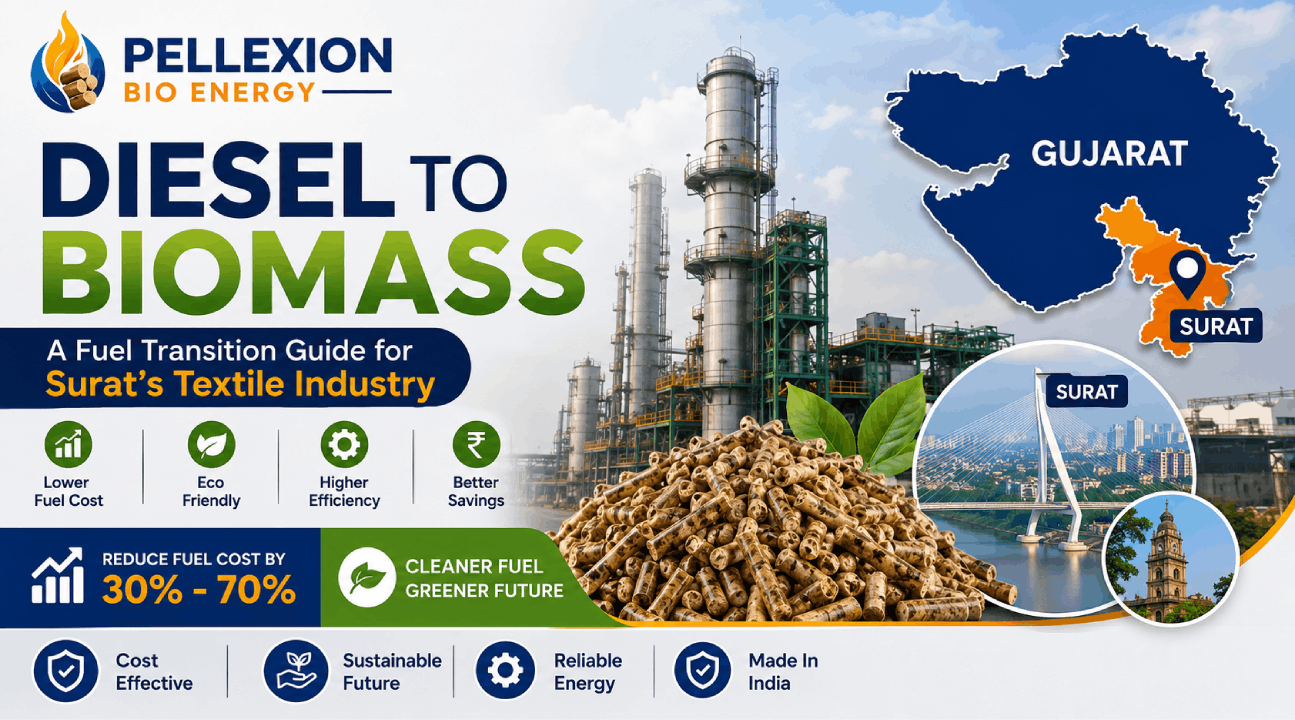
A practical, step-by-step roadmap for dyeing, printing, and processing units in Surat to move off costly, volatile diesel and onto stable, lower-emission biomass pellets — without disrupting production.
Walk through Sachin, Pandesara, or Palsana on any given morning and you’ll hear it before you see it — the low mechanical hum of stenters and dyeing jets, hundreds of them, drawing heat from thermic fluid heaters that most units still fire with diesel. It’s a fuel that’s easy to store, quick to light, and has powered Surat’s textile processing sector for decades. It’s also become one of the biggest line items squeezing margins in the industry today.
This guide walks through why that dependency exists, what it’s actually costing processing units, and — more usefully — how a unit can move to biomass pellets as a fuel source without gambling on production quality or downtime. It’s written for plant owners, production managers, and the person in the finance office asking why the fuel bill keeps climbing.
What follows isn’t a general pitch for renewable energy. It’s a working reference: the mechanics of how a thermic fluid heater actually gets converted, what the numbers look like on a real fuel-cost comparison, what the Gujarat Pollution Control Board expects from the paperwork, and where units commonly stumble if they rush the process. Read it end to end if you’re evaluating the switch for the first time, or jump straight to the roadmap section if you already know diesel’s days at your plant are numbered and you’re ready to plan the move.
Why Surat’s Textile Units Run on Diesel
Surat processes an enormous share of India’s synthetic and blended fabric, and nearly every stage of that process — dyeing, printing, stentering, calendering — needs consistent, controllable heat. Diesel earned its place in this ecosystem for straightforward reasons: thermic fluid heaters designed decades ago were built around liquid-fuel burners, diesel ignites cleanly with minimal ash residue, and supply through local distributors has always been dependable, even if pricing wasn’t.
For a mid-sized processing house running two or three stenters and a dye-house boiler, that reliability mattered more than the per-litre cost, especially when diesel was a smaller share of total operating expense. But the maths on that trade-off has shifted hard over the last few years.
Look at where the heat actually goes on a typical processing floor and the dependency becomes clearer. Stentering machines need sustained, evenly distributed heat to set width and finish on synthetic and blended fabric — any fluctuation shows up directly as an uneven finish. Jet dyeing machines need thermic fluid held at a precise, stable temperature for extended dye cycles, since even small swings affect shade consistency and batch-to-batch matching. Rotary and flat-bed printing units need controlled drying heat immediately after print application, and any interruption there means reprocessing. Diesel-fired thermic fluid heaters were, for a long time, the simplest way to deliver that stability, which is exactly why the fuel became so deeply embedded in plant design rather than being treated as a swappable input.
The Rising Cost and Environmental Burden of Diesel
Three pressures are converging on diesel-dependent units at the same time:
None of these pressures are going to reverse. Together, they’re the reason “switch off diesel” has moved from a sustainability talking point to a line-item decision on the factory floor.
55–70%
Typical fuel cost reduction per unit of heat when switching to biomass pellets
4–8 wks
Typical timeline for a mid-sized unit’s full conversion, start to finish
Low ash
Consistent, quality-controlled biomass pellets leave minimal residue for cleaner burner operation
What Biomass Fuel Actually Is
Biomass pellets and briquettes are compressed, dried agricultural and wood residues — groundnut shell, agro-waste, and similar biomass — processed into dense, uniform fuel units with a high calorific value and low moisture content. Unlike raw agricultural waste, which burns inconsistently and produces variable heat, properly manufactured pellets are engineered for combustion: dried to a controlled moisture level, ground to a uniform particle size, then compressed under high pressure with no added chemicals or binders.
That consistency is what makes biomass viable as a direct substitute for diesel in thermic fluid heaters and boilers, rather than just an occasional supplementary fuel. The heat output per kilogram is predictable, batch to batch, which is the property a stenter or dye-house actually needs from any fuel.
It’s also worth being clear about what biomass is not: it isn’t raw crop stubble burned in the open, and it isn’t a lower-grade substitute adopted only because diesel became expensive. Manufactured pellets go through a defined industrial process — moisture reduction, particle sizing, and high-pressure compression — that turns an otherwise low-value agricultural residue into a fuel with a calorific value and burn behavior that can be engineered to match a specific burner’s requirements. That’s the distinction that makes it a genuine substitute rather than a downgrade.
The transition isn’t about accepting a less reliable fuel — it’s about switching to one priced by weight instead of by volatile global crude benchmarks.
Diesel vs. Biomass, Side by Side
Here’s how the two fuels actually compare across the factors that matter to a processing unit’s operations and compliance position:
| Factor | Diesel | Biomass Pellets |
|---|---|---|
| Fuel cost basis | Tied to volatile global crude prices | Priced by weight, comparatively stable |
| Emissions | High particulate & sulphur output | Substantially lower emissions profile |
| Renewability | Finite, fossil-based | Renewable agricultural residue |
| Storage & handling | Simple tank storage | Requires dry, ventilated storage space |
| Burner compatibility | Native to older thermic fluid heaters | Requires burner retrofit or new feed system |
| Regulatory trajectory | Facing tightening scrutiny | Treated as a cleaner fuel category by GPCB |
| Supply chain exposure | Import-linked price shocks | Locally sourced from Gujarat’s agricultural belt |
The Transition Roadmap: From Diesel to Biomass
A fuel switch touches procurement, plant engineering, and compliance at once, so it goes smoother when it’s sequenced deliberately rather than rushed. Here’s the order that works for most textile processing units:
01. Audit current fuel load and heat demand
Measure actual diesel consumption against the heat output your stenters, jets, or drying range require. This baseline determines the biomass volume and calorific value you’ll need to match performance, not just replace fuel type for type.
02. Assess the existing thermic fluid heater or boiler
An engineer evaluates whether your current heater can accept a biomass combustion chamber retrofit, or whether a parallel biomass unit makes more sense alongside the existing setup during transition.
03. Select and test a biomass fuel source
Source sample batches from a quality-controlled pellet or briquette manufacturer and run combustion trials to confirm calorific value, ash content, and burn consistency under your actual operating conditions.
04. Install the burner retrofit and fuel-feed system
This is the core mechanical work — fitting a biomass-compatible burner, hopper, and automated or semi-automated feed mechanism sized to your unit’s continuous heat demand.
05. Run a parallel trial period
Operate biomass alongside diesel for a short window, comparing temperature stability, fuel consumption, and process output before fully decommissioning the diesel line.
06. Update GPCB consent and lock in supply
File the fuel-type update with the Gujarat Pollution Control Board, and set up a recurring biomass supply agreement to avoid the price and availability risk you’re trying to move away from in the first place.
Savings and Payback Period
The economics vary by unit size, but the underlying pattern holds across most Surat processing houses: diesel is priced and consumed by the litre against a benchmark that moves independently of anything happening on the factory floor, while biomass pellets are priced by weight against a comparatively stable agricultural commodity base. For a unit running a thermic fluid heater at meaningful daily throughput, that difference alone typically covers the retrofit’s capital cost within one to two years of operation, after which the ongoing fuel savings drop straight to margin.
The retrofit itself — burner, feed system, and any storage infrastructure — is the primary capital outlay. It’s worth treating that number the same way you’d evaluate any equipment purchase: against the fuel-cost delta it’s designed to eliminate, not in isolation.
A Worked Example
Numbers vary unit to unit, but a simplified illustration shows how the payback tends to play out for a mid-sized processing house running a single thermic fluid heater at steady daily throughput:
| Item | Diesel (Before) | Biomass (After) |
|---|---|---|
| Fuel cost per unit of heat | Baseline (100%) | ~30–45% of baseline |
| Fuel supply exposure | Global crude-linked pricing | Regional agri-commodity pricing |
| Capital outlay | — | Burner retrofit + feed system |
| Typical payback on retrofit | — | ~12–24 months of fuel savings |
| Ongoing annual impact | — | Savings continue to margin post-payback |
The exact figures depend on your unit’s daily consumption, current diesel rate, and the biomass calorific value you’re sourcing, but the shape of the curve — a defined payback window followed by compounding annual savings — holds consistently across the units we’ve worked with.
Pellets vs. Briquettes: Choosing the Right Format
Biomass fuel isn’t one-size-fits-all, and picking the wrong format for your burner setup is one of the more common early missteps in a conversion. Pellets are small, uniform, and flow easily through automated hoppers and screw-feed systems, which makes them the natural fit for units running continuous, automated combustion — the kind most stenters and larger thermic fluid heaters use. Briquettes are larger and denser, better suited to manually stoked or semi-automatic furnaces where feed timing is controlled by an operator rather than a machine. Getting this match right during the vendor and equipment selection stage — step three and four of the roadmap above — avoids feed jams and inconsistent burn rates down the line.
GPCB Compliance and Environmental Standing
Gujarat’s textile processing belt operates under close environmental oversight, and diesel-fired units face increasing documentation and monitoring requirements around particulate and sulphur emissions. Biomass fuel is generally categorized more favorably under GPCB’s consent framework, since it produces substantially lower particulate and sulphur output when burned in a properly maintained system.
That doesn’t mean compliance is automatic — units still need adequate stack height, ash handling, and periodic emissions testing — but the baseline starting position with biomass is materially better than with diesel, and it tends to make consent renewals less contentious.
It’s also worth planning the paperwork alongside the mechanical retrofit rather than after it. Most units find it faster to submit the Consent to Operate amendment once the burner and feed system are installed and a short combustion trial has generated actual emissions data to attach to the application, rather than trying to get approval on projected figures alone. Building a two-to-three week buffer for this step into your overall project timeline avoids a gap where the retrofit is mechanically complete but the unit isn’t yet cleared to run on the new fuel.
Challenges, Honestly
A fair guide doesn’t pretend the switch is frictionless. The real challenges worth planning for:
None of these are reasons to stay on diesel — they’re just the planning items that separate a smooth conversion from a rushed one. Units that budget time for a proper trial period, and that pick a fuel supplier based on manufacturing quality control rather than the lowest quoted price, consistently report a smoother transition than those that treat the switch as a same-day swap.
What This Means for Surat’s Textile Clusters
Surat’s processing capacity is concentrated in a handful of industrial pockets — Sachin, Pandesara, Palsana, and the Katargam belt — where hundreds of dyeing, printing, and processing units operate within close proximity to each other and, notably, close to Gujarat’s agricultural belt where much of the region’s biomass feedstock is sourced. That geography works in the industry’s favor: shorter supply routes for biomass pellets mean more stable delivery schedules and less exposure to the transport-cost swings that also affect diesel pricing.
As more units in these clusters convert, local biomass supply infrastructure — storage, logistics, and manufacturing capacity — scales alongside demand, which is already making the transition easier for units converting today than it was even two years ago. There’s also a practical peer effect worth noting: once a handful of units in a cluster complete a conversion and share real fuel-cost numbers with neighboring plant owners, adoption tends to move faster through the rest of the cluster than it did for the first movers, simply because the retrofit process and supplier relationships are already proven locally.
For industry associations and common effluent treatment plant clusters coordinating on environmental compliance, a shift toward biomass across member units also strengthens the cluster’s collective standing with GPCB — a meaningful consideration as consent renewals and industrial emissions norms continue to tighten across Gujarat’s textile belt.
Why Textile Units Choose Pellexion Bio Energy
Pellexion Bio Energy manufactures biomass pellets and briquettes from responsibly sourced agricultural waste, with quality control built into every stage — raw material selection, crushing and grinding, pelletizing, and batch testing before dispatch. For a textile unit planning a diesel-to-biomass conversion, that consistency is exactly what a thermic fluid heater or boiler needs to perform reliably: high calorific value, low ash and moisture content, and steady supply.
We work directly with processing units across Gujarat’s textile belt to assess fuel requirements, supply trial batches for combustion testing, and set up recurring supply agreements sized to actual production load. Because we manufacture rather than resell, every batch traces back to sourcing and production decisions we control directly — which is the difference between a supplier who can explain a variance in your fuel’s performance and one who can only guess at it.
Diesel got Surat’s textile processing sector this far because it was simple, available, and largely predictable — until it wasn’t. Biomass pellets aren’t a compromise fuel adopted only for compliance optics; for most stenters, dye-house heaters, and printing units, they deliver comparable process heat at a meaningfully lower and more stable cost, with a compliance position that’s easier to defend as environmental scrutiny across Gujarat’s industrial belt continues to increase. The units that treat this as a planned engineering project — audit, retrofit, trial, then full rollout — come out the other side with a fuel line item that’s finally working in their favor instead of against it.





 Total views : 6879