
Table of contents
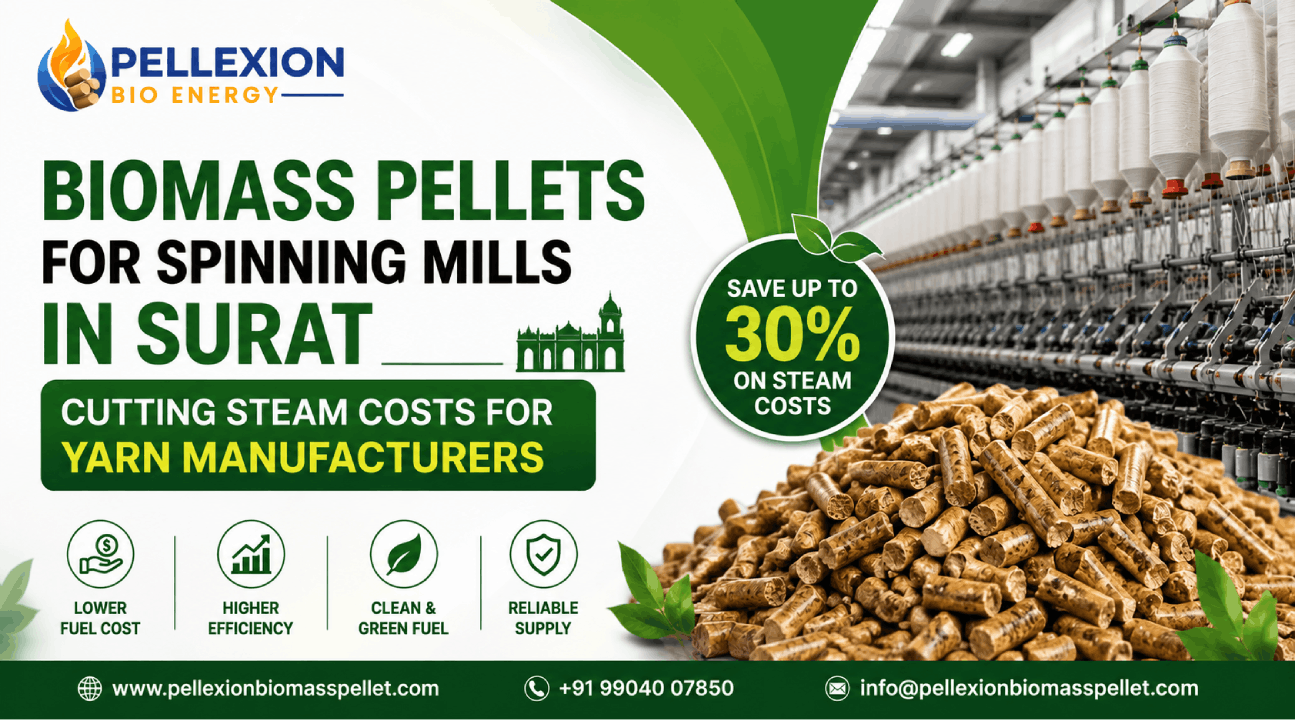
Coal and diesel prices keep climbing while spinning mill margins stay flat. Here’s the fuel-cost math, boiler compatibility notes, and switch plan Surat’s yarn manufacturers are using to bring steam generation costs down — without losing heat output.
Every spinning mill in Sachin, Pandesara, and Udhna runs on the same invisible input: steam. It sizes the yarn, sets the dye, conditions the fibre, and keeps the plant running shift after shift — and for most mills, that steam still comes from burning imported coal or diesel. As those fuel bills climb faster than yarn prices, a growing number of Surat’s spinning and yarn units are quietly switching their boilers over to biomass pellets. This is a practical look at why, and at the real numbers behind the switch.
Why Steam Cost Has Become a Line-Item Problem for Surat’s Spinning Mills
Surat’s textile belt — Sachin GIDC, Pandesara, Udhna, and the smaller clusters around Kadodara and Kim — runs on continuous-process heat. Spinning, sizing, dyeing, and yarn conditioning all draw steam around the clock, which means fuel isn’t a discretionary cost. It’s the second-largest line item after raw cotton or yarn stock for most mills, right behind power.
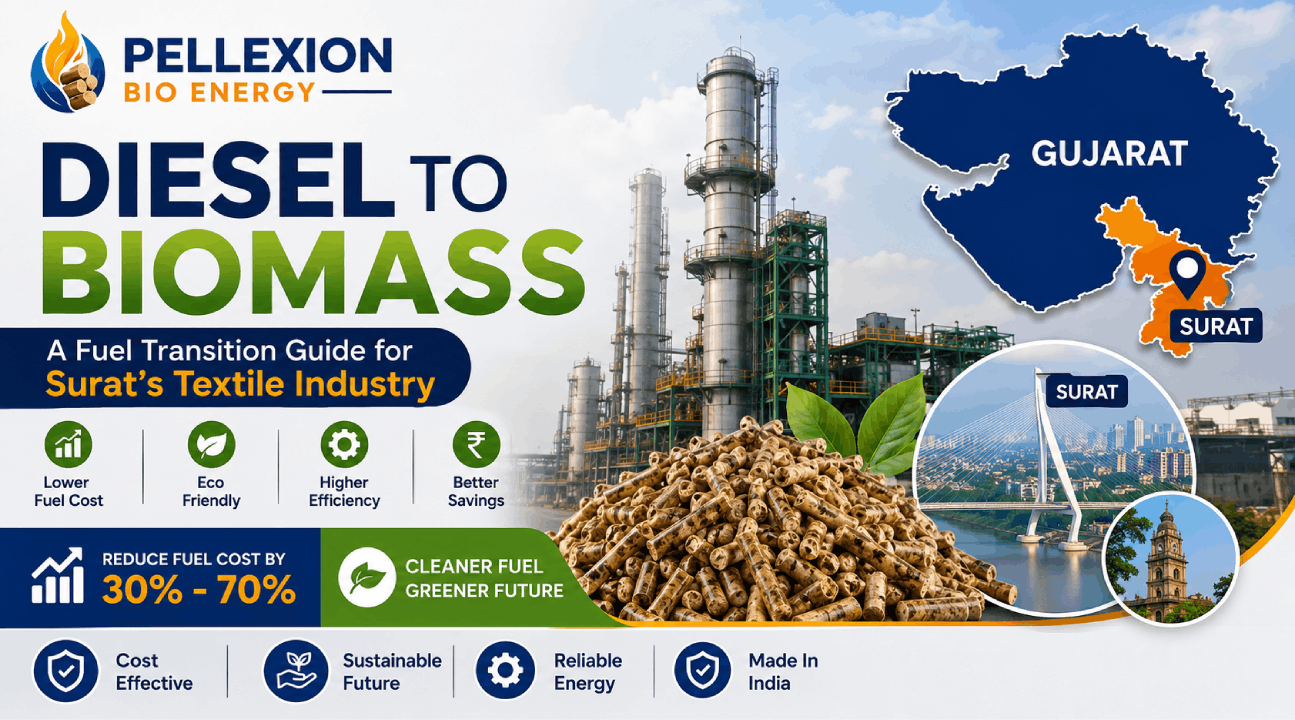
Two pressures have made this worse over the last few years. First, imported coal pricing tracks international benchmarks and shipping costs that a Surat mill owner has no control over. Second, diesel — often used as a backup or for smaller thermic-fluid heaters — is taxed and priced in a way that makes it the most expensive fuel per unit of heat a mill can buy. When both of your main fuel options are tied to volatile, externally-set markets, your steam cost stops being predictable, and that unpredictability is exactly what makes budgeting and quoting yarn contracts difficult.
Biomass pellets change that equation because the input — agricultural residue like groundnut shell, coriander waste, and general agri-waste — is sourced regionally rather than imported or refined. That doesn’t just lower the price; it makes the price more stable, which matters as much to a mill’s finance team as the raw cost per tonne.
“Fuel cost stability is worth almost as much as fuel cost reduction. A mill that can lock in a steam-fuel rate for the next two quarters can price yarn contracts with confidence.”
— Common feedback from spinning mill operators transitioning off coal in South Gujarat
What Biomass Pellets Actually Are — and Why the Feedstock Matters
Biomass pellets are compressed, cylindrical fuel units made by grinding agricultural or wood residue and pressing it under high pressure, without added binders. For a boiler operator, what matters isn’t the process — it’s the resulting fuel specification, because that’s what determines steam output and ash handling.
Pellexion supplies four main pellet and briquette variants relevant to spinning mill boilers:
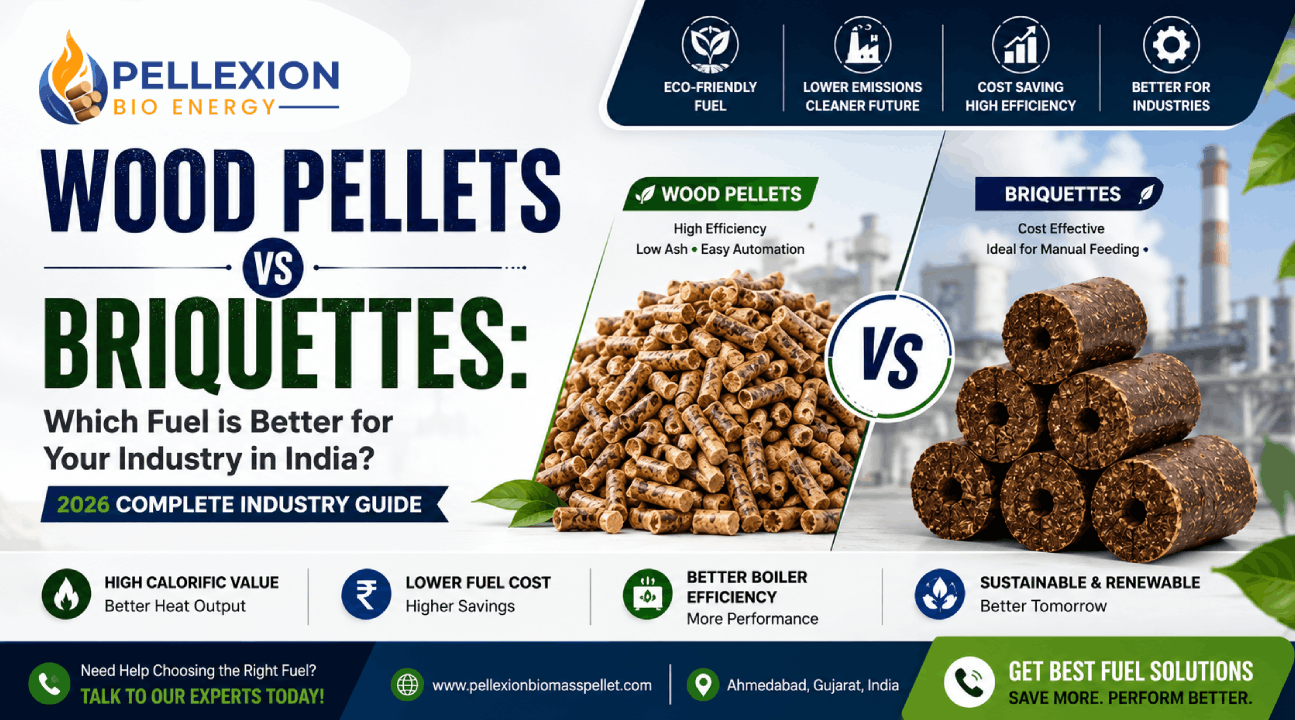
For most spinning mill boilers — automated-feed, chain-grate, or fixed-grate coal-fired units — pellets in 6mm or 8mm diameter are the more practical format, since they flow through existing coal-feed mechanisms with little to no retrofit. Briquettes tend to suit furnaces and thermic-fluid heaters that already burn a larger, denser fuel piece.
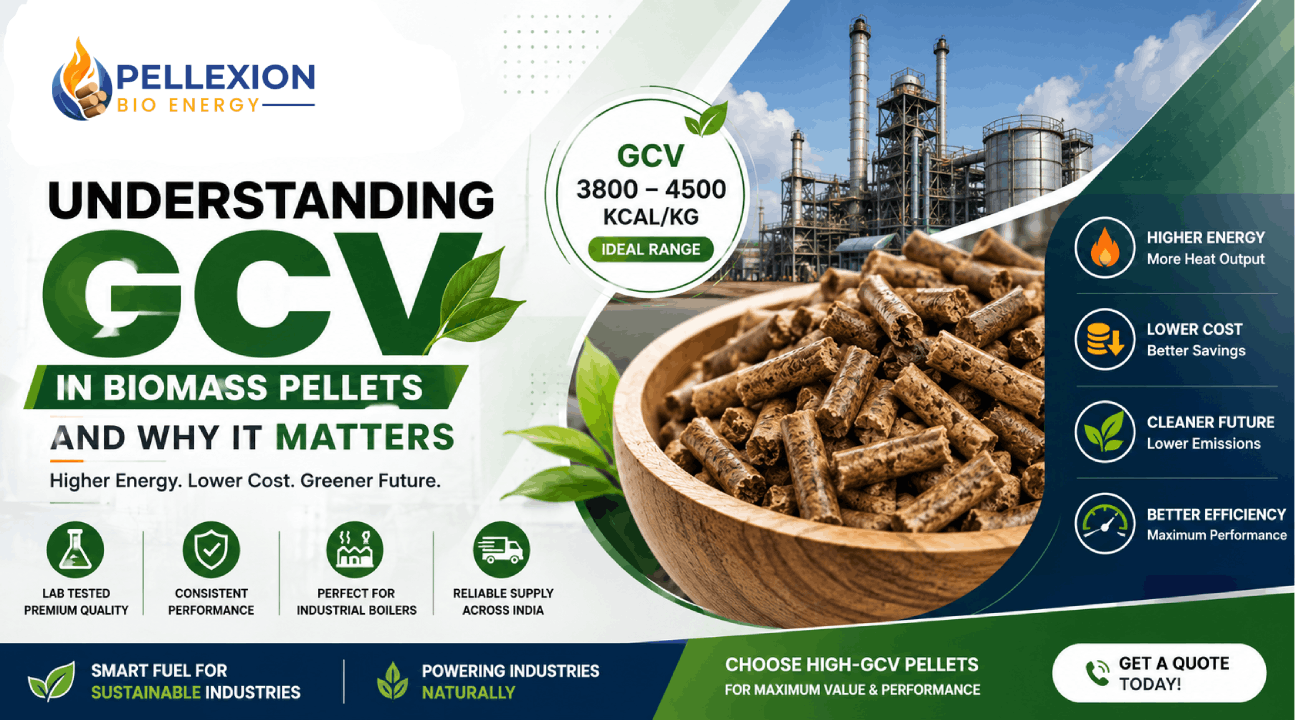
3600–4200
Kcal/kg calorific value
<10%
Moisture content
3–12%
Ash content
The Steam Cost Math: Coal vs Diesel vs Biomass Pellets
The number that actually matters to a spinning mill’s finance team isn’t the price per tonne of fuel — it’s the cost per unit of usable steam, because that accounts for calorific value, moisture, and combustion efficiency together. A cheaper fuel with low calorific value and high ash content can end up costing more per kg of steam than a slightly pricier, cleaner-burning alternative.
FUEL COMPARISON — TEXTILE BOILER USE
| Fuel | Calorific value | Ash / handling |
|---|---|---|
| Imported coal | ~4500–6000 Kcal/kg | Moderate–high ash, disposal cost |
| Diesel (thermic fluid) | ~10,500 Kcal/kg | Low ash, but highest fuel cost per unit heat |
| Biomass pellets | 3600–4200 Kcal/kg | Low ash (3–12%), easy handling |
Indicative, per-mill figures vary
| Price stability | Relative steam cost |
|---|---|
| Volatile, import-linked | Baseline |
| Volatile, tax-linked | Highest per-unit cost |
| Regionally sourced, more stable | 25–40% lower |
Biomass pellets carry a lower calorific value per kg than coal, so a mill will burn a somewhat larger volume of fuel by weight to generate the same steam. What offsets that — and typically pushes the net cost lower — is the combination of a lower base price per tonne, lower ash disposal cost, cleaner combustion that reduces boiler maintenance and downtime, and a supply price that doesn’t move with global coal or crude benchmarks. Mills that model this properly compare cost-per-tonne-of-steam over a full quarter, not a single delivery, because that’s where the fuel-mix savings actually show up.
Why This Matters Specifically for Yarn Manufacturers
Spinning and yarn units have a particular steam profile that makes biomass pellets a strong fit, more so than some other industrial fuel users:
“The boiler doesn’t care where the heat comes from. It cares whether the fuel is consistent, low in ash, and keeps arriving on schedule. That’s the actual bar a fuel switch has to clear.”
— On what actually determines a successful fuel transition
Where Surat’s Spinning Mills Are Making the Switch
The shift isn’t isolated to one part of the city — it’s happening across the industrial belt wherever textile processing is concentrated:
Sachin GIDC in particular sees the highest concentration of switch requests, simply because it carries the largest density of spinning, sizing, and synthetic fabric operations in the region — and the largest collective fuel bill.
How a Mill Actually Switches Fuel Without Risking Production
No spinning mill can afford to gamble with boiler uptime, so the transition to biomass pellets is deliberately incremental rather than a one-time changeover:
01. Boiler & load assessment
Share your boiler type, feed mechanism, and average monthly fuel consumption. This determines whether pellets or briquettes — and which diameter — fit your existing feed system.
02. Trial batch
A small trial order, often 1–5 tonnes, is run alongside existing fuel to confirm calorific performance and ash behaviour on your specific boiler before any commitment.
03. Phased blend-in
Many mills start by blending pellets with existing coal stock at a fixed ratio, gradually increasing the biomass share as operators confirm steam pressure stays consistent.
04. Full switch & recurring supply
Once performance is validated, supply moves to a scheduled recurring delivery — sized to your storage capacity and shift pattern, with 48-hour dispatch lead time from the Jamnagar unit.
05. Batch-wise quality documentation
Every dispatch includes calorific value and moisture test results, plus GPCB-relevant fuel documentation for your compliance records.
What to Check Before You Commit to a Supplier
Not all biomass pellet supply is equal, and a mill switching its primary fuel source should verify a few things upfront rather than after signing a contract:
How Pellexion Supplies Surat’s Spinning Mills
Pellexion Bio Energy manufactures biomass pellets and briquettes at its own production unit in Jamnagar, Gujarat, and runs a direct road-and-rail logistics network into Surat’s industrial zones — Sachin, Hazira, Pandesara, and the surrounding belt. For spinning and yarn manufacturers specifically, that means:
The Bottom Line for Yarn Manufacturers
Steam cost isn’t going to stop being a pressure point for Surat’s spinning mills — coal and diesel pricing is set by markets no single mill controls. What a mill can control is which fuel its boiler burns, and increasingly, that choice is landing on biomass pellets: comparable heat output, lower and more stable pricing, less ash to manage, and documentation that makes GPCB compliance simpler rather than harder. For a sector where steam touches almost every stage of production, that’s not a marginal change — it’s one of the few real levers left on cost.





 Total views : 6814