
Table of contents
If you run a boiler, dryer, or thermic fluid heater in India, you’ve probably already moved past the “should I switch from coal” question. The real question sitting on your desk right now is sharper: wood pellets or briquettes — which one actually fits my plant? This guide breaks down calorific value, ash content, cost per ton, feeding-system compatibility, and real numbers from Gujarat’s industrial belt, so you can make that call with confidence instead of guesswork.
Why This Decision Matters More in 2026 Than Ever
Coal prices in India have stayed volatile through 2026, and diesel isn’t far behind. Meanwhile, state pollution control boards are tightening emission norms for industrial boilers across Gujarat, Maharashtra, and Rajasthan. Biomass fuel — in either pellet or briquette form — has become the default answer for plants that need stable pricing and compliant combustion. But “biomass” isn’t one product. Choosing the wrong form factor for your specific boiler and feeding system can quietly cost you 10-20% in wasted fuel efficiency every single month.
This is the comparison plant managers, procurement officers, and boiler operators actually need — not a generic “biomass is green” pitch, but the operational and financial detail that decides which fuel earns its place on your factory floor.
What Are Wood Pellets?
Wood pellets are small, cylindrical fuel units — typically 6-8mm in diameter and 10-30mm long — made by compressing sawdust, wood shavings, or agricultural residue under extremely high pressure. The lignin naturally present in the wood fibers acts as a binder, so no chemical additives are needed. The result is a dense, uniform, low-moisture fuel with a high calorific value, designed to feed smoothly through automated augers and hoppers.
How Wood Pellets Are Manufactured
- 1
Raw Material Sourcing: Sawdust, wood chips, or crop residue is collected and sorted for consistency.
- 2
Drying: Moisture content is brought down to 8-12% for efficient combustion.
- 3
Grinding: Material is milled into fine, uniform particles.
- 4
Pelletizing: A pellet mill compresses the material through a die under high pressure and heat, forming dense cylindrical pellets.
- 5
Cooling & Screening: Pellets are cooled to lock in hardness, then screened to remove fines and dust.
- 6
Packaging & Dispatch: Bagged or loaded in bulk for delivery to industrial buyers.
What Are Biomass Briquettes?
Briquettes are larger, denser blocks or cylindrical logs of compressed biomass, usually 50-90mm in diameter, made from agricultural waste such as groundnut shells, cotton stalks, coriander residue, or a mixed agro-waste blend. Like pellets, they’re formed under high mechanical pressure without chemical binders, but the coarser particle size and larger form factor make them better suited to manual and semi-automated feeding systems rather than auger-fed boilers.
How Briquettes Are Manufactured
The process mirrors pellet production — sourcing, crushing, drying, and compression — but briquetting machines use a screw-extrusion or piston-press method that can handle coarser, less-processed raw material at a lower energy input than pelletizing. This is the core reason briquettes typically cost less to produce per ton.
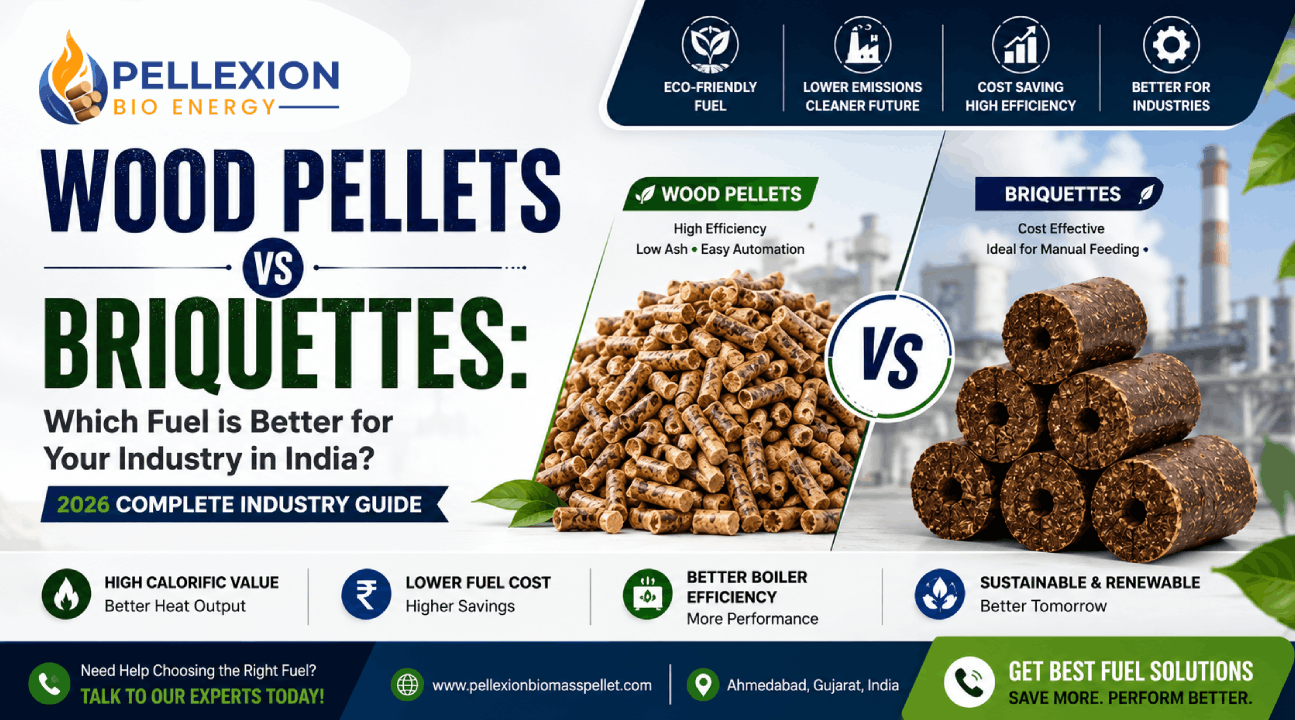
Wood Pellets vs Briquettes: The Complete Comparison Table
| Parameter | Wood Pellets | Biomass Briquettes |
|---|---|---|
| Size & Shape | 6-8mm cylindrical, uniform | 50-90mm blocks or logs, larger |
| Calorific Value | 4,200 - 4,800 kcal/kg (approx.) | 3,800 - 4,400 kcal/kg (approx.) |
| Moisture Content | 8-12% | 10-14% |
| Ash Content | 1-3% | 3-6% |
| Bulk Density | High (600-750 kg/m³) | Moderate (500-650 kg/m³) |
| Feeding Compatibility | Ideal for auger-fed, fully automated boilers | Best for manual/semi-automated, chain-grate boilers |
| Manufacturing Cost | Higher (finer grinding, more energy-intensive) | Lower (coarser material accepted) |
| Storage Sensitivity | More sensitive to moisture; needs covered storage | Slightly more tolerant of ambient humidity |
| Burn Duration (per unit) | Shorter, but consistent and controllable | Longer per piece, suited to steady manual stoking |
| Best Fit Industries | Textile, food processing, dairy, pharma (automated plants) | Brick kilns, ceramics, boilers with manual feeding |
Note: Calorific value and ash content vary by raw material blend (groundnut shell, cotton stalk, sawdust, mixed agro-waste). Figures above are typical industry ranges — always ask your supplier for a batch-specific test certificate.
Wood Pellets: Advantages and Trade-offs
Advantages
Trade-offs
Biomass Briquettes: Advantages and Trade-offs
Advantages
Trade-offs
Step-by-Step: How to Decide Which Fuel Fits Your Plant
Which Fuel Fits Which Industry? A Practical Breakdown
Across Gujarat’s industrial belt — Rajkot, Surat, Ahmedabad, Morbi, and the Saurashtra region — the fuel choice tends to follow the boiler type more than the industry label itself. That said, some clear patterns show up on the ground:
Real Numbers: A Worked Cost Comparison
Here’s a simplified example based on typical Gujarat industrial pricing (illustrative — always confirm live rates with your supplier):
| Metric | Wood Pellets | Briquettes |
|---|---|---|
| Approx. delivered price | Higher per ton | Lower per ton |
| Approx. calorific value | ~4,500 kcal/kg | ~4,000 kcal/kg |
| Ash disposal cost impact | Lower (1-3% ash) | Higher (3-6% ash) |
The takeaway: briquettes often win on sticker price, but pellets frequently win on total cost per unit of usable heat once you factor in ash handling labor, feeding automation, and burn consistency. The right answer depends entirely on your boiler — which is exactly why we recommend a trial batch before switching your full monthly order.
Understanding Your Boiler Type Before You Choose
Most fuel-switching mistakes in Indian factories don’t come from picking a “bad” fuel — they come from picking a fuel that doesn’t match the feeding hardware already installed on the boiler. Before you compare price sheets, it helps to know which category your setup falls into.
Fixed-Grate / Manually Fired Boilers
These are the most common boilers across small and mid-sized units in Rajkot, Morbi, and the Saurashtra belt. Fuel is loaded onto a static grate by hand or with a small conveyor, and combustion air moves up through the grate. Both wood pellets and briquettes work here, but briquettes are usually the more economical choice because their larger size means less frequent stoking and lower labor time per shift.
Chain-Grate / Semi-Automated Boilers
A moving chain grate carries fuel through the combustion zone automatically, though loading onto the chain may still be manual or semi-automated. This is the middle ground where either fuel performs well — the deciding factor becomes ash handling capacity and whether your steam demand is steady or fluctuating through the day.
Fully Automated Auger/Hopper-Fed Boilers
Increasingly common in newer textile, food processing, and pharma installations, these systems use a screw auger to feed fuel directly from a storage silo into the furnace on a timed or sensor-driven basis. This is where wood pellets are close to mandatory — briquettes are too large and irregular for auger feeding, and attempting to force them through can jam the mechanism and cause costly downtime.
How to Test Fuel Quality Before You Commit
Whether you choose pellets or briquettes, the difference between a reliable supplier and an inconsistent one usually shows up in three test results. Ask any prospective supplier for these before signing a monthly contract:
- 1Gross Calorific Value (GCV) test report — confirms the actual heat output per kilogram, ideally from a recent batch, not a generic spec sheet.
- 2Moisture content certificate — fuel above 15% moisture burns inefficiently and can damage combustion consistency, regardless of whether it’s a pellet or briquette.
- 3Ash content percentage — directly affects your de-ashing labor and maintenance schedule; ask for the number, not just “low ash” as a marketing claim.
A supplier who can produce these figures on request — batch by batch — is generally more reliable than one who only offers general assurances. It’s a simple filter, but it separates serious industrial suppliers from opportunistic ones quickly.
Storage, Transport & Monsoon Considerations
Fuel quality doesn’t stop mattering after delivery — how you store it determines how much of that quality survives until it reaches the furnace. This becomes especially important during Gujarat’s monsoon months, when humidity swings can quietly degrade an otherwise good batch of fuel.
Mini Case Study: A Rajkot Boiler Switch
A mid-sized food processing unit near Rajkot was running a semi-automated chain-grate boiler on coal, spending heavily on fuel each month with rising costs and increasing pressure from the local pollution control board to cut emissions. After testing both wood pellets and briquettes on a two-week trial basis, the plant found that briquettes matched their existing manual stoking rhythm well, while pellets required a feeding-system upgrade they weren’t ready to invest in yet. They moved forward with a monthly briquette contract, cutting ash-handling frequency significantly compared to coal, while stabilizing their fuel budget against further coal price swings.
The lesson here isn’t “briquettes win” — it’s that the right fuel decision came from testing against their actual equipment, not from a generic recommendation. That’s the same process we’d recommend for any plant weighing this decision today.
Common Myths About Wood Pellets and Briquettes
Myth: Briquettes are always the “lower quality” option.
Not true. Briquettes made from well-sourced, properly dried raw material can perform excellently in the right boiler. The form factor is a fit-for-purpose choice, not a quality hierarchy.
Myth: Any biomass fuel works in any boiler.
Feeding compatibility matters as much as fuel quality. A high-grade pellet fed into a boiler designed for manual coarse-fuel loading won’t necessarily perform better than a well-made briquette.
Myth: Switching fuel always requires expensive boiler modifications.
Most fixed-grate and chain-grate boilers already in operation across Gujarat can switch to either fuel with only minor feeding adjustments — major retrofits are typically only needed for a jump to full automation.
Environmental & Compliance Angle
Both wood pellets and briquettes are classified as renewable biomass fuel and generally align with tightening emission norms from State Pollution Control Boards. Because both fuels burn cleaner than coal — with lower sulphur content and no fossil carbon contribution — they’re increasingly favored by industries preparing for stricter Consent to Operate (CTO) renewals. Neither fuel involves added chemical binders, and both are made from agricultural or wood waste that would otherwise be burned in the open or landfilled, giving the switch a genuine emissions-reduction story for CSR and ESG reporting.
Frequently Asked Questions
The Automation Shift: Why This Decision Is Getting Bigger in 2026
Across Gujarat’s industrial clusters, a quiet shift has been underway over the last few years: more plants are moving from manual and semi-automated boiler feeding toward fully automated systems, driven by labor cost pressure, safety compliance requirements, and the simple fact that automated combustion is easier to keep consistent for ISO and environmental audits. This shift has a direct bearing on the pellets-versus-briquettes question, because it changes which fuel form factor makes sense not just today, but over the life of your boiler investment.
If your plant is planning any boiler upgrade, capacity expansion, or automation retrofit in the next two to three years, it’s worth thinking about fuel compatibility now rather than after the investment is made. A plant that installs an auger-fed hopper system today but continues sourcing briquettes will either need a costly re-fit or will be stuck paying for manual labor anyway — defeating the purpose of the upgrade. Conversely, a plant with no automation plans on the horizon gains little from paying the pellet premium and is generally better served by briquettes.
This is one of the most overlooked parts of the fuel-switching conversation. Procurement teams often shop purely on price per ton, while the operations team is planning a feeding-system upgrade in the background. Getting these two conversations aligned before signing a long-term fuel contract avoids having to renegotiate supply terms halfway through the year.
Negotiating Your Fuel Contract: What Plant Managers Should Ask For
Once you’ve decided between wood pellets and briquettes, the next step most Indian industrial buyers skip is structuring the supply contract properly. A few points worth clarifying with any supplier before signing:
Suppliers who are comfortable putting these terms in writing are generally the ones worth building a long-term relationship with — biomass fuel supply works best as a steady, predictable partnership rather than a one-off transactional purchase, given how much your boiler’s day-to-day performance depends on consistent fuel quality.
The Labor Cost Factor Most Comparisons Miss
Price-per-ton comparisons dominate most fuel discussions, but the labor cost sitting behind each fuel type rarely gets the same attention — and it can meaningfully shift which option is actually cheaper for your specific operation.
Manual-feed boilers running on briquettes need workers stoking the furnace at set intervals through every shift, plus additional time for the more frequent de-ashing that comes with briquettes’ higher ash percentage. For plants already running lean on shop-floor staffing, this recurring labor demand is a real, ongoing cost — not a one-time consideration. Automated pellet-fed systems, by contrast, shift much of that labor into upfront capital cost (the auger and hopper system itself) and then reduce day-to-day staffing needs considerably, since the boiler doses fuel on its own schedule.
Neither approach is universally cheaper — it depends on whether your plant is labor-constrained or capital-constrained at this point in its growth. A fast-scaling unit that’s struggling to find and retain boiler operators may find the automation-plus-pellets route pays for itself faster than the sticker price suggests. A well-staffed, cost-conscious operation with a manual boiler already paid off may find briquettes the more sensible near-term choice, with automation as a later-stage upgrade once volumes justify it.
This is exactly the kind of calculation that’s hard to get right from a spec sheet alone, which is why we always recommend walking through your specific staffing and shift pattern with a fuel supplier who can map it against real ash and feeding data — rather than assuming the cheaper fuel per ton is automatically the cheaper fuel per month.
Key Takeaways Before You Decide
Conclusion
There’s no universal winner between wood pellets and briquettes — the right choice depends on your boiler’s feeding mechanism, your monthly volume, your storage setup, and how much ash-handling labor you can spare. Automated, high-uptime plants generally get more value from pellets’ consistency and low ash. Manual-feed and cost-sensitive operations often do better with briquettes. The safest path is to test both on your own equipment before locking in a full monthly contract — and that’s exactly the kind of trial Pellexion Bio Energy sets up for plants across Gujarat every month.





 Total views : 6802