
Table of contents
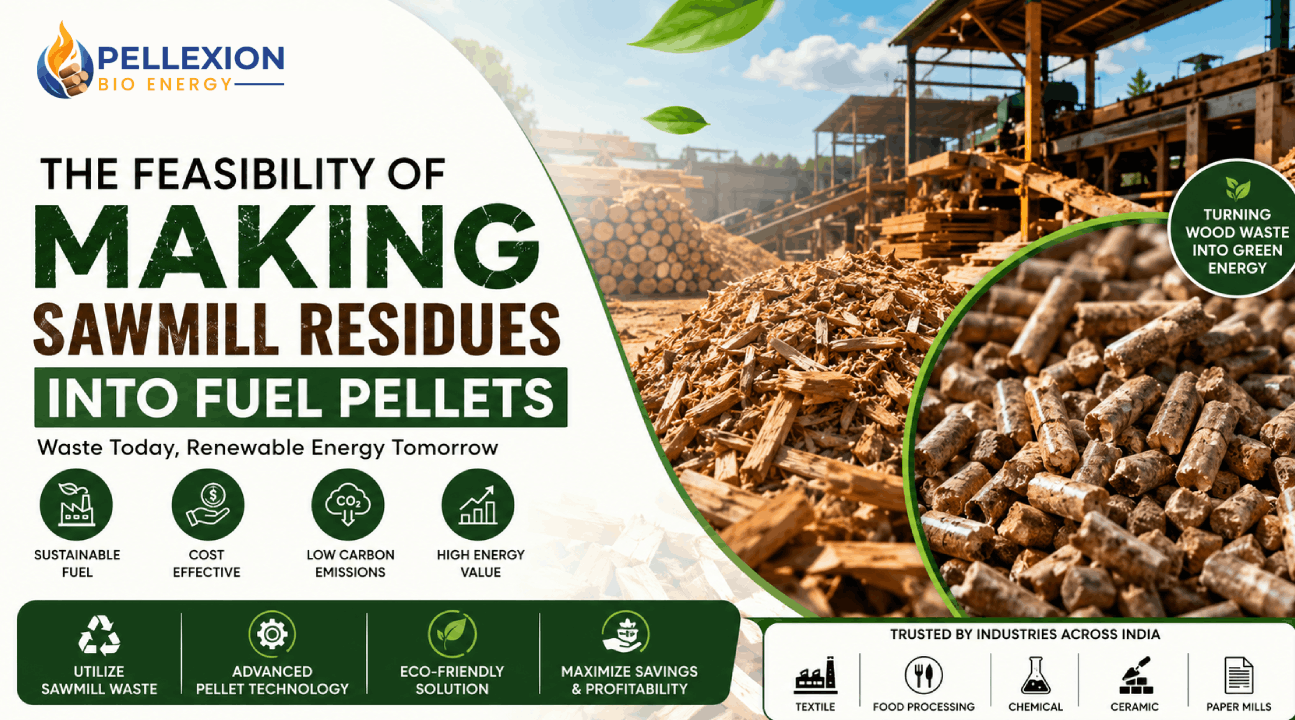
Every sawmill, whether it is cutting teak in Gujarat or pine in the hills of Himachal, ends up with more than just finished timber. For every log that goes in, only 60–70% comes out as usable boards. The remaining 30–40% leaves the mill as sawdust, chip fines, bark, trimmings, and dry shavings — material that most mill owners still treat as a disposal problem rather than a revenue stream. That is beginning to change fast, and for good reason: this “waste” is close to ideal raw material for making fuel pellets.
If you run a sawmill, a timber processing unit, or a wood-based manufacturing plant and you have been wondering whether it actually makes financial and operational sense to convert your leftover wood residue into biomass fuel pellets, this guide walks through the full feasibility picture — the raw material, the equipment, the economics, the compliance angle, and the realistic pitfalls — so you can make a decision with real numbers in front of you, not guesswork.
Why Sawmill Residue Is a Feasibility Story Worth Taking Seriously
Fuel pellet manufacturing depends on three things being true at once: a steady raw material supply, raw material that is already close to the right specification, and a market willing to pay for the finished product. Sawmill residue happens to check all three boxes better than almost any other biomass feedstock available in India today.
1. The supply is already stable and free of seasonal risk.
Unlike agricultural residues such as groundnut shell, cotton stalk, or coriander waste — which are seasonal and tied to harvest cycles — sawmill residue is generated every single working day the mill operates. There is no monsoon gap, no harvest-to-harvest price swing, and no competing use from cattle feed or fodder markets that agri-residue often faces. For a business planning long-term biomass pellet production, that year-round predictability is one of the strongest feasibility indicators there is.
2. The material is already low in contaminants.
Sawdust, chip fines, and shavings coming straight off a sawmill are largely free of soil, stones, and metal fragments compared to field-collected agricultural waste. That means less pre-cleaning, less wear on grinding and pelletizing equipment, and a cleaner ash profile in the finished pellet — all of which reduce processing cost per tonne.
3. The energy content is naturally high.
Wood-based residues generally deliver a higher gross calorific value than most agricultural residues on a like-for-like dry basis, largely because of their lignin content. Lignin acts as a natural binder during pelletizing too, which often means sawmill-residue pellets need little or no additional binding agent — a real advantage over husk-heavy agri-waste, which sometimes needs starch or molasses added to hold pellet shape.
Understanding What Sawmill Residue Actually Looks Like
Before evaluating feasibility, it helps to understand exactly what a sawmill produces, because each residue stream behaves differently in a pelletizing line.
Sawdust
The fine wood particles generated by the saw blade itself. Sawdust is produced in the largest single volume of any residue stream and has a naturally small particle size, which reduces the grinding step needed before pelletizing. Fresh, “green” sawdust straight off the saw typically carries high moisture — often in the 40–50% range on a wet basis — while sawdust that has sat exposed to air for some time can be considerably drier.
Chip Fines
Created when off-cuts and the rounded outer sections of logs are run through a chipper. Chip fines are coarser than sawdust and usually need a hammer mill pass before they are suitable for pelletizing.
Shavings
Generated during planing or molding of seasoned timber to a finished section size. Because the timber has usually already been kiln-dried or air-dried before shaving, this stream tends to be the driest of the three — sometimes already close to the moisture range pellet mills want.
Bark and Trimmings
Bark carries a higher ash content than clean wood fibre and, if used in large proportion, can push the finished pellet into a lower quality grade. Most commercial operations blend bark in at a controlled, minority percentage rather than using it as a standalone feedstock.
Getting a proper mix of these four streams — rather than relying on just one — is one of the most practical ways sawmills improve consistency in the pellets they produce.
The Technical Specification Fuel Pellets Actually Need
This is where most feasibility questions get answered quickly, because raw sawmill residue is already close to specification on almost every parameter that matters.
| Parameter | Target for Pelletizing | Typical Sawmill Residue |
|---|---|---|
| Particle size | Under 6 mm | Sawdust: already fine; chips/bark: need grinding |
| Moisture content | 12%–20% | Fresh sawdust 40–50%; shavings often lower |
| Calorific value | High, low-ash preferred | Naturally high due to lignin content |
| Contaminants | Minimal | Low, compared to field-collected biomass |
Particle size is the first gate. Sawdust generally passes straight through without extra grinding. Chip fines and bark, being coarser, typically need to go through a hammer mill first to bring particle size down under 6 mm — otherwise the pellet press die will jam or produce inconsistent, crumbly pellets.
Moisture content is the second and more decisive gate. Fresh, green sawdust straight from the saw can run as high as 40–50% moisture on a wet basis, while shavings from already-dried timber can sit much lower, sometimes under 15%. Since the pelletizing process itself needs feedstock in the 12–20% moisture band, most sawmills will need a dedicated dryer for at least a portion of their residue stream, unless they are working almost entirely with pre-dried shavings. This is usually the single biggest capital decision in the whole project, because drying capacity has to be sized to your wettest, highest-volume residue stream — not your driest one.
Step-by-Step: How Sawmill Residue Becomes a Finished Fuel Pellet
Step 1 — Raw Material Collection and Sorting
Residue is collected at the point of generation — under the saw, at the chipper outfeed, and from the planer — and sorted broadly by moisture level and particle type. Keeping wet sawdust separate from dry shavings at this stage saves significant energy later, because you can blend the streams deliberately rather than drying everything to the same degree.
Step 2 — Size Reduction (Grinding / Hammer Milling)
Any residue larger than the target particle size — chip fines, bark, off-cuts — is passed through a hammer mill to bring it down to a uniform size under 6 mm. Sawdust that is already fine enough can bypass this step and go straight to drying.
Step 3 — Drying
This is the most energy-intensive stage of the entire process. A rotary drum dryer or belt dryer brings the blended residue down from its raw moisture level to the 12–20% target band. Correct drying is what determines pellet durability, combustion efficiency, and shelf life later — under-dried material produces pellets that crumble and swell in storage, while over-dried material can make the press work harder and increase fines (dust) generation.
Step 4 — Conditioning and Blending
Different residue streams — sawdust, chip fines, a controlled percentage of bark — are blended to a consistent ratio before entering the pellet press. Because wood fibre already contains natural lignin, most sawmill-residue blends do not require an added binder, which keeps production costs lower than binder-dependent agri-residue pellet lines.
Step 5 — Pelletizing
The conditioned material is fed into a ring-die or flat-die pellet press, where it is forced through die holes under high pressure and heat. The friction generated softens the natural lignin in the wood fibre, which acts as the binding agent holding the compressed pellet together as it exits the die.
Step 6 — Cooling
Pellets emerge from the press warm and slightly soft. A counter-flow cooler brings them down to near-ambient temperature, which hardens the pellet and locks in its final density and strength before packaging. Skipping or rushing this step is a common cause of pellets breaking apart in transit.
Step 7 — Screening
A vibrating screen removes fines and broken pellet fragments (often called “pellet dust”) before packaging. These fines are not wasted — they are typically recirculated back into the pelletizing feed rather than discarded.
Step 8 — Quality Testing
Before dispatch, finished batches are tested for moisture, ash content, calorific value, bulk density, and mechanical durability, in line with recognized biomass fuel standards, to confirm the pellet meets the specification promised to the customer.
Step 9 — Packaging and Storage
Pellets are bagged (commonly in 25–50 kg bags for industrial dispatch, or bulk-loaded for large-volume buyers) and stored in a dry, ventilated warehouse. Properly dried and stored pellets can typically hold their quality for one to two years, which gives producers meaningful flexibility in inventory planning.
The Economics: Does It Actually Pay Off?
Feasibility ultimately comes down to one question: does the cost of turning residue into pellets come in comfortably below what the finished pellet sells for, after accounting for the capital cost of the equipment?
Cost Side
Revenue Side
Turning a Cost Center Into a Profit Center
This is the real feasibility headline for most sawmill owners: residue disposal is currently a cost. Even a modest-scale pelletizing setup — grinder, dryer, pellet press, cooler, and screener — flips that cost into a saleable product, often within a payback window that makes sense for mills producing meaningful daily residue volumes. The exact payback period depends heavily on your residue volume, moisture profile, and local energy cost for drying, which is why a proper feasibility study specific to your mill’s output is worth doing before committing capital.
Sawmill Pellets vs. Buying Raw Coal or Diesel: The Comparison That Matters to Your Buyers
If you are evaluating this from the supply side, it helps to understand why your future customers — industrial boiler operators — are switching in the first place.
| Feature | Biomass Pellets (from sawmill residue) | Coal | Column 4 |
|---|---|---|---|
| Emissions | Low | High | High |
| Renewable | Yes | No | No |
| Ash Content | Low | High | High |
| Cost Stability | More stable, predictable | Fluctuating | Highly volatile |
| Environmental Impact | Eco-friendly | Polluting | Polluting |
Every one of these comparison points is a selling point you can use directly in your own marketing once your pellets are ready for the market — buyers are not just looking for a cheaper fuel, they are also under growing pressure from environmental regulation to lower their emissions footprint, and wood-residue pellets answer both needs at once.
Common Feasibility Pitfalls to Plan For
Underestimating drying costs. This is the single most common mistake in early feasibility calculations. Mills that model their economics on already-dry shavings, then try to scale up using green sawdust, often find their real operating cost is significantly higher than projected.
Inconsistent residue mix. A pellet press performs best on a consistent feedstock blend. Mills that feed whatever residue happens to be sitting around on a given day — sometimes bark-heavy, sometimes sawdust-heavy — will see inconsistent pellet quality, which shows up as customer complaints and rejected batches.
Undersized storage for seasonal demand swings. Industrial pellet demand for heating applications can rise sharply in certain seasons. Mills that do not build enough dry storage capacity end up either turning away orders or rushing shipment of under-cooled, fragile pellets.
Skipping quality testing. Buyers — particularly larger industrial boiler operators — increasingly ask for calorific value, ash content, and moisture data before committing to a supply contract. A mill without in-house or third-party testing capability will struggle to win and retain larger accounts.
None of these are reasons to avoid the opportunity — they are simply the variables a proper feasibility assessment needs to price in from day one.
Why This Makes Sense for Sawmills Specifically — More Than Any Other Biomass Source
Agricultural residue pellet production, while widely practiced across India, comes with real constraints: seasonal availability, competing demand from fodder and mulch markets, and often a need for added binders. Sawmill residue avoids nearly all of these constraints. It is generated continuously, has no competing agricultural use, is naturally rich in the lignin that binds pellets together, and — critically — is a material the mill is already paying to dispose of. Few feasibility studies in the renewable fuel space start from a position this favorable: negative-cost raw material, daily generation, and a finished product with a genuine, growing buyer base among industrial boiler operators moving away from coal and diesel.
How Pellexion Bio Energy Fits Into This Picture
At Pellexion Bio Energy, we manufacture and supply premium-quality biomass pellets and briquettes to industries across Gujarat and beyond, built on exactly the kind of process discipline this feasibility guide describes — controlled moisture, consistent particle size, low ash, and batch-tested calorific value. Whether you are a sawmill exploring whether to set up your own pelletizing line, or an industrial buyer looking for a reliable, ready-made supply of high-calorific biomass fuel without the capital investment of building a pellet plant yourself, our biomass pellet range and manufacturing process are built around the same fundamentals covered in this guide.





 Total views : 6802