
Table of contents
A step-by-step guide to the one number that decides whether your biomass fuel is actually cheap — or just cheap-looking. What GCV means, how it’s tested, what destroys it, and how to buy heat instead of weight.
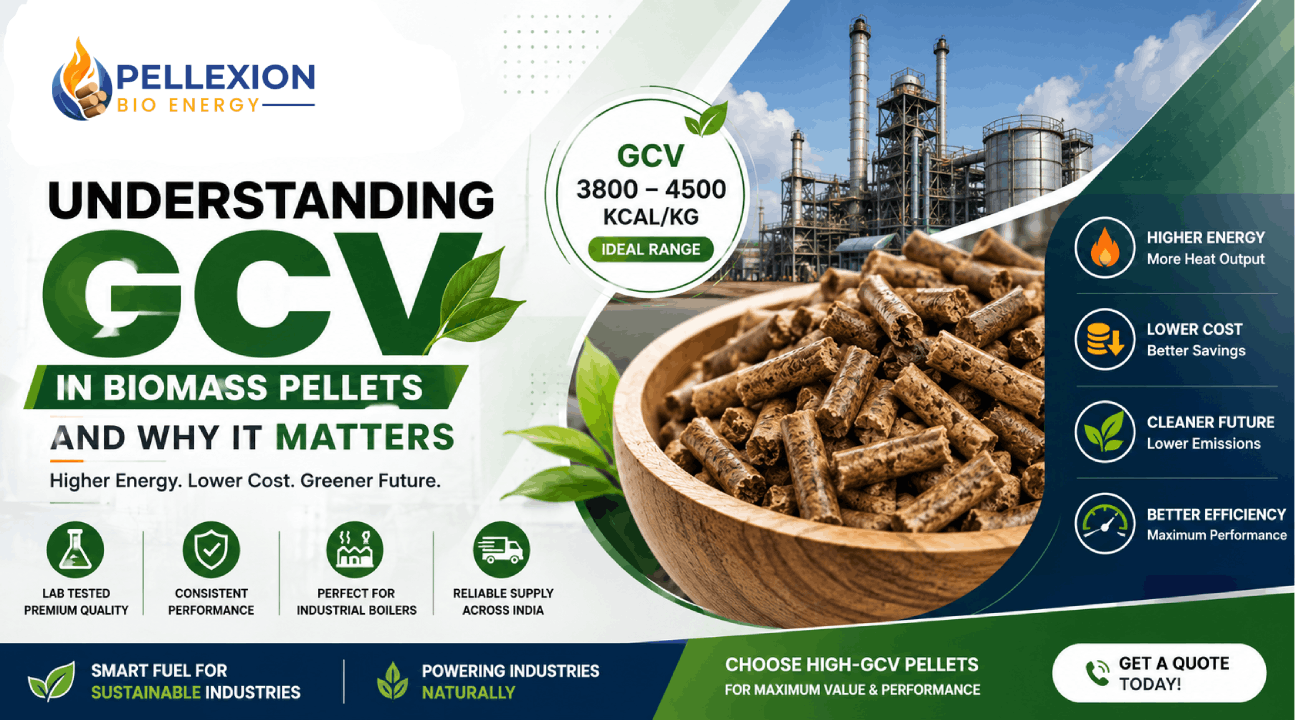
When you buy biomass pellets, you are not really buying tons of dried plant matter. You are buying heat — a specific, measurable quantity of thermal energy that your boiler will convert into steam, drying air, or process heat. The number that tells you exactly how much heat you are buying is called Gross Calorific Value, or GCV. Yet most procurement conversations still revolve around price per kilogram or price per ton, a habit that quietly costs industrial buyers lakhs of rupees a year in wasted fuel, extra ash disposal, and lower boiler efficiency. This guide breaks down what GCV actually is, how it is tested, what raises or destroys it, and exactly how to use it to negotiate a genuinely cheaper fuel contract.
What Is Gross Calorific Value (GCV)?
Gross Calorific Value — also called Higher Heating Value (HHV) in international literature — is the total amount of heat energy released when one kilogram of fuel is burned completely under standard laboratory conditions. It is expressed in Kilocalories per kilogram (Kcal/kg) in India, or Megajoules per kilogram (MJ/kg) internationally. One Kcal/kg is roughly equal to 0.0042 MJ/kg, so a pellet rated at 4,300 Kcal/kg works out to about 18 MJ/kg.
In practical terms: if a batch of biomass pellets is rated at 4,300 Kcal/kg, burning one kilogram of that fuel releases 4,300 kilocalories of heat into your system — enough, roughly, to raise the temperature of 4,300 litres of water by one degree Celsius. Multiply that by the tons you burn each month, and GCV stops being a lab statistic and becomes the single biggest lever on your fuel bill.
Why this matters
Two pellet batches can look identical — same colour, same diameter, same bag — and still differ by 800–1,000 Kcal/kg in usable heat. That gap is invisible on a weighing scale and completely visible on your gas or coal-replacement fuel bill three months later.
GCV vs NCV — The Number That Actually Heats Your Boiler
GCV is a laboratory figure. It assumes the water vapour produced during combustion condenses back to liquid and releases its latent heat — which happens inside a sealed calorimeter, but almost never happens inside a real industrial boiler, where that vapour escapes up the flue as steam. The heat actually available to your boiler is called Net Calorific Value (NCV), and it is always lower than GCV.
The gap between GCV and NCV widens with two things: the hydrogen content of the fuel (which forms water on combustion) and, more importantly for biomass, the moisture already present in the pellet before it even reaches the flame. A rough working relationship used across the industry is:
You don’t need to run this calculation yourself — any competent lab report will list both GCV and NCV. What matters is knowing that quoted GCV is a ceiling, not a delivered value, and that the size of the drop from GCV to NCV is controlled almost entirely by one variable: moisture.
How Is GCV Actually Measured?
GCV is not estimated or eyeballed — it is measured with a bomb calorimeter, an instrument standardised under IS 1350 (Part 2) in India and ASTM D5865 internationally. The process is straightforward but precise:
- 1Sampling: A representative pellet sample is drawn from the batch and ground into a fine, uniform powder.
- 2Loading: A precisely weighed quantity (typically around 1 gram) is placed inside a small steel combustion vessel — the “bomb.”
- 3Pressurising: The bomb is sealed and filled with pure oxygen at high pressure to guarantee complete combustion.
- 4Ignition: The sample is ignited electrically inside the sealed vessel, which sits inside a water jacket.
- 5Measurement: The heat released raises the temperature of the surrounding water by a measurable amount. That temperature rise, combined with the known mass of water and the calorimeter’s heat capacity, is used to back-calculate the GCV in Kcal/kg.
A trustworthy biomass supplier tests every production batch this way and can produce a signed lab report on request — not a generic spec sheet copied across every order.
GCV by Raw Material — Why Feedstock Choice Comes First
Biomass is not one fuel; it is a family of very different fuels wearing the same pellet shape. The plant residue used as feedstock is the single biggest determinant of GCV, because it fixes the fuel’s fixed-carbon content, resin/oil content, and — critically — its natural ash and silica load.
| Raw Material | Typical GCV (Kcal/kg) | Notes |
|---|---|---|
| Rice Husk | 3,000 – 3,500 | High silica & ash content pulls GCV down |
| Wheat / Rice Straw | 3,300 – 3,800 | Low density, higher ash |
| Sawdust / Wood Waste | 4,000 – 4,500 | Low ash, consistent burn |
| Cotton Stalk | 4,100 – 4,500 | Common in Gujarat & Maharashtra belts |
| Mustard Husk / Stalk | 4,200 – 4,600 | Good density, low moisture retention |
| Groundnut Shell | 4,300 – 4,700 | High fixed carbon, low ash |
| Mixed Agro-Residue Blend | 4,200 – 4,700 | Engineered blend ratio for consistency |
This is exactly why Pellexion Bio Energy manufactures separate product lines — Groundnut Shell, Agriculture Waste, Coriander Waste, and Mixed Material pellets — rather than a single generic “biomass pellet.” Matching feedstock to your boiler’s requirement is the first and cheapest optimisation available to any industrial buyer.
What Else Affects GCV Beyond Raw Material
Feedstock sets the ceiling; everything downstream of harvesting decides how close a pellet gets to that ceiling.
Moisture Content
Covered in depth below — the largest and most controllable variable in the entire supply chain.
Ash Content
Ash is inert mineral matter that does not burn. Every percentage point of ash is a percentage point of the pellet’s weight contributing zero heat. High-silica residues like rice husk naturally carry more ash; well-processed groundnut shell and wood-based pellets typically stay under 2–3% ash.
Density & Compression
Densely compressed pellets burn more evenly and completely than loosely compacted ones, reducing unburnt carbon loss. Bulk density above 650 kg/m³ is generally considered good for industrial-grade pellets.
Particle Size Consistency
Uniform 6mm or 8mm pellets feed consistently through auger and stoker-fed boiler systems, supporting complete combustion. Irregular sizing causes uneven burn rates and localised incomplete combustion, which lowers effective heat delivery even if the lab-tested GCV is high.
Moisture — The Single Biggest Enemy of Usable Heat
If there is one number to interrogate before signing any biomass supply contract, it is moisture percentage. Raw, unprocessed agricultural residue can arrive at 20–30% moisture straight from the field. When wet fuel enters a furnace, the boiler has to spend a portion of the combustion heat simply evaporating that water before the underlying material can ignite and burn — heat that never reaches your process.
This is precisely the mechanism that separates GCV (lab ceiling) from NCV (real-world delivery), and it compounds: a pellet that looks perfectly fine in a warehouse can lose a meaningful share of its rated heat output by the time it reaches the grate, if moisture wasn’t controlled during manufacturing.
Reputable manufacturers address this with mechanical drying — typically rotary drum dryers — that bring raw material moisture down to a controlled, consistent band before pelletizing, and hold finished pellets below roughly 10% moisture. Ask any supplier for their moisture specification in writing, and treat “moisture not specified” as a red flag, not an oversight.
It also matters how that moisture control is maintained after manufacturing. Pellets that are dried correctly but then stored in open sheds or uncovered stacks during monsoon months can re-absorb moisture from the surrounding air, quietly eroding the NCV you originally paid for. Ask suppliers how pellets are packed and stored before dispatch — moisture-resistant bagging and covered warehousing are simple checks that protect the calorific value you’re actually paying for, not just the figure printed on the batch report.
How to Calculate Real Fuel Cost Using GCV
Smart procurement teams do not compare fuels on price per ton. They compare fuels on price per unit of delivered heat, because that is the number that actually determines your monthly fuel spend.
Worked example: Supplier A sells low-GCV pellets (3,500 Kcal/kg) at ₹7.00/kg. Supplier B sells high-GCV pellets (4,500 Kcal/kg) at ₹8.50/kg.
| Supplier | Price/kg | GCV (Kcal/kg) | Cost per Million Kcal |
|---|---|---|---|
| Supplier A (low GCV) | ₹7.00 | 3,500 | ₹2,000 |
| Supplier B (high GCV) | ₹8.50 | 4,500 | ₹1,889 |
Despite the higher per-kilogram price, Supplier B is the cheaper fuel once you price it by delivered heat — and that gap widens further once you factor in the lower ash disposal cost and reduced maintenance load that typically come with a cleaner-burning, high-GCV pellet.
GCV Standards & Certification to Look For
Matching GCV to Your Industry
Different industrial processes tolerate different fuel specifications. Here is a general guide to what buyers in various sectors typically look for:
| Industry | Typical Application | Recommended GCV |
|---|---|---|
| Textile & Dyeing | Steam boilers, thermic fluid heaters | 4,000+ Kcal/kg |
| Ceramic & Tile | Kiln firing, continuous high heat | 4,200+ Kcal/kg |
| Food Processing | Drying, steam generation | 4,000+ Kcal/kg |
| Chemical Plants | Process steam, thermic fluid | 4,200+ Kcal/kg |
| Dairy Industry | Pasteurisation steam boilers | 4,000+ Kcal/kg |
| Brick Kilns | Firing, lower-intensity heat | 3,500+ Kcal/kg |
| Power Generation | Co-firing, biomass boilers | 4,300+ Kcal/kg |
Buyer’s Checklist — 7 Questions to Ask Before You Buy
- 1Can you share a batch-wise, lab-tested GCV report, not just a brochure figure?
- 2What is the guaranteed moisture percentage, and is it tested per batch?
- 3What is the ash content, and how does it compare across raw materials you offer?
- 4What raw material(s) make up this specific pellet — single-source or blended?
- 5What is the bulk density and pellet diameter, and does it match my boiler’s feed system?
- 6Have you calculated cost per million Kcal, not just price per ton, for this quote?
- 7Can you supply consistent GCV across large-volume, long-term orders — not just a sample batch?
Common Mistakes Buyers Make When Evaluating GCV
Even experienced procurement teams fall into a handful of predictable traps when comparing biomass suppliers on paper. Watch for these before signing a long-term contract:
How Pellexion Bio Energy Approaches GCV
At Pellexion Bio Energy, we treat GCV as a manufacturing target, not a marketing number. Our process starts with sourcing responsibly collected agricultural residue — groundnut shell, mixed agro-waste, and coriander waste among them — matched to the calorific requirement of the industries we serve, from ceramic kilns to food processing boilers. Raw material is crushed and ground to a controlled particle size, then compressed under high pressure into dense, uniform pellets designed for low ash and low moisture retention. Every batch passes through quality testing before packaging and dispatch, so the GCV figure you’re quoted is the GCV figure you receive on the ground.
Conclusion — Buy Energy, Not Weight
The cheapest-looking pellet on a per-kilogram basis is very often the most expensive fuel once you account for GCV, moisture, and ash. The fix is simple, and it costs nothing: before your next purchase order, ask for a lab-tested GCV and moisture report, run the cost-per-million-Kcal comparison, and buy the fuel that actually delivers more heat for less money — not just more tons for less rupees.
Over a year of continuous boiler operation, the gap between a 3,500 Kcal/kg pellet and a 4,500 Kcal/kg pellet compounds into a meaningful swing in total fuel spend, ash disposal cost, and unplanned maintenance — long before you factor in the environmental benefit of displacing coal or diesel with a renewable, agricultural-residue-based fuel. Treat GCV the same way you’d treat any other spec on a purchase order: verified, batch-tested, and non-negotiable.





 Total views : 6794