
Table of contents
Why manufacturers across Rajkot and the Saurashtra belt are replacing coal, diesel, and LPG with biomass pellets and briquettes — and what it means for your boiler, your costs, and your compliance record.
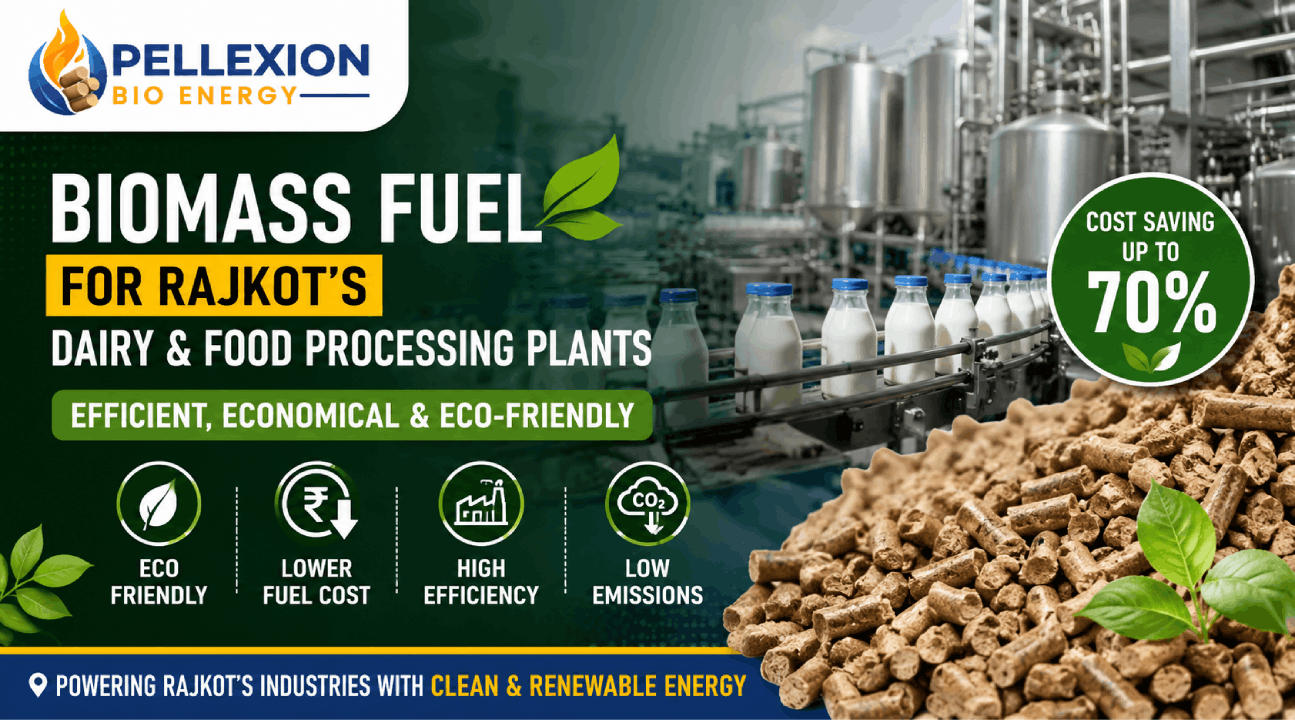
Rajkot’s dairy cooperatives and food processing units run on heat. Pasteurizers, sterilizers, spray dryers, and cooking vessels all draw their energy from a boiler, and that boiler has traditionally been fed by coal, furnace oil, diesel, or increasingly expensive LPG. Over the last few years, the economics and the environmental rules around that boiler have shifted, and plant owners across Saurashtra are asking the same question: is there a fuel that costs less, burns cleaner, and doesn’t leave production hostage to global oil prices? For a growing number of dairies and food units in and around Rajkot, the answer has been biomass fuel — pellets and briquettes made from compressed agricultural residue.
This guide walks through exactly why biomass fuel fits the dairy and food processing sector so well, what it changes on the shop floor, what it costs against coal and diesel, and how a plant in Rajkot can make the switch without disrupting production.
Why Rajkot’s Dairy & Food Processing Sector Is Rethinking Fuel
Rajkot sits at the center of a district that produces milk, groundnut, cotton, and a wide range of processed food products for both domestic and export markets. Dairy cooperatives here run pasteurization lines and milk-drying units around the clock, and food processing plants — from spice units to snack manufacturers — depend on continuous, predictable heat for cooking, roasting, and drying. Three pressures have converged on these operations recently:
Biomass fuel answers all three pressures at once, which is why it has moved from a niche alternative to a mainstream boiler fuel for dairy and food units across Gujarat.
What Exactly Is Biomass Fuel?
Biomass fuel refers to solid fuel made by compressing organic agricultural residue into a dense, uniform form that burns efficiently. Pellexion Bio Energy manufactures two forms of it:
What Exactly Is Biomass Fuel?
Small, cylindrical, and highly compact, biomass pellets are produced by grinding dried agricultural residue and compressing it under high pressure with no added chemicals or binders. Their uniform size makes them ideal for automated feeding systems and boilers that need a consistent, controllable fuel flow.
Biomass Briquettes
Larger and denser than pellets, briquettes are suited to boilers and furnaces designed for manual or semi-automated feeding, and are a direct, drop-in replacement for lump coal in many industrial furnaces.
Both are made from raw materials such as groundnut shell, cotton stalk, mixed agricultural waste, and coriander residue — all of which are abundant across the Saurashtra region surrounding Rajkot.
Why Biomass Fuel Suits Dairy Plants Specifically
A dairy plant’s boiler doesn’t just need to produce heat — it needs to produce it consistently, at the right pressure, for processes where inconsistent temperature control can mean spoiled batches. Here’s how biomass fuel holds up against that requirement:
Why Biomass Fuel Suits Food Processing Plants
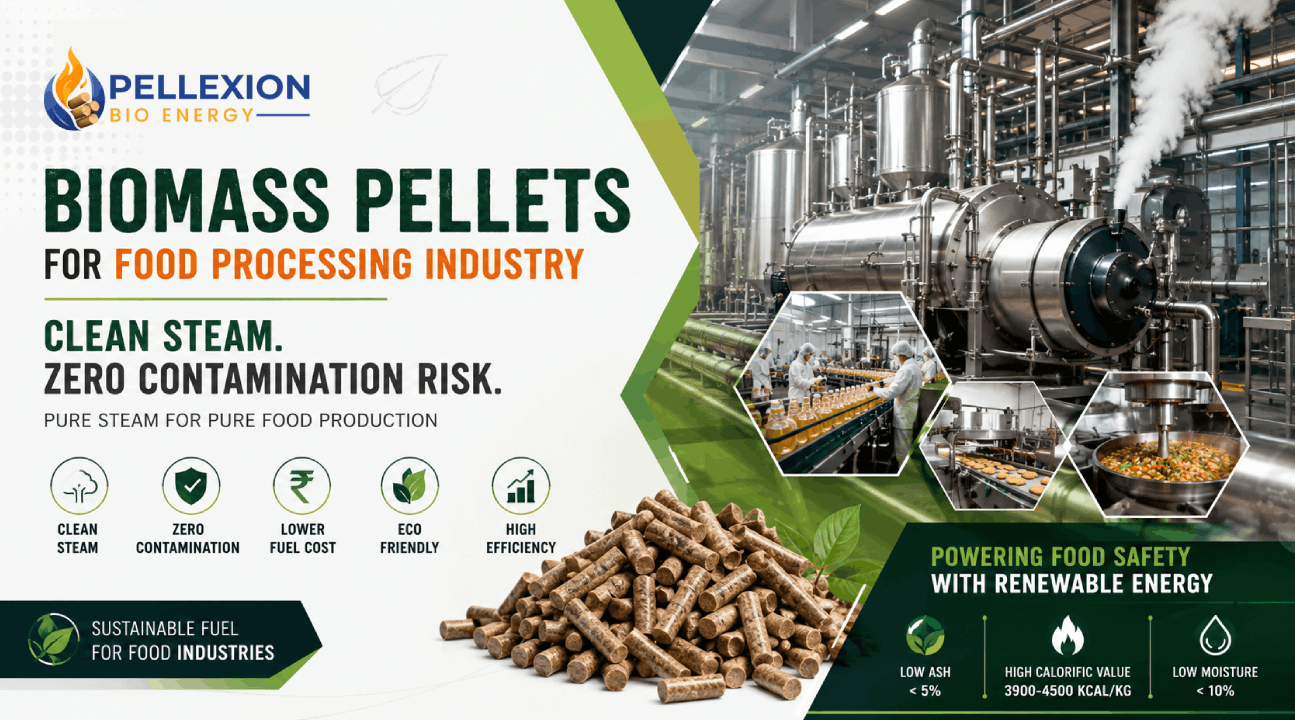
Food processing covers a wide range of heat-driven operations — cooking, frying, roasting, drying, sterilizing, and packaging — and Rajkot’s food processing sector spans everything from namkeen and snack units to spice processors and edible oil facilities. Biomass fuel fits this sector for several concrete reasons:
Choosing Between Pellets and Briquettes for Your Plant
One question almost every dairy or food processing plant asks before switching is whether to use pellets or briquettes, and the answer usually comes down to the boiler’s feeding system rather than personal preference.
Pellexion Bio Energy typically reviews a plant’s boiler specification sheet before recommending one or the other, since the wrong choice can mean inefficient combustion even though the underlying fuel quality is identical.
A Realistic Snapshot: What the Switch Looks Like in Practice
Consider a mid-sized dairy processing unit near Rajkot running a coal-fired boiler roughly ten hours a day to support pasteurization and a small milk-drying line. Coal costs fluctuate with import pricing and rail logistics, and ash disposal adds a recurring housekeeping cost. After trialing biomass briquettes made from groundnut shell for a few weeks, the plant typically notices three things: steam pressure stays more consistent through the day, ash volume drops noticeably, reducing daily cleanup time, and the fuel bill becomes easier to forecast from month to month because pricing is tied to a regional agricultural supply chain rather than an international commodity market.
None of this requires a new boiler. In the large majority of cases, the existing coal-fired unit continues running as-is, with the fuel itself being the only variable that changes.
Biomass vs. Coal vs. Diesel: A Straight Comparison
Every plant’s numbers differ by boiler efficiency, load pattern, and local pricing, but the structural comparison between fuel types is consistent across Rajkot’s industrial base:
| Factor | Biomass Fuel | Coal | Diesel |
|---|---|---|---|
| Price stability | Stable, locally sourced | Fluctuating, import-linked | Highly volatile |
| Emissions | Low | High | High |
| Ash content | Low | High | Very low |
| Renewability | Renewable | Non-renewable | Non-renewable |
| Equipment change needed | Minimal to none | — | Often significant |
| Local availability (Rajkot/Saurashtra) | High | Low, transported | Refinery-dependent |
The biggest structural advantage biomass holds isn’t just the price at any single point in time — it’s that the price stays comparatively stable, because the raw material is grown regionally every season rather than being tied to global energy markets.
Environmental & Compliance Benefits
Beyond cost, environmental compliance is increasingly a license-to-operate issue for industrial units in Gujarat. Biomass fuel offers three compliance-relevant advantages:
For dairy cooperatives and food exporters in particular, this also supports sustainability reporting and buyer audits that increasingly ask about energy sourcing as part of vendor qualification.
Why Rajkot Is Especially Well-Positioned for Biomass Fuel
Biomass fuel isn’t equally practical everywhere — it depends on a steady, nearby supply of agricultural residue. Rajkot and the wider Saurashtra region happen to sit inside one of Gujarat’s most productive agricultural belts, which is exactly why the fuel makes unusual economic sense here:
This regional advantage also cuts both ways for the local economy: farmers gain an additional revenue stream from residue that would otherwise be burned in the field or discarded, and industrial buyers gain a fuel source that doesn’t depend on a port, a pipeline, or a national coal linkage. For a district built on agriculture, turning that same agriculture into industrial fuel is less a novelty and more a natural extension of what the region already produces at scale.
How Pellexion Bio Energy Supplies Rajkot’s Industrial Plants
Pellexion Bio Energy manufactures biomass pellets and briquettes from responsibly sourced agricultural waste, following a structured process designed for consistency:
- 1Raw material selection — sourcing quality agricultural and crop residue from farms across the region.
- 2Crushing and grinding — processing raw material to the correct particle size for dense, uniform pellets and briquettes.
- 3Pelletizing and briquetting — compressing material under high pressure using modern biomass machinery, with no chemical additives.
- 4Quality testing and dispatch — checking every batch for calorific value, moisture, and ash content before it leaves for a client’s plant.
This consistency matters most for dairy and food plants, where an unpredictable fuel batch can mean an unpredictable boiler and, downstream, an unpredictable production run.
How to Switch Your Plant to Biomass Fuel
Plants considering the move from coal, diesel, or LPG typically follow a similar sequence:
- 1Share your boiler details. Boiler type, current fuel, and daily/monthly consumption help determine whether pellets or briquettes are the better fit.
- 2Get a trial batch. Most plants test a limited quantity in live production before committing to a full switch.
- 3Adjust feeding if needed. Many boilers need no changes at all; others benefit from a simple feeding-system adjustment for smoother automated combustion.
- 4Set up a recurring supply schedule. Once satisfied with performance, plants typically move to a scheduled bulk delivery arrangement to match their production calendar.
Storage tip: Keep biomass pellets and briquettes in a dry, covered, ventilated space. Properly stored material can retain its quality for one to two years, making it easy to plan inventory around seasonal production peaks.
Getting the Most Out of Biomass Fuel: Boiler & Storage Tips
Switching fuel is straightforward, but a handful of operating habits make the difference between an average result and the full cost and efficiency benefit biomass fuel can offer:
None of these steps require specialized training beyond what a boiler operator already applies to coal or diesel systems — they are adjustments in habit, not in skill.
The Bottom Line for Rajkot’s Dairy & Food Processing Plants
Biomass fuel isn’t a future concept for Rajkot’s industrial base — it’s already running boilers across the dairy and food processing sector today. It offers a rare combination for an industrial buyer: a lower and more stable cost than coal or diesel, meaningfully cleaner combustion that eases compliance pressure, and a raw material supply that is grown regionally rather than imported. For a dairy cooperative running pasteurizers around the clock, or a food processing unit whose margins depend on fuel cost per batch, that combination is difficult to ignore.
Pellexion Bio Energy supplies biomass pellets and briquettes to industrial plants across Rajkot and the wider Saurashtra region, backed by a quality-tested manufacturing process built specifically for consistent, high-calorific industrial fuel.





 Total views : 6788
Saras mahiti, dairy plant mate eco-friendly fuel switch karvano samay aavi gayo chhe evu lage chhe have.
Diesel ke jagah biomass briquette use karna shuru kiya, cost bhi kam aur GPCB wale bhi khush.