
Table of contents
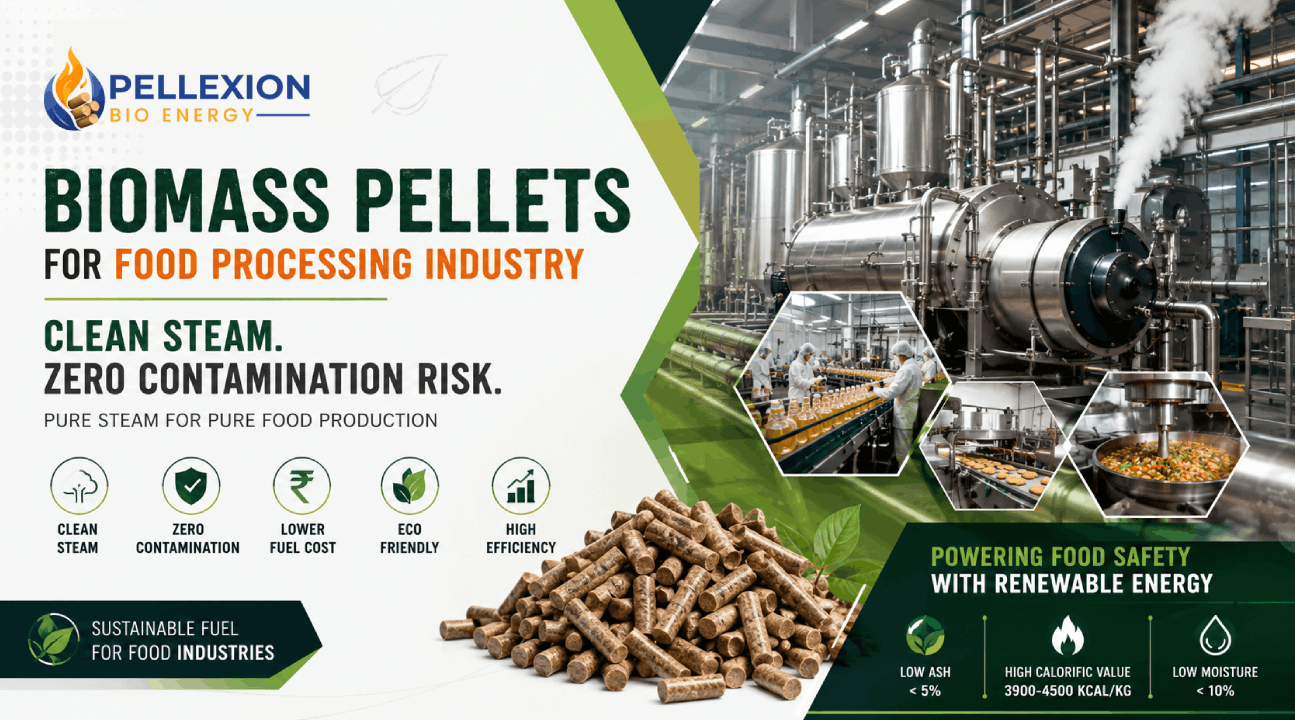
Why India’s rice mills, spice units, dairies and edible oil plants are replacing coal and furnace oil with sulfur-free biomass pellets — and what it means for FSSAI and export compliance.
Why Steam Purity Is a Food Safety Issue, Not Just an Engineering One
Every industrial boiler burns fuel to produce heat, and that combustion always creates flue gas — a mix of sulfur compounds, nitrogen oxides, trace metals, and particulate ash. In a fully indirect system (fire-tube or water-tube boilers where steam never touches the flue gas), this is mostly a maintenance and emissions concern. But food processing rarely stays that clean.
Rice mills use direct steam injection for parboiling. Spice dryers pull hot combustion air straight through the product bed. Edible oil plants use steam for solvent stripping and desolventising, often in near-direct contact with the product stream. In every one of these processes, whatever is in your fuel can end up, however faintly, in what people eat.
What Makes Biomass Pellets Different
Pellexion’s biomass pellets are compressed entirely from agricultural residue — groundnut shell, coriander waste, and other crop by-products that are themselves food-chain materials to begin with. No mineral content, no chemical binders, no imported contaminants. That feedstock choice is what drives every safety advantage below.
From Farm Waste to Clean Steam: How the Fuel Is Made
The safety profile of a biomass pellet is decided long before it reaches your boiler — in how consistently it’s manufactured. Here’s the process Pellexion follows for every batch:
- 1Raw material sourcing
Groundnut shell, coriander residue and other agricultural by-products are sourced and screened for moisture and foreign matter before entering the line. - 2
Crushing and grinding
Material is reduced to a uniform particle size, which is what makes consistent, low-ash combustion possible later. - 3
Pelletizing under pressure
Ground residue is compressed at high pressure and temperature into dense pellets — the natural lignin binds the material, so no chemical additive is needed. - 4
Quality testing
Every batch is checked for calorific value, ash content, and moisture before packaging and dispatch. - 5
Combustion and clean steam delivery
In your boiler, the low-sulfur, low-ash fuel burns predictably, producing the cleaner steam your process actually needs.
Where It Matters Most: Applications Across Food Processing
Grain & Rice
Rice Mills & Parboiling Units
Parboiling needs large volumes of clean steam at moderate pressure, often in direct contact with the grain. Mills across Gujarat and Madhya Pradesh are moving from husk-fired boilers to pellet-fired systems for more consistent combustion.
Spice
Spice Processing & Drying
Coal combustion can introduce tar and phenolic compounds into dryer air. Clean agro-residue pellets remove that risk entirely, keeping the drying atmosphere odour-free.
Edible Oil
Edible Oil Extraction
Solvent extraction and desolventising rely on steam quality directly affecting flavour. Even trace sulfur can create off-notes in the finished oil — near-zero-sulfur pellets prevent it.
Dairy & Bakery
Dairy, Bakery & Beverage
Pasteurization, sterilization and CIP cleaning all depend on hygienic steam and hot water. Biomass pellet boilers deliver both with lower particulate carryover than coal.
FSSAI, Export Audits and the Paper Trail You’ll Need
FSSAI doesn’t certify boiler fuel directly, but food safety audits increasingly look upstream of the product line — including what’s burning in the boiler room. Facilities exporting to the EU, US and Japan face buyer audits from retailers like Lidl, Tesco and Carrefour that ask for documentation of clean fuel sourcing as part of their hygiene and sustainability checks.
Switching to a documented, quality-tested biomass fuel gives your compliance team a paper trail: batch-level ash, moisture and calorific data that can be handed straight to an auditor, instead of trying to explain coal’s variable composition after the fact.
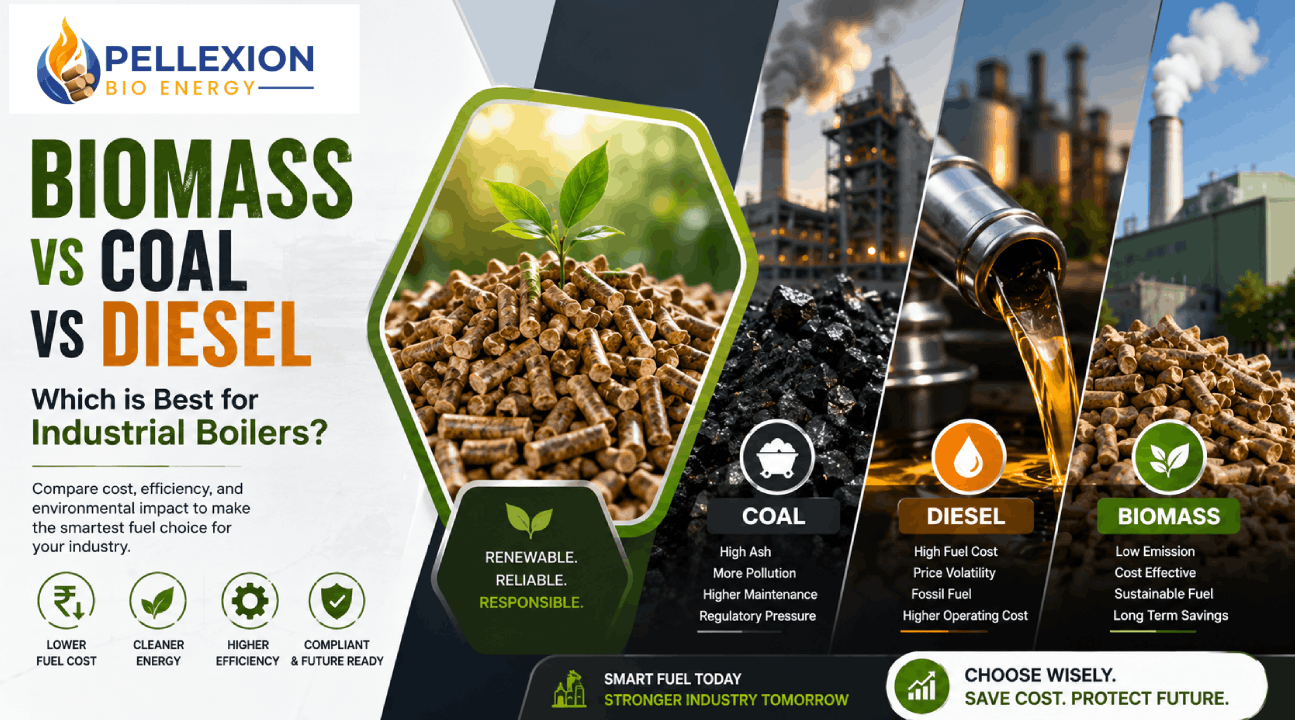
Biomass Pellets vs. Coal vs. Furnace Oil
| Factor | Biomass Pellets | Coal | Furnace Oil |
|---|---|---|---|
| Sulfur content | < 0.1% | 0.5 – 1.5% | Up to 4% |
| Heavy metals | None | Trace Hg, As, Pb | Trace vanadium, nickel |
| Ash content | Low, < 10% | 15 – 40% | Very low |
| Renewable | Yes | No | No |
| Price stability | Relatively stable | Fluctuating | Highly volatile |
| Food-contact steam risk | Low | High | High |
Pellexion Biomass Pellet Specifications
Typical values based on feedstock (groundnut shell, coriander waste, mixed agro-residue). Ask our team for a batch-specific quality sheet.
Why Food Processors Choose Pellexion
We manufacture from Jamnagar, Gujarat, supplying groundnut shell, coriander waste, mixed agro-residue and other biomass pellets and briquettes to industrial boiler operators across India. Every batch goes through the same quality checks before dispatch, and we work directly with plant teams on the boiler-side changes — feeding systems, grate settings — needed to convert cleanly from coal.






 Total views : 6820