A real-number breakdown of biomass pellets vs firewood cost for Indian boilers — price per kg, calorific value, combustion efficiency, and what it actually costs to generate heat in 2026.
Cost per 10,00,000 usable kcal delivered
Based on the worked example below: pellets at ₹8/kg (85% boiler efficiency) vs firewood at ₹7/kg (55% boiler efficiency). Full assumptions and formula in Section 3.
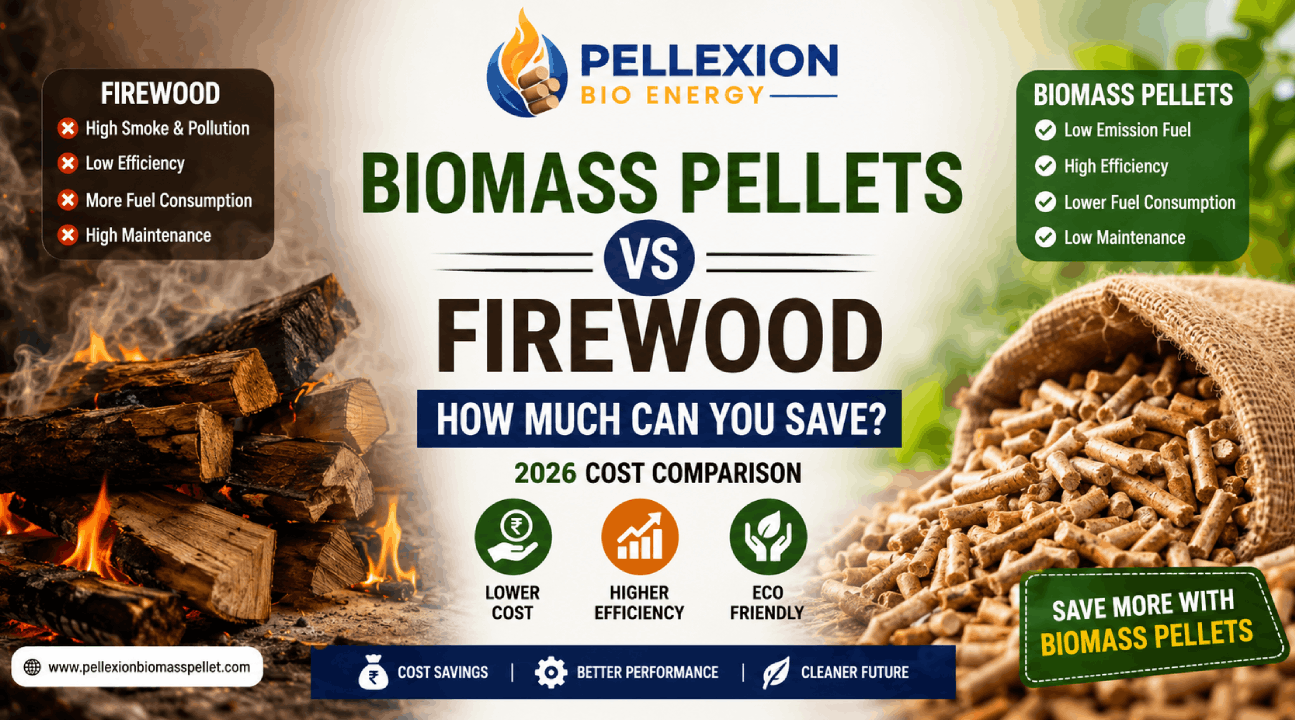
If you run an industrial boiler, brick kiln, or dryer in Gujarat, you’ve probably compared the price tags and picked firewood because it looks cheaper per kilogram. That comparison is misleading. What matters isn’t price per kg — it’s cost per unit of usable heat, and on that measure, biomass pellets usually win by a wide margin.
This guide walks through the real biomass pellets vs firewood cost using current Indian market prices, shows the exact calculation so you can rerun it with your own numbers, and covers the hidden costs — storage, labour, ash, and boiler wear — that rarely show up in a supplier’s quote.
01. Biomass Pellets vs Firewood: The Numbers at a Glance
Here’s how the two fuels stack up on paper, using current wholesale/industrial rates from Indian suppliers (₹/kg, mid-2026):
Typical industrial-grade prices and fuel properties — India, mid-2026
| Property |
Biomass Pellets |
Firewood (logs) |
| Price (bulk, industrial) |
₹7 – ₹9 / kg |
₹5 – ₹8 / kg |
| Calorific value (GCV) |
3,800 – 4,200 kcal/kg |
3,000 – 3,800 kcal/kg (as-fired) |
| Moisture content |
8 – 12% |
25 – 50% |
| Ash content |
2 – 6% |
Varies, higher with bark/soil |
| Typical boiler combustion efficiency |
85 – 90%+ |
50 – 65% |
| Storage life |
1–2 years, compact |
Bulky, degrades with damp |
Firewood’s rock-bottom mandi rate (as low as ₹2.8–4.16/kg in some regions) looks unbeatable — but that price is for green, high-moisture wood straight from the market, not the seasoned, boiler-ready fuel most units actually burn. Once you account for moisture and how much of that fuel actually turns into usable heat, the picture changes.
02. Why Price Per Kg Is the Wrong Number to Compare
Two things get ignored when people compare firewood and biomass pellets by weight alone:
1. Moisture eats your calorific value
Firewood is rarely fully seasoned when it reaches a boiler. Higher moisture means more of the fuel’s own energy gets spent evaporating water inside the furnace before any of it reaches your process — instead of heating your product. Biomass pellets are manufactured to under 12% moisture, so almost everything you burn contributes to usable heat.
2. Combustion efficiency is not the same fuel-to-fuel
Because pellets are uniform, dense and dry, boilers burn them far more completely — commonly 85–90%+ combustion efficiency. Firewood, especially in manually-fed or open-style furnaces, typically burns at 50–65% efficiency, with the rest lost as smoke, unburned char, and heat that escapes with excess moisture.
The takeaway: A fuel that costs less per kilo but delivers less than two-thirds of its energy as usable heat can end up costing you more per unit of heat than a fuel that costs slightly more per kilo but burns almost completely.
03. Step-by-Step: How to Calculate Real Fuel Cost Savings
Use this formula for any fuel, with your own supplier’s price and boiler data:
Cost per usable kcal = Price per kg ÷ (Calorific Value × Boiler Efficiency)
Here’s a worked example for a boiler that needs to deliver 10,00,000 kcal of usable heat — a scale typical of a small food processing or textile dyeing unit in Gujarat.
Worked example — 10,00,000 kcal of usable heat
| Step |
Biomass Pellets |
Firewood |
| Price |
₹8/kg |
₹7/kg |
| As-fired calorific value |
4,000 kcal/kg |
3,000 kcal/kg |
| Boiler efficiency |
85% |
55% |
| Usable heat per kg |
3,400 kcal |
1,650 kcal |
| Fuel needed for 10,00,000 kcal |
≈ 294 kg |
≈ 606 kg |
| Total cost |
₹2,353 |
₹4,242 |
Result: biomass pellets deliver the same usable heat for roughly 44–45% less, even though the per-kg price is higher. Swap in your own supplier rates and boiler efficiency to get a number specific to your plant.
~45%
Typical fuel cost savings per unit of usable heat, pellets vs firewood
2×
Roughly the extra volume of firewood needed for the same heat output
85–90%
Typical combustion efficiency of a pellet-fed industrial boiler
04. Beyond Fuel Cost: The Savings That Don’t Show Up on the Invoice
The per-kg comparison is only the starting point. Over a month of operation, a few other line items tilt further in favour of pellets:
Storage space: Pellets are dense and stack in bags or silos; the same heat value in firewood takes roughly double the space, and needs a dry, covered yard to avoid moisture pickup.
Handling and labour: Automated or semi-automated feeding is far easier with uniform pellets than with irregular logs that need manual loading and constant tending.
Ash and maintenance: Lower ash content means less frequent de-ashing, less clinker formation, and reduced wear on grates and blowers.
Consistency of output: Because pellets burn predictably batch to batch, boiler temperature is more stable — useful for process-sensitive industries like food processing, textiles, and pharmaceuticals.
Price stability: Firewood pricing swings with monsoon supply and local demand; industrially manufactured biomass pellets tend to hold a steadier price through the year.
05. Gujarat Industries: Where the Savings Add Up Fastest
Industrial biomass pellets in Gujarat are already replacing firewood and coal across several sectors where boiler fuel is a major running cost:
Textile dyeing and processing units (Surat, Ahmedabad belt) — steady, high-volume steam demand.
Ceramic and tile units (Morbi) — consistent kiln temperatures matter for product quality.
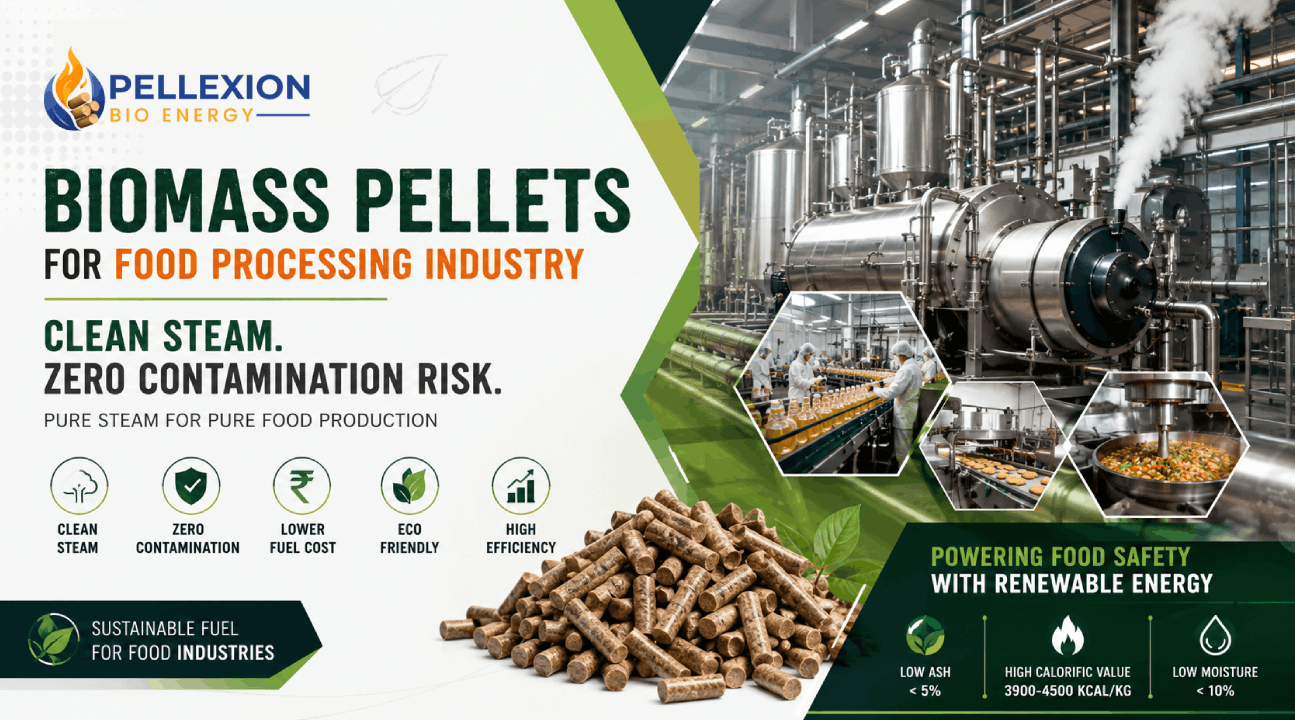
Food processing and dairy plants — frequent, predictable heating cycles.
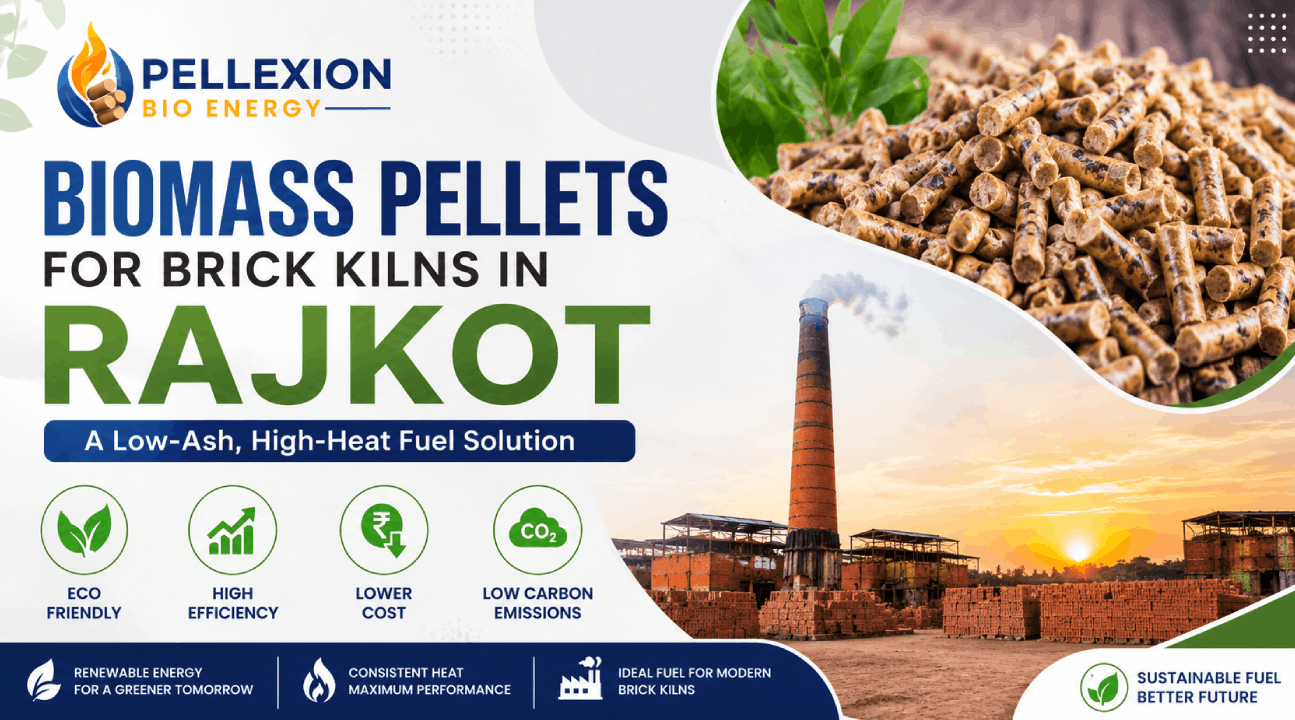
Brick kilns — large fuel volumes make the per-unit-heat savings especially significant.
Chemical and pharmaceutical units — cleaner combustion helps meet emission norms.
For a mid-sized unit burning even 2–3 tonnes of fuel a day, a 40%+ saving per unit of usable heat translates into a meaningful monthly number — often enough to justify switching within a single season.
06. When Firewood Might Still Make Sense
To be fair, firewood isn’t always the wrong choice. It can still work reasonably well when:
Fuel volumes are small and a local, no-cost or very low-cost wood supply already exists on-site.
The furnace or hearth is simple and doesn’t benefit much from a denser, automated fuel.
There’s spare storage space and labour to manage handling and ash removal.
For larger, continuous industrial loads, though, the efficiency gap tends to outweigh firewood’s lower sticker price fairly quickly.
07. How to Switch to Biomass Pellets
- 1
Get your current fuel data: your existing fuel cost per month, boiler capacity, and typical daily consumption.
- 2
Request a sample and spec sheet: check calorific value, moisture, and ash content from your supplier.
- 3
Run the calculation above with your own numbers to estimate real savings.
- 4
Trial a batch on your existing boiler setup — most units need minimal or no modification to burn pellets.
- 5
Move to a regular supply contract once performance and savings are confirmed.
Get a Free Biomass Pellet Cost Comparison for Your Boiler
Pellexion Bio Energy supplies high-calorific, low-ash biomass pellets and briquettes from Jamnagar, Gujarat. Share your current fuel and consumption details, and we’ll run the savings numbers for your plant.
FAQs
Per kilogram, biomass pellets usually cost slightly more than firewood. But because pellets have lower moisture and burn far more efficiently in a boiler, the cost per unit of usable heat is typically 40–45% lower with pellets — making them the cheaper option in practice for industrial use.
Industrial-grade biomass pellets in India typically range from ₹7 to ₹9 per kg for bulk orders, depending on raw material (groundnut shell, agro-waste, mixed biomass), calorific value, and delivery location. Bulk and long-term contracts often bring the effective rate down further.
In real boiler conditions, it typically takes roughly 1.8–2× the weight of firewood to match the usable heat delivered by 1 kg of biomass pellets, mainly due to firewood’s higher moisture content and lower combustion efficiency.
Yes. Gujarat has an active biomass pellet manufacturing base, including groundnut shell and agro-waste pellets, supplying textile, ceramic, food processing, and brick kiln industries across the state.
Most existing wood or biomass-fired boilers can burn pellets with little to no modification. Some operators add a hopper or automated feeder over time to take full advantage of the pellets’ consistent size and burn rate.
Firewood pricing depends heavily on local supply, season, moisture content, and whether it’s bought at a mandi (raw, high-moisture) or from a dedicated seasoned-wood supplier. This is one reason it’s an unreliable long-term budgeting fuel compared to manufactured biomass pellets.
Biomass pellets are made from compressed agricultural and wood waste, burn more completely, and produce less smoke and ash than firewood, making them a cleaner combustion option while remaining a renewable, carbon-neutral fuel source.






 Total views : 6831