
Table of contents
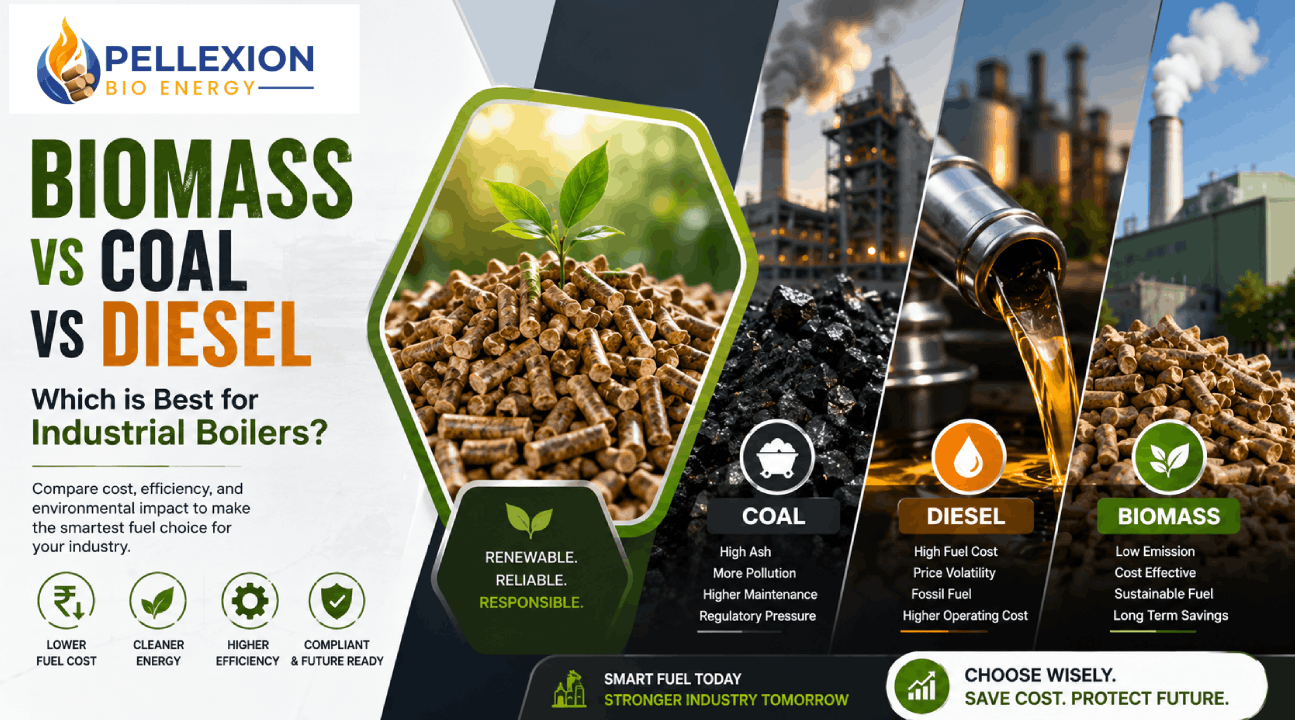
Every plant manager staring at a rising fuel bill eventually asks the same question: coal, diesel, or biomass — which one actually makes sense for my boiler? It’s not a small decision. Fuel is usually the single biggest recurring cost in a factory’s energy budget, and the wrong choice doesn’t just cost money — it can mean compliance headaches, unpredictable supply, and equipment wear that shortens the life of your boiler.
In this guide, we break the decision down the way an energy auditor would: cost per unit of heat, combustion efficiency, ash and maintenance load, emissions and regulatory exposure, and supply reliability. By the end, you’ll have a clear, numbers-backed answer for your specific operation — along with a step-by-step process for making the switch if biomass turns out to be the right call for you.
Quick Answer
For most Indian industrial boilers running continuous or near-continuous operations — textile units, food processing plants, chemical plants, brick kilns, dairies, and steel re-rolling mills — biomass pellets and briquettes deliver the lowest total cost of heat, more stable pricing than coal, dramatically lower emissions than both coal and diesel, and payback periods for conversion that typically fall between 6 and 24 months depending on boiler size and usage hours. Diesel remains useful only as a backup or emergency fuel due to its high per-unit cost. Coal is cheaper than diesel but is increasingly burdened by compliance costs, ash disposal, and price volatility that biomass avoids.
That’s the short version. Here’s the full breakdown.
Understanding the Three Fuel Options
Before comparing numbers, it helps to understand what you’re actually burning in each case.
Coal
Coal is a fossil fuel mined from underground deposits, commonly supplied to Indian industry as raw coal or graded coal for boiler use. It has a high fixed carbon content and a calorific value that typically ranges between 4,500 and 6,500 kcal/kg depending on grade. Coal has powered Indian industrial boilers for decades because it was cheap, widely available, and boiler systems were built around it. That advantage is eroding fast under rising import costs, freight charges, and tightening emission norms.
Diesel
Diesel is a refined petroleum distillate used in oil-fired boilers, thermic fluid heaters, and as a backup fuel for standby heating systems. Its calorific value is high — around 10,000–10,500 kcal/kg — and it burns cleanly with very low ash. But diesel is priced per litre against international crude benchmarks, so its cost per unit of heat is by far the highest of the three, and it swings with global oil markets and currency movements.
Biomass (Pellets & Briquettes)
Biomass fuel is made from compressed agricultural and wood residues — groundnut shells, cotton stalks, mustard husk, coriander waste, sawdust, and similar agro-industrial by-products — densified under high pressure into pellets or briquettes. Properly processed biomass fuel typically delivers a calorific value between 3,800 and 4,600 kcal/kg, with low ash and low moisture content when manufactured to consistent quality standards. Because it is made from renewable agricultural waste rather than mined or imported fossil resources, its price is tied to regional agricultural cycles rather than global oil and coal markets — which is the single biggest reason its pricing tends to stay more stable year over year.
Fuel Cost Comparison: Price Per Kg vs. Price Per Unit of Heat
This is where most fuel comparisons go wrong. Comparing coal, diesel, and biomass by price-per-kg is misleading, because each fuel delivers a different amount of usable heat per kilogram, and each burns at a different combustion efficiency inside a real boiler. The number that actually matters is cost per useful kilocalorie delivered, which factors in both calorific value and typical combustion efficiency for that fuel type.
| Fuel | Typical Calorific Value (kcal/kg) | Typical Combustion Efficiency | Approx. Ash Content | Price Volatility | Renewable |
|---|---|---|---|---|---|
| Biomass Pellets/Briquettes | 3,800 – 4,600 | 82% – 90% | 2% – 6% | Low – tied to local agri-cycles | Yes |
| Coal | 4,500 – 6,500 | 70% – 80% | 15% – 35% | High – linked to import/freight costs | No |
| Diesel | 10,000 – 10,500 | 85% – 92% | Below 1% | Very High – linked to global crude oil | No |
Diesel wins on raw calorific value and combustion efficiency — but it loses badly on price per unit of energy, because it is priced as a refined petroleum product rather than a bulk industrial fuel. Coal sits in the middle: reasonable calorific value, but lower combustion efficiency in older or poorly maintained boilers, plus a heavy ash burden that adds hidden handling and disposal costs most plants under-budget for.
Biomass, when sourced from a quality-controlled supplier, closes most of the calorific gap with coal while running cleaner, and its per-unit cost tends to stay meaningfully below both alternatives once you account for coal’s compliance costs and diesel’s fuel price.
The Real Comparison: Total Cost of Heat, Not Just Fuel Price
Several published industry cost studies converge on the same pattern: plants switching from coal to biomass briquettes commonly report fuel cost savings in the 40–60% range, while plants running diesel or LPG as their primary heating fuel and switching to biomass typically see conversion payback periods of well under a year to just over one year, depending on operating hours and boiler load.
Why the gap is so large:
Emissions & Environmental Impact
If your plant is anywhere near an industrial cluster under CAQM (Commission for Air Quality Management) oversight, or operates under Gujarat Pollution Control Board (GPCB) norms, emissions are no longer a side consideration — they directly affect whether you can keep operating without penalty.
Ash Content, Boiler Wear & Maintenance Load
Ash is the maintenance cost nobody puts on the fuel invoice, but every boiler operator eventually feels it.
Lower ash also means less abrasive wear on grates, feed systems, and heat-exchanger surfaces, which extends boiler component life and reduces unplanned maintenance shutdowns — a benefit that compounds over years of continuous industrial operation.
Supply Chain Stability & Price Predictability
Cost per kilocalorie only tells half the story if your fuel supply itself is unreliable. This is where the three fuels diverge sharply:
Storage, Handling & Site Footprint
Fuel choice doesn’t just affect the boiler room — it affects how much space, labor, and safety infrastructure your site needs to set aside.
Regulatory Pressure Is Accelerating the Shift
Emission compliance isn’t a future consideration — it’s already reshaping fuel decisions across Indian industrial belts. The Commission for Air Quality Management (CAQM) has progressively tightened restrictions on coal and pet coke in several regions, and state pollution control boards, including Gujarat Pollution Control Board (GPCB), have increased scrutiny on industrial stack emissions, particulate matter, and ash disposal practices.
For plants operating in or near designated industrial clusters, this means:
Factoring in likely regulatory direction — not just today’s compliance requirement — is an important part of any multi-year fuel decision, since boiler and compliance infrastructure typically has a working life measured in decades, not years.
Step-by-Step: How to Decide the Right Fuel for Your Boiler
If you’re evaluating a switch, don’t guess — run the numbers for your specific boiler using this process:
Step 1: Calculate your current fuel cost per useful kilocalorie.
Take your monthly fuel spend, multiply your fuel’s calorific value by your boiler’s actual (not rated) combustion efficiency, and divide your spend by the useful heat delivered. This is your true baseline cost — not the price per kg or per litre on the invoice.
Step 2: Check your boiler’s compatibility with biomass.
Most FBC (fluidized bed combustion) and grate-fired boilers can burn biomass pellets or briquettes with minimal or no retrofit. Thermic fluid heaters and some older coal-fired units may need a burner or feed-system modification — ask your fuel supplier or boiler OEM to confirm compatibility before committing.
Step 3: Request a fuel sample and lab report.
A reliable biomass supplier should provide calorific value (GCV), ash content, and moisture content data for the specific pellet or briquette type you’re evaluating — not just marketing claims. Run a trial burn if possible before switching your full fuel volume.
Step 4: Model your total cost of ownership, not just fuel price.
Include ash disposal savings, reduced maintenance downtime, avoided compliance/scrubber costs, and any available subsidy or accelerated depreciation benefit for renewable-fuel conversion (schemes exist through the Ministry of New and Renewable Energy and several state programs, including in Gujarat).
Step 5: Secure a supply agreement with volume and delivery guarantees.
Since biomass is regionally sourced, confirm your supplier’s monthly production capacity, delivery radius, and monsoon-season contingency plan — supply consistency during the rainy season is the most common concern plant managers raise before switching.
Step 6: Run a phased trial before full conversion.
Blend biomass with your existing fuel for 2–4 weeks, monitor steam output, ash levels, and boiler response, then move to full biomass once your operations team is comfortable with the new fuel’s handling and combustion behavior.
Worked Example: A Mid-Sized Industrial Boiler
To make this concrete, consider a plant running a 4 TPH (tonnes per hour) boiler, 20 hours a day, currently on coal:
Run through the cost-per-useful-kcal math for your own boiler using Step 1 above, and in most cases the biomass side comes out lower — which lines up with the 40–60% fuel-cost-savings range reported across multiple industry cost studies for coal-to-biomass conversions. The exact number depends heavily on your local coal price, your biomass supplier’s delivered rate, and your boiler’s actual efficiency, so treat this as a starting framework, not a guarantee — always run your own numbers with real quotations before committing.
Which Industries Benefit Most From Each Fuel
Common Myths About Biomass Fuel
“Biomass can’t match coal’s heat output.” Modern, quality-controlled biomass pellets reach calorific values close enough to mid-grade coal that, combined with higher combustion efficiency, the useful heat delivered per rupee spent is frequently better than coal — not worse.
“Biomass supply is unreliable during monsoon.” This was a real historical issue with unorganized biomass trading, but established manufacturers with dedicated drying, storage, and processing infrastructure maintain consistent supply through the monsoon season. Ask any supplier directly about their monsoon contingency plan before signing a contract.
“Switching fuels means replacing the whole boiler.” In the large majority of cases, existing grate-fired and FBC boilers handle biomass with no or minimal modification. Full boiler replacement is rarely required.
“Biomass pellets are more expensive once you include logistics.” This is only true if you’re sourcing biomass from far outside your region. A regionally based manufacturer — one processing local agricultural waste rather than importing biomass long-distance — largely eliminates this cost gap.
Why Plants Across Gujarat Choose Pellexion Bio Energy
Pellexion Bio Energy manufactures and supplies biomass pellets and briquettes from our facility in Kalavad, Jamnagar, serving industrial boiler operators across Rajkot, Ahmedabad, Surat, and the wider Saurashtra industrial belt. Every batch is processed from responsibly sourced agricultural residue — groundnut shell, cotton stalk, coriander waste, and mixed agri-waste — and tested for calorific value, ash, and moisture content before dispatch, so the fuel you receive matches the specification you were quoted.
If your boiler currently runs on coal or diesel and you want a clear, numbers-based answer on what switching would actually cost and save, our team responds to industrial inquiries within 2 business hours.
Frequently Asked Questions
Conclusion
There’s no single “best” fuel for every boiler — but for the large majority of continuous industrial operations in Gujarat and across India, biomass pellets and briquettes offer the strongest combination of low cost per unit of heat, price stability, reduced ash and maintenance burden, and compliance-friendly emissions — without requiring a new boiler. Diesel remains a sound choice only for backup and emergency heating. Coal still has a role where compliance pressure is low and biomass supply is inconvenient, but that window is narrowing every year.
The best next step isn’t to take this article’s averages at face value — it’s to run the real numbers for your specific boiler, using your own fuel prices and consumption data.






 Total views : 6879