
Table of contents
Choosing the wrong industrial fuel in 2026 can quietly drain lakhs of rupees from your bottom line every single month. With volatile crude prices, tightening emission norms, and India’s aggressive push toward net-zero, factory owners across Gujarat and the rest of the country are asking one urgent question: Biomass pellets vs furnace oil vs LNG — which industrial fuel actually wins in 2026?
This complete guide from Pellexion Bio Energy, a leading biomass pellets manufacturer in Gujarat, breaks down the real numbers — calorific value, price per kilogram, cost per million kilocalories, boiler efficiency, emissions, and payback period — so you can make a confident, data-backed decision for your boiler, furnace, or dryer.
Quick Answer: Which Industrial Fuel Wins in 2026?
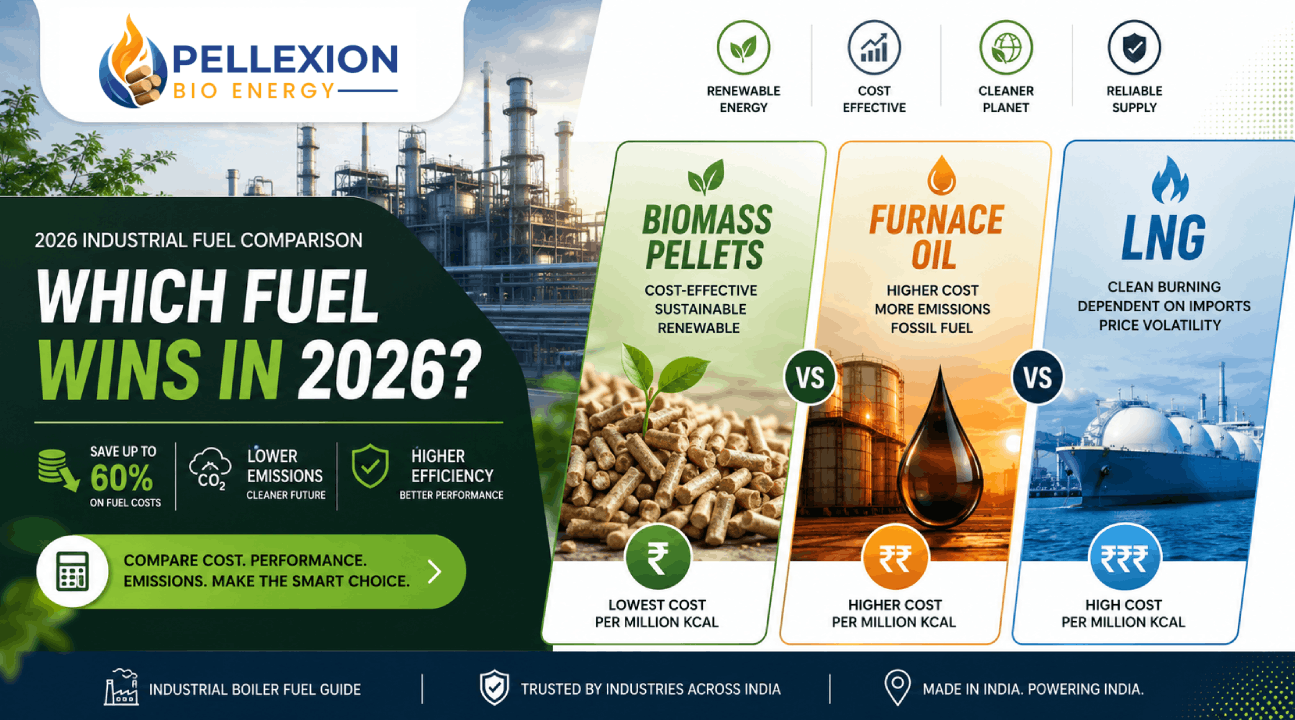
If you only read one paragraph, read this: Biomass pellets are the clear winner for cost and sustainability in 2026, delivering usable heat at roughly ₹2,600–₹3,400 per million kcal — nearly 40–50% cheaper than furnace oil (₹5,240–₹6,650 per million kcal) and 25–40% cheaper than LNG (₹4,700–₹6,300 per million kcal). Furnace oil still wins on raw energy density and legacy convenience, while LNG wins on cleanliness where a piped-gas grid exists. But for the majority of Indian industries chasing lower fuel bills and emission compliance, biomass pellets offer the best overall value.
Why Industrial Fuel Choice Matters More Than Ever in 2026
Fuel is often the single largest variable cost in any thermal process — textiles, dyeing, chemicals, food processing, paper, pharmaceuticals, rubber, ceramics and more. In 2026, three forces are reshaping the industrial fuel landscape in India:
Against this backdrop, the fuel you burn is no longer just an operational choice — it’s a strategic decision that affects profitability, compliance, and long-term competitiveness.
What Are Biomass Pellets? (The Renewable Challenger)
Biomass pellets are compact, cylindrical fuel units (typically 6–8 mm in diameter) made from densified agricultural and forestry residues such as groundnut shells, cotton stalks, sawdust, rice husk, bagasse and other agro-waste. At Pellexion Bio Energy, these residues are dried, ground and compressed under high pressure, where the natural lignin in the biomass binds the particles together — no chemical adhesives required.
The result is a clean, energy-dense, carbon-neutral fuel with consistent quality. Key specifications of quality industrial biomass pellets in 2026:
Because the CO₂ released during combustion equals the CO₂ the plants absorbed while growing, biomass pellets are considered carbon-neutral — a decisive advantage in an emissions-driven market. Explore our biomass pellets and briquettes range to see grades matched to your boiler.
What Is Furnace Oil? (The Legacy Incumbent)
Furnace oil (FO), also known as heavy fuel oil, is a thick, dark residual product of crude oil refining. For decades it has been the default fuel for Indian industrial boilers and furnaces because of its high energy density and easy handling in existing oil-fired systems.
Furnace oil’s strength is its raw calorific punch and plug-and-play compatibility with legacy equipment. Its weakness is a triple burden: high running cost, high carbon footprint, and rising regulatory pressure that is banning or restricting FO use in several Indian industrial zones.
What Is LNG? (The Clean-Burning Contender)
LNG (Liquefied Natural Gas) is natural gas cooled to roughly −162°C so it can be stored and transported as a liquid, then regasified for combustion. It burns cleaner than both furnace oil and coal, producing far less particulate matter and sulphur.
LNG is an excellent choice where piped gas or a reliable regasification supply exists. Its drawbacks are infrastructure dependency (pipeline access or cryogenic storage), price linkage to global gas markets, and the fact that it remains a non-renewable fossil fuel that does not qualify as carbon-neutral.
Head-to-Head Comparison Table: Biomass Pellets vs Furnace Oil vs LNG (2026)
Here is the side-by-side comparison every plant manager needs. Figures reflect typical Indian industrial conditions in 2026 and will vary with supplier, location and boiler type.
| Parameter | Biomass Pellets | Furnace Oil (FO) | LNG |
|---|---|---|---|
| Calorific Value | 3,400–4,500 kcal/kg | 10,000–10,200 kcal/kg | 12,000–13,000 kcal/kg |
| Typical Price (2026) | ₹7–₹10 / kg | ₹45–₹60 / kg | Market-linked (gas grid) |
| Boiler Efficiency | 75–80% | 85–90% | 88–92% |
| Cost per Million kcal (usable) | ₹2,600–₹3,400 | ₹5,240–₹6,650 | ₹4,700–₹6,300 |
| Renewable? | Yes ✔ | No ✗ | No ✗ |
| Carbon Neutral? | Yes ✔ | No ✗ | No ✗ |
| Emissions (SOx/NOx/PM) | Low | High | Very Low |
| Price Stability | Stable (domestic agro-waste) | Volatile (crude-linked) | Volatile (global gas) |
| Infrastructure Needed | Solid-fuel boiler / retrofit | Oil-fired boiler + storage | Pipeline / cryogenic storage |
| Ash Handling | Low (2–6%) | Minimal | None |
| Regulatory Outlook 2026 | Encouraged / incentivised | Restricted in many zones | Permitted |
The Metric That Actually Matters: Cost per Million Kilocalories
This is where most fuel decisions go wrong. Buyers compare price per kg and conclude furnace oil “does more” because its calorific value is higher. But you don’t buy fuel — you buy heat. The only fair comparison is the cost to deliver one million kilocalories of usable heat, which accounts for calorific value and boiler efficiency.
| Fuel | Cost per Million kcal (2026) | Relative Cost |
|---|---|---|
| Biomass Pellets | ₹2,600–₹3,400 | Baseline (lowest) ✔ |
| LNG | ₹4,700–₹6,300 | ~1.8–1.9× costlier |
| Furnace Oil | ₹5,240–₹6,650 | ~2.0× costlier |
The verdict is unambiguous: even though biomass pellets have a lower calorific value per kilogram, their dramatically lower price means the cost of usable heat is roughly half that of furnace oil. For a plant spending ₹1 crore a year on furnace oil, switching to biomass pellets can realistically save ₹40–₹50 lakh annually.
Emissions & Compliance: The 2026 Regulatory Reality
Cost is only half the story. In 2026, emission compliance can determine whether your plant keeps running at all in certain clusters. Here’s how the three fuels stack up environmentally.
A documented Indian case study showed a 5 TPH boiler switching from furnace oil to biomass fuel eliminating around 4,500 tonnes of CO₂ per year — roughly equivalent to taking 1,000 cars off the road.
Boiler Efficiency & Retrofit: What You Need to Know
A common concern is that biomass boilers run at slightly lower efficiency (75–80%) than oil (85–90%) or gas (88–92%) systems. This is true — but the fuel cost gap is so large that the efficiency difference is easily absorbed. The key is proper combustion design.
Most existing oil-fired boilers can be retrofitted to burn biomass pellets by adding a dedicated combustion grate, a biomass feeding system, and a redesigned flame path — while preserving the boiler’s pressure body. Retrofits are typically completed with minimal downtime, and the monthly fuel savings usually deliver payback within months.
How to Choose the Right Industrial Fuel in 2026 — Step by Step
Follow this practical, step-by-step framework to select the winning fuel for your operation.
- 1Calculate your true heat demand. Convert your monthly fuel usage into million kcal of usable heat, factoring in your current boiler efficiency. This gives you an apples-to-apples baseline.
- 2Compare cost per million kcal, not price per kg. Use the table above. This single metric exposes the real cost winner instantly.
- 3Check local fuel availability & logistics. Biomass pellets are strongest where agro-waste supply is reliable and close — as in Gujarat. LNG needs pipeline or cryogenic access; FO needs storage tanks.
- 4Review your emission obligations. Confirm your cluster’s Pollution Control Board rules. If FO is restricted or penalised, biomass or LNG becomes essential.
- 5Assess boiler compatibility & retrofit cost. Determine whether your existing boiler can be retrofitted for biomass, and estimate the one-time conversion cost against monthly savings.
- 6Model the payback period. Divide the retrofit/switching cost by expected monthly savings. Most FO-to-biomass conversions pay back within a few months.
- 7Lock in supply reliability. Choose a manufacturer that guarantees consistent calorific value, low moisture and on-time bulk delivery — the foundation of stable operations.
Real Savings: What Indian Industries Are Reporting in 2026
The numbers from the field consistently favour biomass:
Industry Applications: Who Benefits Most from Biomass Pellets?
Biomass pellets are ideal wherever consistent industrial heat or steam is required:
Understanding Calorific Value: Why “More kcal” Doesn’t Mean “Cheaper Heat”
To make a truly informed fuel decision in 2026, you need to understand calorific value (CV) — the amount of heat energy released when a fuel is completely burned, measured in kilocalories per kilogram (kcal/kg) or per standard cubic metre (kcal/SCM) for gases.
There are two versions of calorific value you’ll encounter:
Here is the trap that costs Indian factories crores every year: buyers look at furnace oil’s ~10,000 kcal/kg versus biomass pellets’ ~4,000 kcal/kg and conclude furnace oil is “2.5× more powerful,” so it must be the smarter buy. But calorific value alone tells you nothing about cost efficiency. You must combine three variables:
- 1Calorific value (how much heat per kg)
- 2Fuel price (how much you pay per kg)
- 3Boiler efficiency (how much of that heat actually reaches your process)
When you multiply these together, the “weaker” fuel frequently produces cheaper usable heat. That is exactly what happens with biomass pellets — and it’s why the cost-per-million-kcal metric is the only comparison that protects your margins.
Worked Example: A Real Cost Calculation for a Mid-Sized Plant
Let’s put numbers to it. Imagine a textile dyeing unit in Gujarat that needs 500 million kcal of usable heat per month for its boiler.
| Scenario | Cost per Million kcal | Monthly Heat Demand | Monthly Fuel Cost | Annual Fuel Cost |
|---|---|---|---|---|
| Furnace Oil | ₹6,000 | 500 million kcal | ₹30,00,000 | ₹3.6 crore |
| LNG | ₹5,500 | 500 million kcal | ₹27,50,000 | ₹3.3 crore |
| Biomass Pellets | ₹3,000 | 500 million kcal | ₹15,00,000 | ₹1.8 crore |
The difference is staggering. By switching from furnace oil to biomass pellets, this single plant would save approximately ₹15 lakh per month — or ₹1.8 crore per year. Even after accounting for a one-time boiler retrofit and slightly higher ash-handling effort, the payback period is typically just a few months. Over a five-year horizon, the cumulative saving can exceed ₹8–₹9 crore.
This is the core reason so many Indian industries are switching. The savings aren’t marginal — they are transformational for competitiveness in price-sensitive export and domestic markets.
How LNG Pricing Actually Works (and Why It’s Hard to Compare)
One reason LNG confuses procurement teams is that it’s priced by energy but consumed by volume or weight. LNG is quoted in dollars per MMBTU (million British thermal units), but your boiler consumes it as standard cubic metres (SCM) of regasified gas. To compare LNG fairly with biomass or furnace oil, you must convert everything to a common heat basis.
A practical field conversion: 1 MMBTU = 252,000 kcal. If LNG is priced at, say, ₹1,083 per MMBTU with a gross calorific value of about 9,640 kcal/SCM, the delivered cost works out to roughly ₹41.5 per SCM. Only after this conversion — and after applying your boiler efficiency — can you compute a genuine cost per million kcal for LNG and line it up against the other fuels.
The takeaway: LNG’s headline price can look attractive, but once converted to usable heat, it lands in the ₹4,700–₹6,300 per million kcal range in 2026 — still meaningfully more expensive than biomass pellets, and exposed to global gas-market swings and the rupee-dollar exchange rate.
Government Policy, Incentives & the 2026 Push for Biomass
Fuel economics don’t exist in a vacuum. In 2026, Indian policy is actively tilting the field toward renewable biomass:
- 1Emission tightening: Pollution Control Boards continue to phase down furnace oil and other high-sulphur fuels in dense industrial clusters, making biomass and gas the compliant path forward.
- 2Biomass co-firing mandates: Directives encouraging the use of biomass pellets in thermal applications have expanded demand and strengthened the domestic pellet supply chain.
- 3Agricultural residue utilisation: Policies aimed at curbing crop-residue burning channel agro-waste into pellet production — improving supply and stabilising prices.
- 4Net-zero alignment: Large corporate buyers increasingly require low-carbon supply chains, giving factories that use carbon-neutral biomass a commercial edge when bidding for contracts.
The direction of travel is clear: the regulatory and commercial environment in 2026 rewards factories that move to renewable biomass and penalises those clinging to high-emission fossil fuels.
Storage, Handling & Safety: A Practical Comparison
Beyond cost and emissions, day-to-day handling matters for uptime and safety.
| Aspect | Biomass Pellets | Furnace Oil | LNG |
|---|---|---|---|
| Storage | Dry covered shed / silo | Heated oil tanks | Cryogenic tanks / pipeline |
| Handling risk | Low (inert solid) | Spillage, fire risk | High-pressure / extreme cold |
| Pre-heating needed? | No | Yes (FO must be heated to flow) | Regasification required |
| Shelf life | Long if kept dry | Long | Boil-off losses over time |
| Fire/explosion hazard | Low | Moderate | Moderate–high (flammable gas) |
Biomass pellets are the simplest and safest to store and handle, provided they are kept dry to preserve their calorific value. Furnace oil requires heated tanks and carries spillage and fire risks, while LNG demands specialised cryogenic infrastructure and careful pressure management.
Total Cost of Ownership (TCO): Looking Beyond the Fuel Price
Smart buyers evaluate total cost of ownership, not just fuel price. TCO includes fuel cost, equipment and retrofit cost, maintenance, ash/waste handling, emission compliance and carbon liability, and downtime risk.
- 1Fuel cost: Biomass wins decisively (roughly half of FO).
- 2Retrofit/equipment: A one-time cost for biomass conversion, quickly recovered through savings.
- 3Maintenance & ash handling: Slightly higher for biomass (2–6% ash) — but modern systems automate this.
- 4Emission compliance: Biomass reduces compliance risk and potential penalties; FO increases it.
- 5Carbon liability: Biomass is carbon-neutral, insulating you from future carbon costs; FO and LNG carry growing exposure.
Across a realistic 3–5 year horizon, biomass pellets deliver the lowest total cost of ownership for the vast majority of industrial thermal applications in India.
Myths vs Facts: Biomass Pellets in 2026
| Myth | Fact |
|---|---|
| "Biomass is weaker, so it costs more to run." | Cost per usable kcal is roughly half that of furnace oil. |
| "Switching means buying a whole new boiler." | Most oil boilers can be retrofitted, preserving the pressure body. |
| "Biomass supply is unreliable." | A quality manufacturer guarantees consistent CV, low moisture and on-time bulk delivery. |
| "Pellet quality is inconsistent." | Standardised 6–8 mm pellets with controlled moisture and ash offer uniform performance. |
| "Ash handling is a dealbreaker." | Low ash (2–6%) is easily managed with modern de-ashing systems. |
Why Gujarat Is India’s Biomass Advantage
Location matters enormously in biomass economics, because transport is a large share of delivered fuel cost. Gujarat is uniquely positioned: it combines a dense industrial base (textiles, chemicals, ceramics, food processing) with abundant agricultural residue — groundnut shells, cotton stalks, and more — that feeds pellet production close to the point of use.
This proximity means Gujarat-based industries enjoy shorter supply chains, lower logistics costs, and more stable pricing than regions that must import fuel over long distances. As a #1 biomass pellets manufacturer in Gujarat, Pellexion Bio Energy leverages exactly this advantage to deliver high-calorific, competitively priced pellets to industrial buyers across the state and beyond.
Your Biomass Switching Checklist
Before you make the move, run through this quick checklist to ensure a smooth, profitable transition:
Pros & Cons at a Glance
| Fuel | Pros | Cons |
|---|---|---|
| Biomass Pellets | Lowest cost per kcal; renewable & carbon-neutral; stable domestic pricing; low emissions; incentivised | Lower CV per kg; needs solid-fuel boiler/retrofit; ash handling required |
| Furnace Oil | Very high energy density; easy handling; plug-and-play with legacy boilers | Highest running cost; high emissions; crude-linked volatility; increasingly restricted |
| LNG | Cleanest fossil fuel; high efficiency; no ash; clean combustion | Infrastructure-dependent; global price volatility; still fossil (not carbon-neutral) |
The 2026 Verdict: Which Industrial Fuel Wins?
Weighing cost, emissions, stability and future-readiness, here is the honest verdict for 2026:
For the vast majority of factories seeking to slash fuel bills and meet emission targets, biomass pellets are the fuel that wins in 2026.
Frequently Asked Questions (FAQ)
What to Look for in a Biomass Pellet Supplier
The single biggest risk in switching to biomass is not the fuel — it’s an unreliable supplier. The savings only materialise if your pellets are consistent and delivered on time. When evaluating a manufacturer, insist on:
Pellexion Bio Energy meets every one of these criteria, combining advanced manufacturing, rigorous quality control, and Gujarat’s agro-waste advantage to deliver fuel you can rely on.
Common Mistakes to Avoid When Switching Industrial Fuel
A fuel transition is a high-value project, and a few avoidable errors can undermine the returns. Learn from what has tripped up other factories:
Avoiding these mistakes ensures your switch delivers the full 40–50% savings the numbers promise.
Environmental Impact: The Carbon Math Explained Simply
The environmental case for biomass rests on a simple, powerful principle: the carbon cycle. When crops grow, they absorb CO₂ from the atmosphere through photosynthesis. When their residues are pelletised and burned, that same CO₂ is released back. The net addition of carbon to the atmosphere is effectively zero — which is why biomass is classified as carbon-neutral.
Contrast this with furnace oil and LNG. These fossil fuels release carbon that was locked underground for millions of years, adding new CO₂ to the atmosphere with no natural offset. Furnace oil alone emits about 2.64 kg of CO₂ per litre burned. Across a year of continuous operation, a single industrial boiler can emit thousands of tonnes of avoidable CO₂.
Beyond carbon, biomass pellets produce far lower sulphur oxides and particulate matter than furnace oil, directly improving local air quality around your plant and easing compliance with State Pollution Control Board limits. For factories pursuing ISO environmental certifications or supplying ESG-conscious global buyers, this clean profile is increasingly a commercial requirement, not just a nice-to-have.
Industry-Specific Guidance: Matching Fuel to Application
While biomass pellets win broadly on cost and sustainability, the ideal choice can vary slightly by industry context:
Whatever your sector, the decision framework stays the same: compute cost per usable kcal, confirm compliance, verify supply, and model payback. In nearly every Indian industrial scenario in 2026, that analysis points to biomass pellets.
The Bigger Picture: Biomass and India’s Energy Future
Switching your industrial fuel is not just a cost decision — it’s a contribution to a larger transformation. Every tonne of furnace oil replaced with biomass pellets reduces India’s fossil-fuel import bill, curbs crop-residue burning that pollutes northern skies each winter, creates rural employment in the agro-waste supply chain, and moves the country closer to its climate commitments.
For forward-looking factory owners, this alignment of profit and purpose is powerful. You cut your fuel bill, protect yourself from fossil-fuel volatility, satisfy tightening regulations, strengthen your ESG credentials with large buyers, and support a cleaner, more self-reliant energy economy — all at once. In 2026, few operational decisions deliver this much value from a single move.
Key Takeaways: Biomass Pellets vs Furnace Oil vs LNG in 2026
Conclusion: Make the Fuel Decision That Pays You Back
The 2026 industrial fuel debate — biomass pellets vs furnace oil vs LNG — comes down to what you value most. If you want the lowest cost of usable heat, price stability, carbon-neutral compliance, and a future-proof energy source, biomass pellets are the decisive winner. Furnace oil remains a legacy option burdened by high costs and shrinking regulatory space, while LNG is a clean but volatile fossil fuel best suited to gas-grid locations.
For factory owners ready to cut fuel bills by up to 50% while meeting emission targets, the path forward is clear. Get in touch with Pellexion Bio Energy — your trusted #1 biomass pellets manufacturer in Gujarat — for a free savings estimate and bulk quote today.





 Total views : 6866