
Table of contents
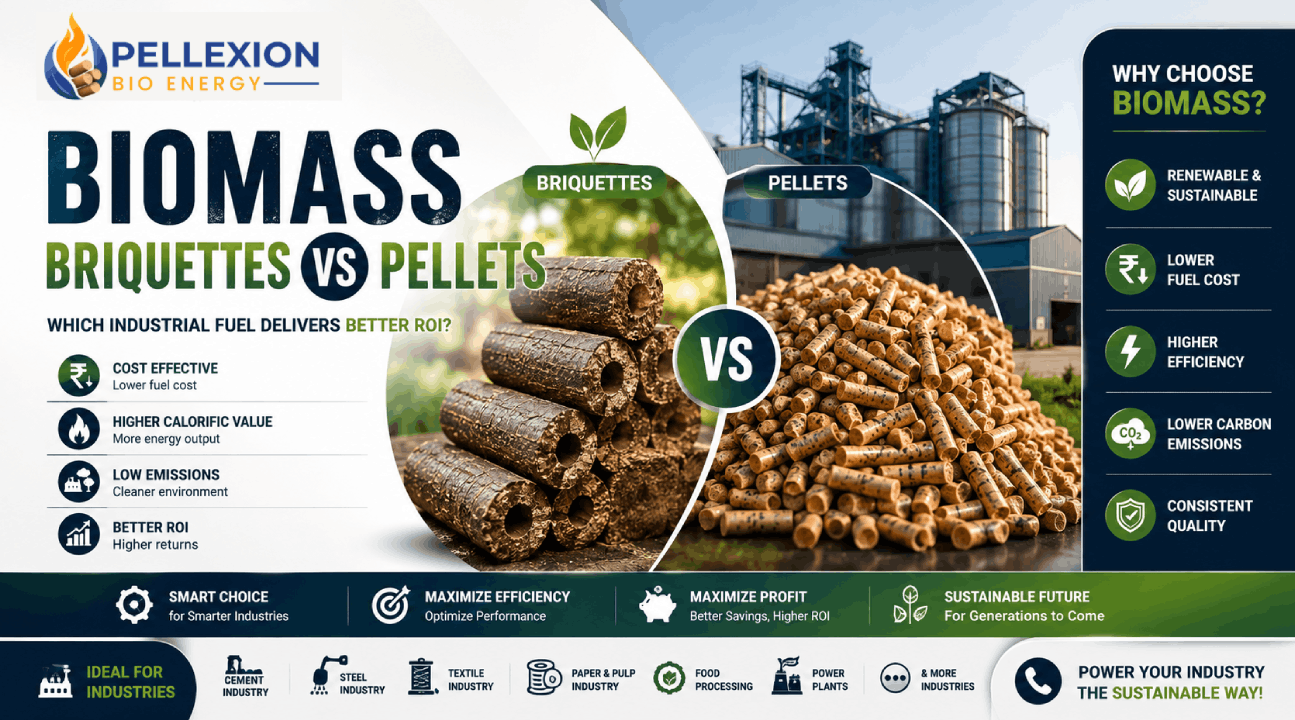
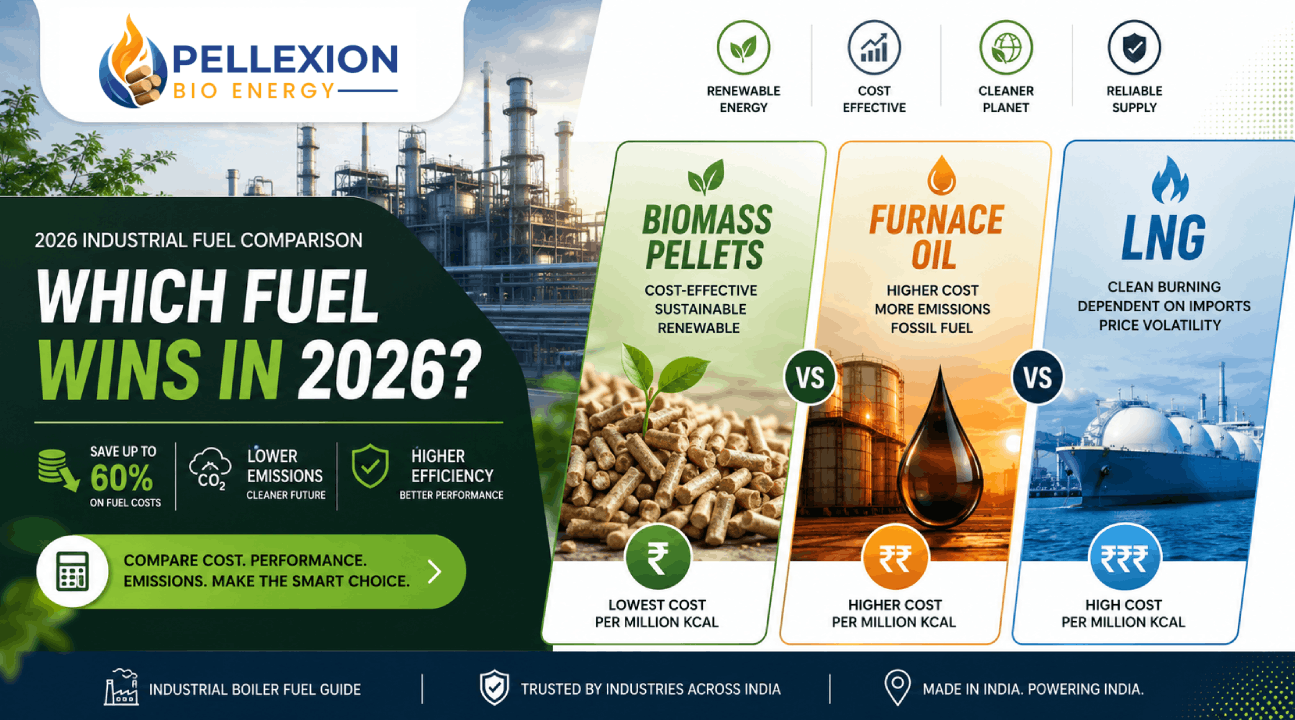
With rising fuel costs and strict environmental regulations in India, industries are rapidly shifting toward biomass fuels. Two of the most popular options are biomass briquettes and biomass pellets.
As Indian industries rapidly transition away from coal and furnace oil, two renewable fuel options dominate procurement discussions: biomass briquettes and biomass pellets. Both are manufactured from compressed agricultural waste, both are significantly cleaner than fossil fuels, and both qualify under India’s renewable energy obligations — but they serve different operational needs, suit different boiler configurations, and deliver different returns on investment.
At Pellexion Bio Energy, based in Jamnagar, Gujarat, we manufacture and supply both premium biomass pellets and biomass briquettes to industries across India. This in-depth guide will help procurement officers, plant managers, and energy decision-makers choose the right fuel for their specific application — backed by actual technical specifications and real-world ROI data.
But the real question is:
👉 Which fuel delivers better ROI (Return on Investment) for industries in 2026?
What Are Biomass Briquettes and Pellets?
Biomass pellets are small, dense cylindrical fuel pieces manufactured using ring-die or flat-die pellet presses at very high pressures (200–300 MPa). The process produces highly uniform fuel with excellent combustion properties.
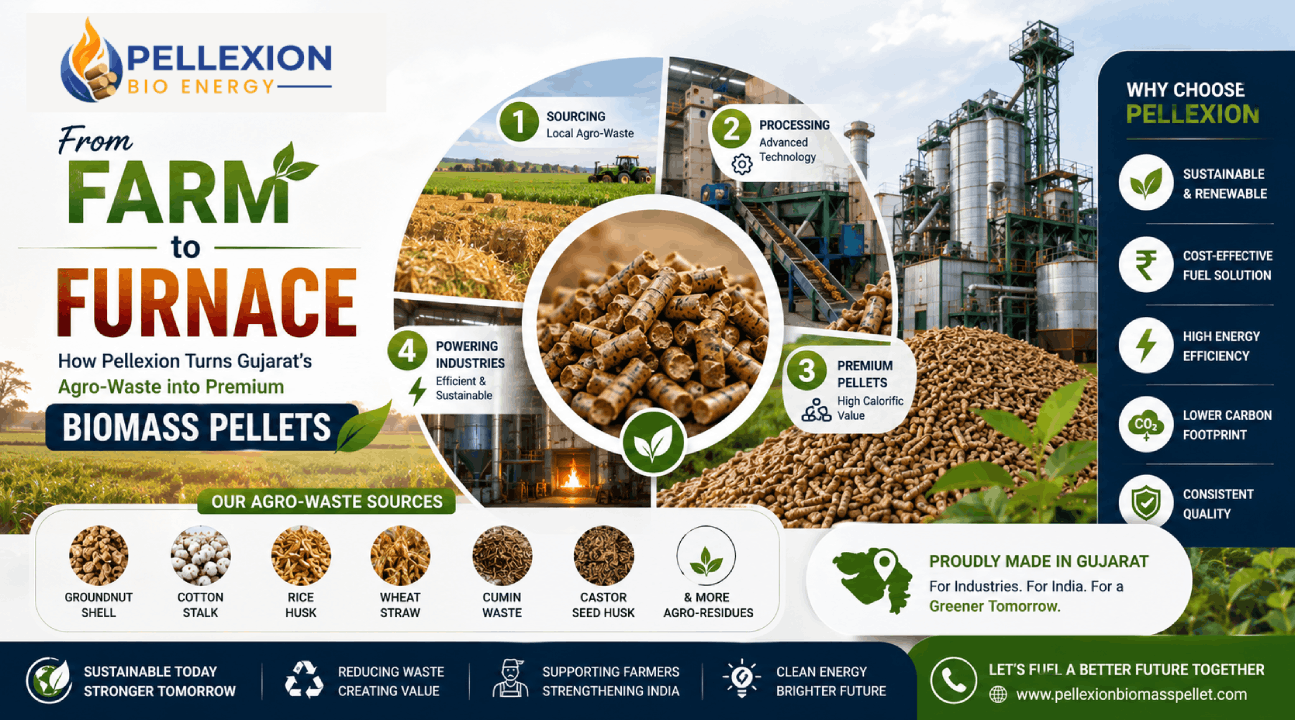
Typical dimensions: 6mm or 8mm diameter, 15–40mm length. Pellexion Bio Energy produces pellets from:
Biomass briquettes are large, cylindrical blocks of compressed agricultural and agro-industrial waste. They are produced using hydraulic or mechanical piston presses that apply high pressure to dried biomass without any chemical binders.
Typical dimensions: 60–90mm diameter, 150–300mm length. Common raw materials used by Pellexion Bio Energy include:
Detailed Technical Comparison: Briquettes vs Pellets
The table below compares key combustion and physical parameters of biomass briquettes and pellets:
| Parameter | Biomass Briquettes | Column 3 |
|---|---|---|
| GCV (Kcal/kg) | 3,800 – 4,200 | 4,200 – 4,600 |
| Ash Content | < 4% | < 2% |
| Moisture Content | < 12% | < 10% |
| Bulk Density | 600–700 kg/m³ | 650–750 kg/m³ |
| Combustion Speed | Slow (sustained burn) | Faster (high temp) |
| Boiler Type | Fixed grate, batch kilns | Stoker, spreader, co-firing |
| Feeding System | Manual / semi-auto | Fully automated |
| Price Range (bulk) | ₹7 – ₹10 / kg | ₹8 – ₹12 / kg |
| Storage Space | Needs more space | Compact & efficient |
| Transport Ease | Bulky, heavier loads | Easy, higher density |
ROI Analysis: Which Fuel Saves More Money?
Return on investment depends on four factors: fuel price per kg, GCV delivered, boiler efficiency with that fuel type, and operational/handling costs. Here’s how each scores:
1. Fuel Cost per Useful Kcal
Even though pellets cost slightly more per kg (₹8–12 vs ₹7–10 for briquettes), their higher GCV (4,200–4,600 Kcal/kg vs 3,800–4,200 Kcal/kg) means you consume less fuel to produce the same heat output. For high-throughput industrial boilers running 16–24 hours/day, this can mean 8–12% lower fuel consumption with pellets.
2. Labour and Handling Costs
Briquettes typically require manual or semi-automated feeding, which adds labour cost. Pellets, with their uniform size and flowability, work with fully automated stoker systems — reducing manpower requirements by 60–70% in large installations. For industries in Gujarat with rising labour costs, this is a significant ROI factor.
3. Boiler Maintenance
Pellets produce less than 2% ash content vs up to 4% for briquettes. Lower ash means less frequent cleaning cycles, lower downtime, and reduced maintenance costs — typically saving ₹15,000–₹40,000 per month on maintenance for medium industrial boilers (3–10 ton/hour).
4. Carbon Credits and ESG Benefits
Both fuels qualify as renewable biomass under India’s Perform, Achieve and Trade (PAT) scheme and the Renewable Purchase Obligation (RPO). However, pellets — especially certified wood pellets — are more widely accepted for international carbon credit programs, adding an additional revenue stream for export-oriented industries.
When Should You Choose Biomass Briquettes?
Briquettes are the right choice when:
Industries in Gujarat that commonly prefer briquettes: small and medium textile units, brick kilns around Morbi, small-scale food processing, and traditional dhow-building industries.
When Should You Choose Biomass Pellets?
Pellets are the right choice when:
Pellexion Bio Energy’s groundnut shell and agricultural waste pellets are widely used in Saurashtra’s textile and food processing sectors, delivering consistent 4,200+ Kcal/kg with under 2% ash — ideal for high-efficiency industrial boilers.
Industry
-Specific Recommendations
| Industry | Recommended Fuel | Reason |
|---|---|---|
| Ceramic & Tile (Morbi) | Pellets | High GCV, automated feeding |
| Textile (Surat, Rajkot) | Pellets | Precise temp. control needed |
| Food Processing | Pellets / Briquettes | Depends on boiler size |
| Dairy Industry | Briquettes | Smaller boilers, batch heat |
| Brick Kilns | Briquettes | Sustained slow combustion |
| Pharma Industry | Pellets | Consistent GCV, clean burn |
| Paper & Pulp | Pellets | High throughput, co-firing |
| Hotels & Restaurants | Briquettes | Lower volumes, manual use |
| Steel Re-rolling | Pellets | High temp requirements |
| Power Generation | Pellets | Co-firing compliance |
Pellexion Bio Energy: Our Products
Based in Jamnagar, Gujarat, Pellexion Bio Energy manufactures both biomass pellets and biomass briquettes from locally sourced agricultural waste. Our product lineup:
Biomass Pellets Range:
Biomass Briquettes Range:
All products undergo strict quality control testing before dispatch. We serve industries across Gujarat and pan-India including food processing, textiles, pharmaceuticals, ceramics, dairy, rubber, steel re-rolling, hotels, and power generation.
FAQs
Conclusion: The Right Fuel for Your Industry
Both biomass briquettes and pellets are excellent, eco-friendly alternatives to coal and furnace oil — but they are not interchangeable. The right choice depends on your boiler type, steam capacity, automation level, budget, and industry requirements.
As a rule of thumb:
At Pellexion Bio Energy, we make it simple. Whether you need biomass pellets or briquettes — or both — we supply from our Jamnagar, Gujarat facility with consistent quality, competitive pricing, and on-time delivery.





 Total views : 6795