For any plant consuming 50 MT to 500+ MT of biomass pellets per month, procurement is not a casual purchase — it is a mission-critical supply chain decision that directly affects production uptime, boiler efficiency, and overall cost competitiveness. Getting the right quality, at the right price, from a reliable supplier in Gujarat or across India can mean the difference between smooth operations and costly downtime.
This comprehensive guide walks procurement officers, plant managers, and purchase teams through the complete bulk biomass pellet buying process — from defining technical specifications to signing a long-term supply agreement — all tailored to the Indian industrial market.
Biomass pellets are compressed organic materials such as:
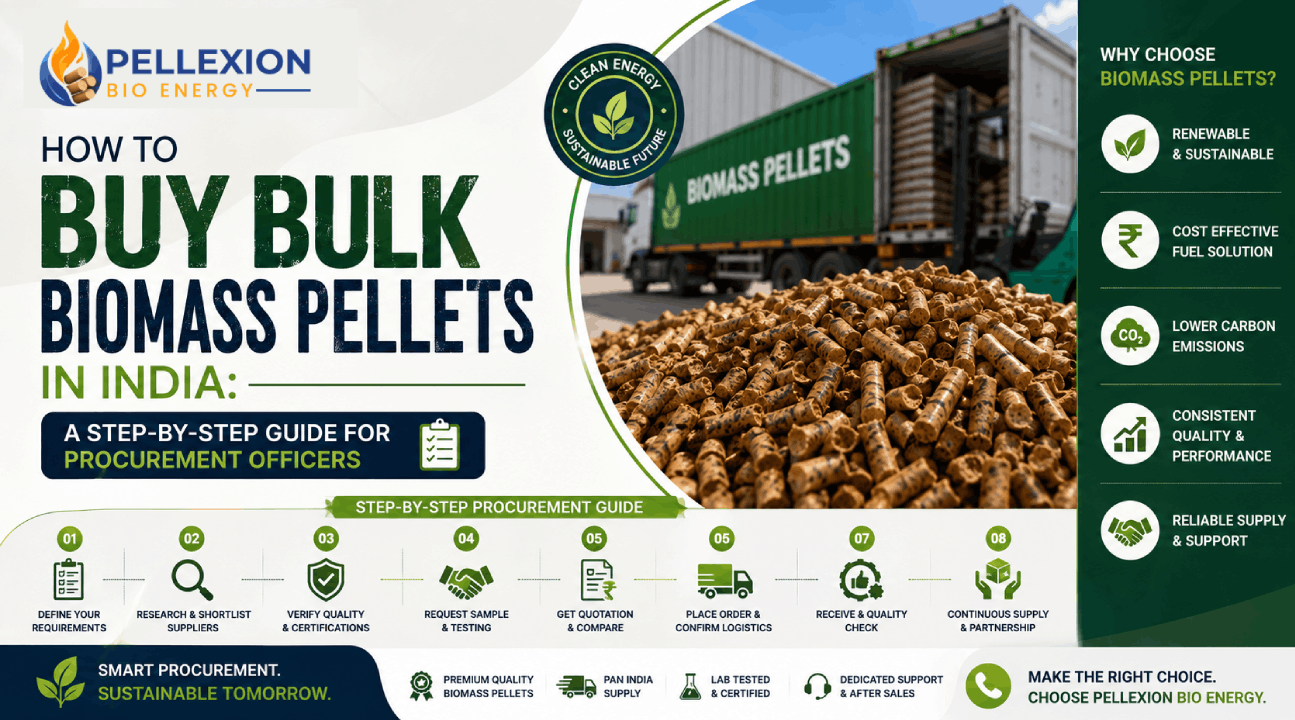
Step 1: Define Your Technical Specifications
Before reaching out to any supplier, it is essential to know exactly what fuel your boiler requires. Buying biomass pellets without clear specifications is the single biggest procurement mistake industrial buyers make.
Key Technical Parameters to Specify:
Gross Calorific Value (GCV): Most industrial boilers require a minimum of 3,800 Kcal/kg. High-pressure steam boilers typically need 4,200+ Kcal/kg for optimal performance. Pellexion Bio Energy supplies pellets in the 3,800–4,500+ Kcal/kg range across product types.
Ash Content (%): High ash content increases maintenance costs and downtime. Specify a maximum — generally <3% for standard industrial use, and <1% for pharmaceutical, food processing, or precision applications.
Moisture Content (%): Target <10% moisture for efficient, high-output combustion. Higher moisture means lower effective calorific value per kg — you are essentially paying to burn water.
Pellet Diameter: Specify 6mm or 8mm depending on your boiler’s feed auger or stoker system. Using the wrong diameter causes feed jams and uneven combustion.
Fines Content (%): Fines below 5% are acceptable in most applications. Excess fines (broken pellet dust) cause feed blockages, increase fire risk, and reduce boiler efficiency.
Bulk Density (kg/m³): Important for storage planning and freight cost calculation. Higher density = more energy per truckload.
Step 2: Know Your Raw Material Options
India produces a wide variety of agricultural residues used as biomass pellet feedstock. Each has distinct combustion characteristics. At Pellexion Bio Energy (Jamnagar, Gujarat), we produce pellets from:
| Raw Material |
Key Advantage |
Best For |
| Groundnut Shell |
Groundnut Shell High GCV (4,000–4,400 Kcal/kg), low ash Boilers, brick kilns, food processing |
Boilers, brick kilns, food processing |
| Agriculture Waste Mix |
Widely available, cost-effective |
General industrial heating |
| Coriander Waste |
Clean combustion, low moisture |
Textile, pharma, dairy |
| Mixed Biomass |
Consistent blended quality |
Large-scale power plants |
Ask any shortlisted supplier to disclose the exact feedstock composition. Blends without disclosure can lead to inconsistent GCV readings and combustion problems.
Step 3: Evaluate Supplier Quality Systems
Not all biomass pellet suppliers maintain equal manufacturing and quality standards. Before committing to any order, ask every potential supplier these critical qualification questions:
Do you provide a Certificate of Analysis (COA) with every batch, showing GCV, ash %, moisture %, and fines %?
Are your lab reports from NABL-accredited or ISO-certified third-party laboratories?
What is your GCV variance batch-to-batch? (Accept a maximum variance of ±200 Kcal/kg for reliable operations.)
Can I schedule a facility visit before placing the first order?
What is your rejection or replacement policy for off-specification deliveries?
How is quality controlled during production — are there in-process checks or only end-of-batch testing?
Pellexion Bio Energy maintains strict in-process and post-production quality controls. Every batch is tested before dispatch. We welcome facility visits from qualified procurement teams at our Kharedi, Jamnagar plant.
Step 4: Request a Sample / Trial Order
Never commit to a large volume contract without first running a trial in your own boiler. Laboratory numbers on a COA can look excellent; what matters is how the pellets perform in your specific combustion system.
Sample Order Protocol:
- 1
Request a minimum 25 MT trial order — sufficient for a meaningful 72-hour continuous boiler run.
- 2
Cross-check the delivered batch’s COA against an independent lab test if possible.
- 3
Run your boiler for a minimum of 72 continuous hours on the sample fuel before evaluating.
- 4
Record actual GCV performance (back-calculated from steam output), ash quantity per tonne, feed system performance, and any handling or blockage issues.
- 5
Compare your observed boiler efficiency against your coal or diesel baseline on a per-million-Kcal cost basis.
Step 5: Calculate Total Landed Cost — Not Just Ex-Factory Price
The price per kg quoted at the factory gate is only the starting point. Your actual procurement cost is the total landed cost at your facility. Comparing suppliers on ex-factory price alone is a critical mistake.
| Cost Component |
Column 2 |
| Ex-factory price per kg |
₹7.00 – ₹11.00/kg depending on quality & volume |
| Transport cost per kg |
₹0.50 – ₹2.00/kg depending on distance |
| Unloading & handling |
₹0.10 – ₹0.30/kg |
| GST (biomass pellets) |
5% on assessable value |
| Storage loss (moisture gain) |
0.5 – 2% if improper storage |
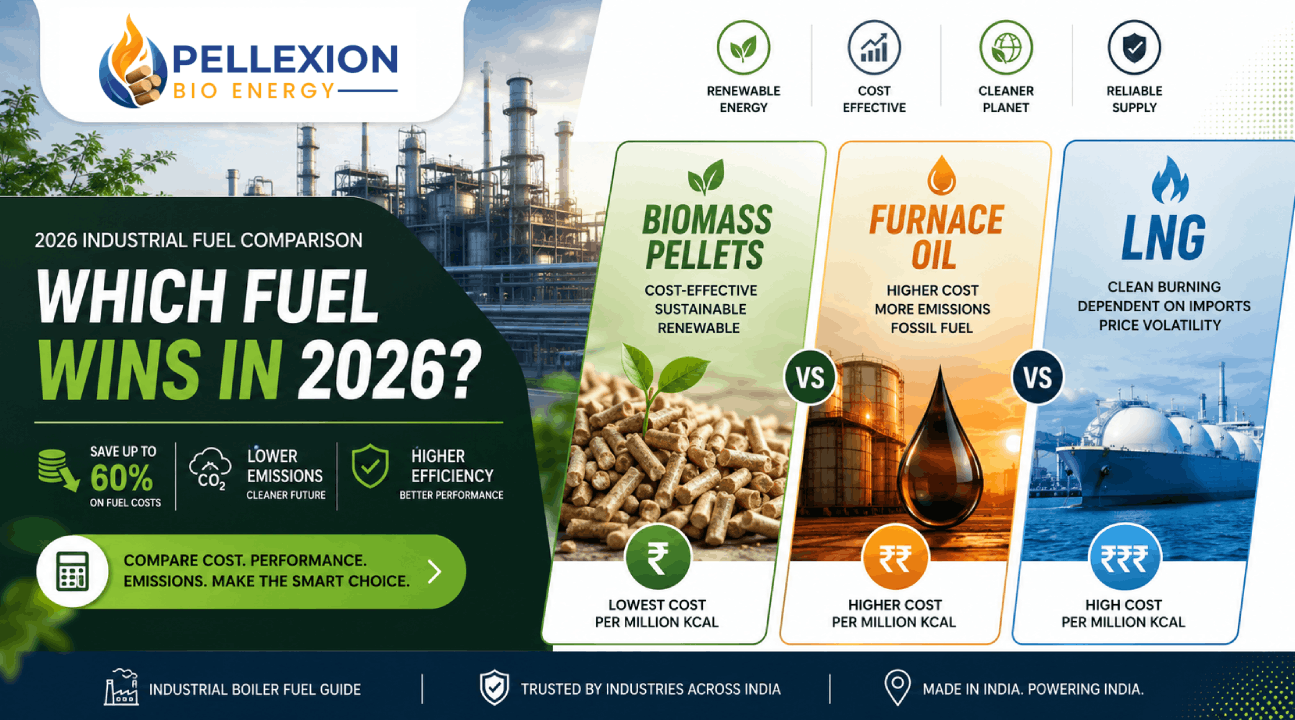
Once you have the total landed cost per kg, convert it to a cost-per-million-Kcal figure (Total Landed Cost ÷ GCV × 1,000,000) and compare it directly against coal, lignite, or natural gas on the same basis. In most Indian industrial applications, biomass pellets are 20–35% more cost-effective than coal on this metric.
Step 6: Assess Logistics & Supply Reliability
For consistent production, supply reliability is often as important as price. Evaluate:
Distance from manufacturer to your plant — directly affects lead time and freight cost.
Supplier’s production capacity vs. your monthly requirement — can they scale if your consumption grows?
Monsoon-season supply continuity plan — biomass availability can be seasonal for some feedstocks.
Minimum order quantity (MOQ) — does it align with your storage capacity?
Delivery mode — full truckload (FTL) typically costs less per kg than LTL (less than truckload).
Pellexion Bio Energy is located in Kharedi, Jamnagar, Gujarat — well-positioned to serve industrial buyers across Gujarat, Rajasthan, Maharashtra, and beyond via NH highway corridors.
Step 7: Negotiate a Long-Term Supply Agreement
For regular consumption above 50 MT/month, a formal annual supply agreement protects both buyer and supplier and enables better pricing. Ensure the agreement covers:
Committed monthly volume with a ±15% flexibility clause to accommodate production fluctuations.
Price escalation formula — ideally linked to a published index (CPI, agricultural commodity index) to avoid annual renegotiation disputes.
Quality guarantee with clear penalty or credit clauses for off-specification deliveries.
Delivery lead time and minimum reliability commitment (e.g., 48-hour advance notice of dispatch).
Force majeure provisions for weather events, crop failure seasons, or regulatory changes.
Payment terms — standard in India is 30–45 days credit for established buyers; advance or PDC for new relationships.
Quality Verification Checklist at Every Delivery
Vehicle cleanliness check — no coal, chemical, or foreign material contamination
Visual pellet inspection — uniform cylindrical shape, minimal dust or broken pieces
Portable moisture meter reading — confirm <10% moisture
Fines check — pass through 3mm sieve, confirm <5% fines
Certificate of Analysis (COA) received and batch number matched to delivery
Weight verified on weighbridge or against delivery invoice
Storage area dry and ventilated — pellets stacked away from ground moisture
Why Choose Pellexion Bio Energy as Your Biomass Pellet Supplier?
Pellexion Bio Energy is a Gujarat-based manufacturer and bulk supplier of biomass pellets and biomass briquettes, serving industrial buyers across India. Here is why procurement teams choose us:
| Advantage |
What It Means for Your Plant |
| High GCV (3,800–4,500+ Kcal/kg) |
Maximum heat output from every kg — reduces total consumption |
| Low Ash Content (<2–3%) |
Less downtime for boiler cleaning, lower maintenance cost |
| Low Moisture (<10%) |
Efficient, predictable combustion — no efficiency loss |
| Consistent Batch Quality |
Reliable boiler performance — no unexpected output drops |
| COA with Every Batch |
Full traceability and quality documentation on every delivery |
| Direct Manufacturer Pricing |
No middlemen — competitive rates for bulk buyers |
| Multiple Feedstock Options |
Groundnut shell, agriculture waste, coriander, mixed biomass |
| Gujarat Manufacturing Base |
Fast, cost-efficient logistics to Gujarat & nearby states |
Our biomass pellets and briquettes are trusted by industrial buyers across multiple sectors:
Food Processing & FMCG — for steam generation and process heating
Textile & Dyeing Units — for continuous steam boilers
Pharmaceutical Manufacturing — for clean, consistent heat
Ceramic & Tile Industry (Morbi cluster) — high-volume boiler fuel
Paper & Pulp Plants — for large-scale process steam
Brick Kilns — cost-effective coal replacement
Dairy & Cold Chain — for steam and water heating
Hotels, Hospitals & Commercial Laundries
Power Generation Plants (biomass co-firing)
FAQs
Our standard minimum trial order is 25 MT. For regular supply contracts, we typically work with buyers consuming 50 MT/month or more, though we can accommodate smaller volumes for new buyers during the evaluation phase.
Depending on the feedstock and product type, our pellets deliver between 3,800 and 4,500+ Kcal/kg GCV. Groundnut shell pellets typically achieve the highest GCV in our range. Contact our sales team to match the right product to your boiler’s requirements.
Our manufacturing facility is in Kharedi, Jamnagar, Gujarat. We supply buyers across Gujarat, Rajasthan, Maharashtra, Madhya Pradesh, and other states. For large volumes, we coordinate FTL transport directly from our plant to your facility.
Store pellets in a covered, well-ventilated godown or silo, away from direct ground contact (use pallets or raised flooring). Protect from rain, humidity, and direct sunlight. Properly stored pellets maintain quality for 12–24 months. Avoid storing near coal or chemical materials that can cause contamination.
The Indian government under the National Bioenergy Programme and MNRE (Ministry of New and Renewable Energy) supports biomass energy adoption. Some states offer incentives for industries switching from coal to biomass. Consult your state’s energy department or a tax advisor for current scheme eligibility.
Biomass pellets and briquettes attract 5% GST in India as of the current tax structure. Always verify current rates with your CA or GST consultant, as classification can vary by feedstock type.
In most cases, yes — biomass pellets can serve as a 1:1 replacement for coal in travelling grate, FBC (Fluidized Bed Combustion), and fixed grate boilers. Some older boilers may require minor modifications to the feed system or air supply. We recommend consulting your boiler manufacturer or an energy consultant before full conversion.
Use the delivery checklist above. For in-depth verification, a portable moisture meter, sieve set, and a combustion test in your boiler over 24–72 hours are the most practical on-site methods. For new supplier qualification, send a sample to an NABL-accredited lab for full proximate analysis.
Pellets (6mm or 8mm diameter, 20–30mm length) are designed for automated feed systems with augers, conveyor belts, and stokers. Briquettes (60–90mm diameter, 150–300mm length) are larger and suited for manual or semi-automated systems. Both products are available from Pellexion Bio Energy.
Contact our sales team at +91 95106 75879 or email pellexionbioenergy@gmail.com. Share your monthly requirement, boiler type and capacity, and current fuel type. We will respond with a product recommendation, technical datasheet, and pricing within 24 hours.






 Total views : 6802