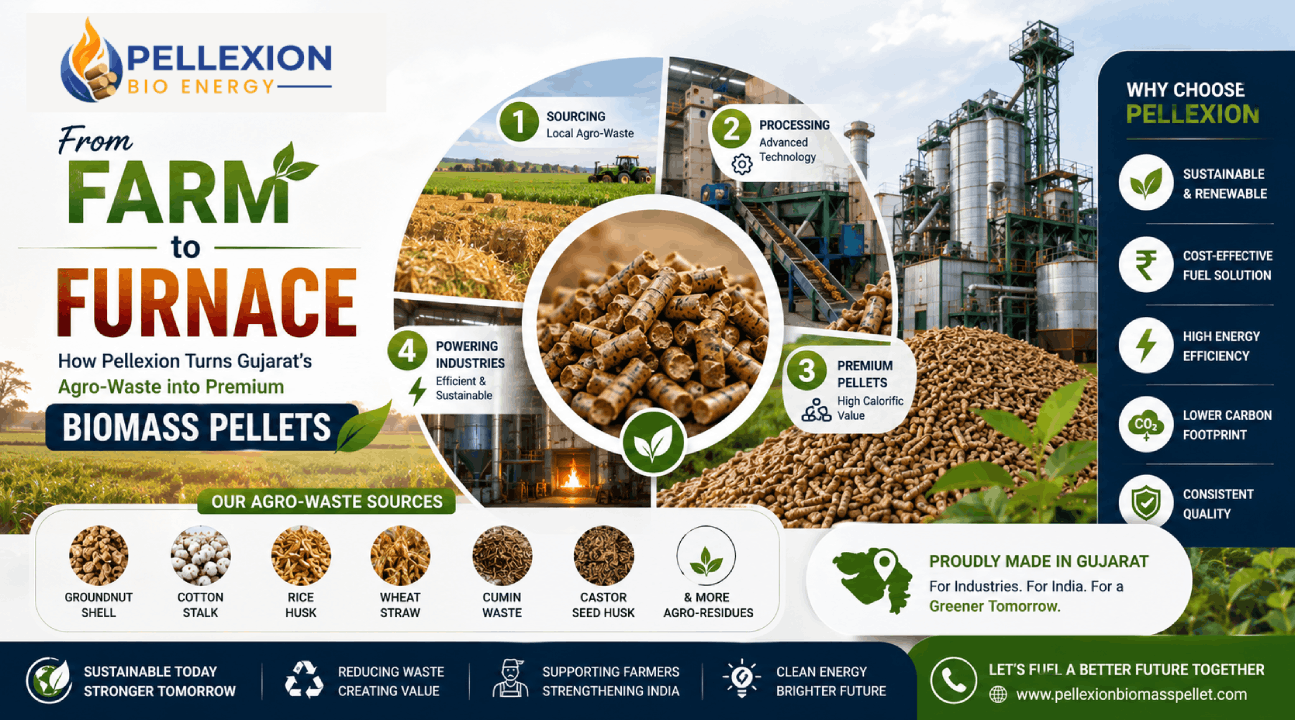
A complete behind-the-scenes look at Pellexion Bio Energy’s 5-step process of converting Gujarat’s agricultural residues — cotton stalks, groundnut shells, and mustard husk — into certified 4200–4600 Kcal/kg industrial biomass pellets.
Every Pellexion biomass pellet begins not in a factory — but in Gujarat’s farmlands. The cotton fields of Ahmedabad district, the groundnut farms of Saurashtra, the mustard fields of North Gujarat: these are the true origins of our fuel.
India produces over 500 million tonnes of agricultural waste every year. A large portion of this is burned openly in fields, contributing to air pollution, soil degradation, and carbon emissions. Pellexion Bio Energy transforms this waste liability into a premium, certified, renewable energy source for Indian industries.
The journey from agricultural residue to certified industrial fuel at Pellexion involves five precise manufacturing steps, each designed to maximize the Gross Calorific Value (GCV) while minimizing ash content and moisture — delivering the cleanest, most efficient biomass fuel for your boiler, furnace, or thermal plant.
🌿 Environmental Impact: Every tonne of biomass pellets used instead of coal prevents approximately 1.8–2.2 tonnes of CO₂ emissions. Pellexion’s agro-waste sourcing also prevents harmful open field burning across Gujarat.
1. Raw Material Sourcing & Quality Screening
Pellexion Bio Energy procures agricultural residues directly from farmer cooperatives and aggregators across Gujarat. Our procurement team evaluates every incoming feedstock for three critical parameters before accepting it into our production chain:
Baseline GCV (Gross Calorific Value) — Only high-energy raw materials qualify
Ash content percentage — Low-ash feedstocks ensure clean combustion
Initial moisture level — Determines drying effort and final pellet quality
This strict incoming quality control is what separates premium pellets from ordinary biomass fuel. Let’s look at the four primary raw materials Pellexion uses:
| Raw Material |
GCV Range |
Ash Content |
Key Advantage |
| Cotton Stalks & Husks |
4000–4200 Kcal/kg |
Very Low |
Abundant in Ahmedabad/Surat region |
| Groundnut Shells |
4200–4400 Kcal/kg |
Low |
Excellent combustion characteristics |
| Mustard Stalks |
4100–4300 Kcal/kg |
Low |
Ultra-low sulphur content |
| Sawdust & Wood Waste 4 |
4200–4500 Kcal/kg |
Ultra-Low |
Highest GCV, cleanest burn |
Industries searching for “biomass pellets Gujarat”, “groundnut shell pellets supplier”, or “cotton stalk biomass fuel” — Pellexion Bio Energy is your certified, quality-guaranteed source in Rajkot & Gujarat.
2. Pre-Processing — Shredding & Grinding
Raw agricultural residue arrives at our facility in large, irregular bulk forms — baled stalks, loose shells, wood chips in various sizes. Before any further processing can happen, this material must be reduced to a uniform particle size of 3–5mm.
Pellexion’s pre-processing stage uses:
Industrial hammer mills — Break down large stalk material into smaller pieces
High-speed grinders — Achieve the precise 3–5mm particle size required
Vibrating screening conveyors — Remove contaminants like rocks, soil clumps, and metal fragments
Consistent particle size is absolutely critical for the next step: uniform die extrusion in the pellet press. Irregular particle sizes result in uneven density, weak pellets, and inconsistent GCV — exactly what we prevent at this stage.
The grind is the foundation of the pellet. If particle size varies, everything downstream varies — density, GCV, and combustion consistency. Precision at this stage defines the final product quality.
— Pellexion Bio Energy, Quality Manufacturing Team
3. Drying — Achieving <10% Moisture
This is arguably the most important step in the entire biomass pellet manufacturing process. Incoming biomass from the field can carry 20–35% moisture — far too high for efficient pellet production or combustion.
High moisture content causes two major problems:
- 1
Poor pellet formation — wet biomass doesn’t bind well under pressure
- 2
Significantly reduced GCV — water absorbs heat during combustion, lowering effective energy output
Pellexion’s rotary drum dryers use controlled, calibrated heat to reduce incoming moisture to strictly below 10%, with our target being 8–9% moisture. Our team maintains detailed batch records of pre-drying and post-drying moisture levels for every production run, ensuring complete quality traceability.
📊 Why Moisture Matters for Your Boiler: A pellet at 20% moisture delivers roughly 20–25% less usable heat than the same pellet at 8% moisture. Pellexion’s strict <10% moisture guarantee means your boiler runs hotter, cleaner, and more cost-efficiently.
4. High-Pressure Extrusion — Pellet Formation
The heart of Pellexion’s manufacturing process is the ring-die pellet press. Dried, ground biomass is fed into the press under high pressure of 100–150 MPa and moderate temperature.
Here is where the science of pelletisation becomes remarkable:
The combination of pressure and heat causes the natural lignin present in the biomass to soften and act as a binding agent
This means Pellexion pellets are formed using zero chemical binders, zero artificial additives — 100% natural formation
Pellets exit the die at either 6mm or 8mm diameter, in lengths of 15–40mm
Immediately cooled by counterflow air to harden the outer surface and lock in density
🌱 100% Natural Fuel: Because Pellexion uses no artificial binders or chemical additives, our biomass pellets produce zero toxic emissions during combustion — making them suitable even for food-adjacent industries and environmentally regulated facilities.
The result: dense, hard, cylindrical pellets with bulk density exceeding 650 kg/m³ — significantly denser than loose biomass, easier to store, transport, and feed into automated boiler systems.
5. Quality Testing & Dispatch
Before a single bag or bulk consignment leaves Pellexion’s facility, every production batch undergoes rigorous quality sampling in our in-house laboratory.
Each batch is tested for all of the following parameters:
Gross Calorific Value (GCV) — Must meet 4200–4600 Kcal/kg specification
Moisture content — Must be below 10%
Ash content — Must be below 2%
Sulphur content — Verified for low-emission compliance
Bulk density — Confirmed above 650 kg/m³
Batches that pass all five parameters are cleared for dispatch with a Certificate of Analysis (CoA) — your documented proof of fuel quality for every order. Sub-standard batches are reprocessed or rejected, never dispatched.
Our manufacturing philosophy is simple: every pellet that leaves our facility must perform exactly as the customer expects — every single time. No compromises on consistency.
— Pellexion Bio Energy, Quality Assurance Team
Why Gujarat’s Agro-Waste Makes Superior Biomass Pellets
Gujarat is uniquely positioned as India’s premier source of high-quality biomass raw material. Here’s why:
Cotton Belt Dominance: Gujarat accounts for over 30% of India’s cotton production, generating massive volumes of stalks with excellent GCV
Groundnut Heartland: Saurashtra alone produces millions of tonnes of groundnut shells annually — one of the highest-GCV biomass feedstocks available
Low-Sulphur Mustard: North Gujarat’s mustard crop produces ultra-clean stalks ideal for industries with strict emission norms
Year-Round Supply: Gujarat’s diverse cropping calendar ensures continuous raw material availability across seasons
Proximity to Industry: Ahmedabad, Rajkot, Surat, Morbi ceramics clusters — all major industrial zones are within economical delivery range
Which Industries Benefit from Pellexion Biomass Pellets?
Pellexion Bio Energy supplies premium biomass pellets to a wide range of thermal-intensive industries across Gujarat and India:
🏭 Ceramic & Tile Manufacturing (Morbi Cluster)
Biomass pellets replace coal in ceramic kiln firing, delivering comparable heat output at significantly lower cost — and with substantially reduced CO₂ and particulate emissions.
🧵 Textile Mills & Dyeing Units
Steam generation for textile processing and dyeing is one of the highest fuel cost centres. Biomass pellets provide a cost-effective, regulatory-compliant coal alternative.
🏗️ Chemical & Pharma Manufacturing
Process heat for reactors and dryers can be met with biomass-fired steam boilers, providing consistent, controllable thermal energy from a certified, traceable fuel source.
🍃 Food Processing & Agro-Industries
100% natural, chemical-free Pellexion pellets are the preferred choice for food processing industries requiring clean combustion without toxic emissions near food products.
⚡ Power Plants & Thermal Energy
Biomass co-firing with coal in power plants reduces carbon footprint and helps achieve renewable energy compliance targets under India’s RPO (Renewable Purchase Obligation) norms.
FAQs
Pellexion biomass pellets deliver a Gross Calorific Value (GCV) of 4200–4600 Kcal/kg, depending on the raw material blend used in each batch. This GCV range is suitable for all types of industrial boilers, furnaces, kilns, and thermal power systems — directly comparable to and often superior to low-grade coal currently used in many Indian industries.
Pellexion Bio Energy uses Gujarat’s agricultural residues as the primary feedstock, including cotton stalks, groundnut shells, mustard stalks, and sawdust/wood waste. These are sourced directly from farmer cooperatives and certified agricultural aggregators across Gujarat. All incoming raw materials are quality-screened before entering our production facility.
Yes — absolutely. Pellexion pellets are 100% natural and completely chemical-free. The pellets are formed through high-pressure extrusion (100–150 MPa), which activates the natural lignin present in biomass to act as a binding agent. No artificial binders, adhesives, or chemical additives are introduced at any stage of manufacturing. This makes Pellexion pellets safe even for use near food products and in environmentally regulated facilities.
Pellexion biomass pellets maintain moisture content strictly below 10%, with our standard production target being 8–9% moisture. This is achieved through our rotary drum drying process, where incoming biomass (which may carry 20–35% field moisture) is dried to specification. Low moisture is critical — it directly determines the effective heat output of the pellet during combustion.
Pellexion biomass pellets are produced in 6mm and 8mm diameter, with a length range of 15–40mm and a bulk density exceeding 650 kg/m³. The 6mm pellets are suitable for most automated boiler feeding systems, while the 8mm pellets are preferred for large industrial furnaces and kilns with wider throat openings.
Yes. Every dispatched batch of Pellexion biomass pellets is accompanied by a Certificate of Analysis (CoA), which documents the tested results for GCV, moisture content, ash content, sulphur level, and bulk density for that specific production batch. This provides full quality traceability for your procurement records and regulatory compliance requirements.
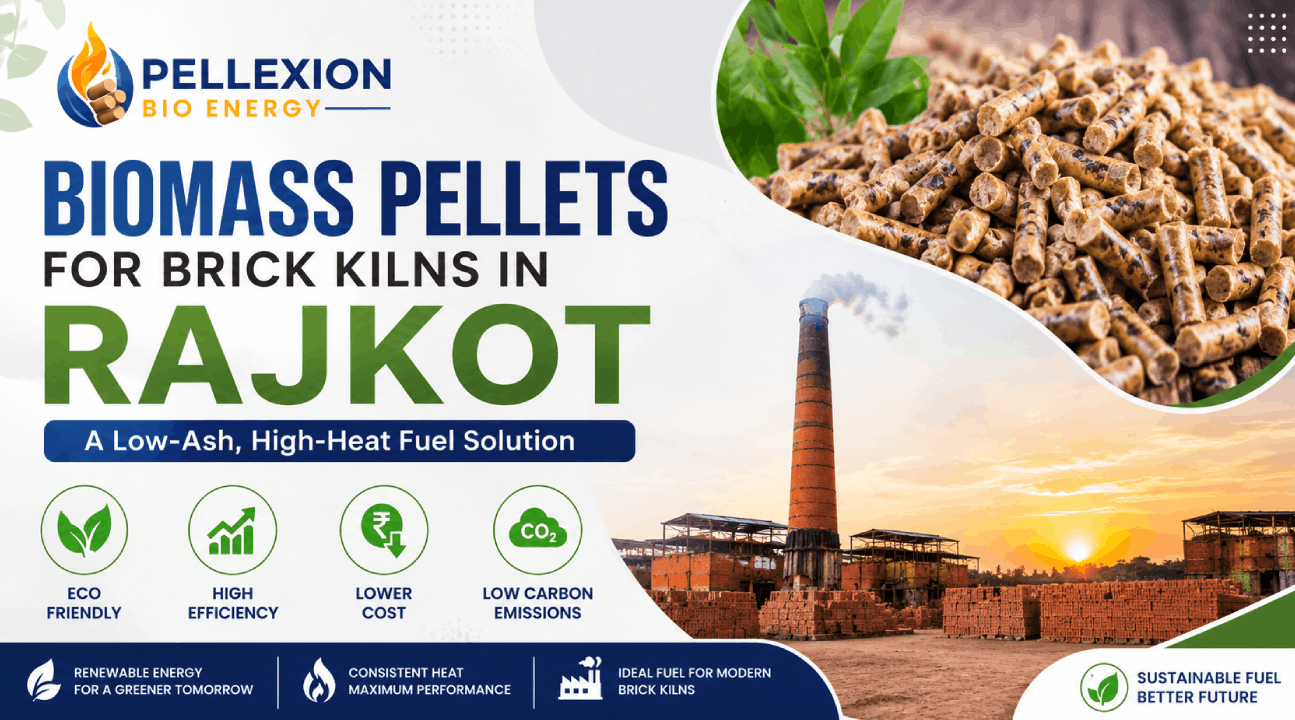
Pellexion biomass pellets are used across a wide range of thermal-intensive industries including ceramic and tile manufacturing (Morbi cluster), textile mills and dyeing units, food processing plants, chemical and pharma manufacturing, paper and pulp mills, distilleries, brick kilns, and biomass co-firing power plants. Any industry using coal, lignite, or natural gas for industrial heat generation can switch to Pellexion biomass pellets.
You can request a free bulk quote directly at pellexionbiomasspellet.com/contact. Pellexion offers customized bulk supply contracts, flexible delivery scheduling, and free samples for quality evaluation before committing to a long-term supply agreement. Our team will provide a detailed proposal based on your monthly consumption volume, delivery location, and quality requirements.
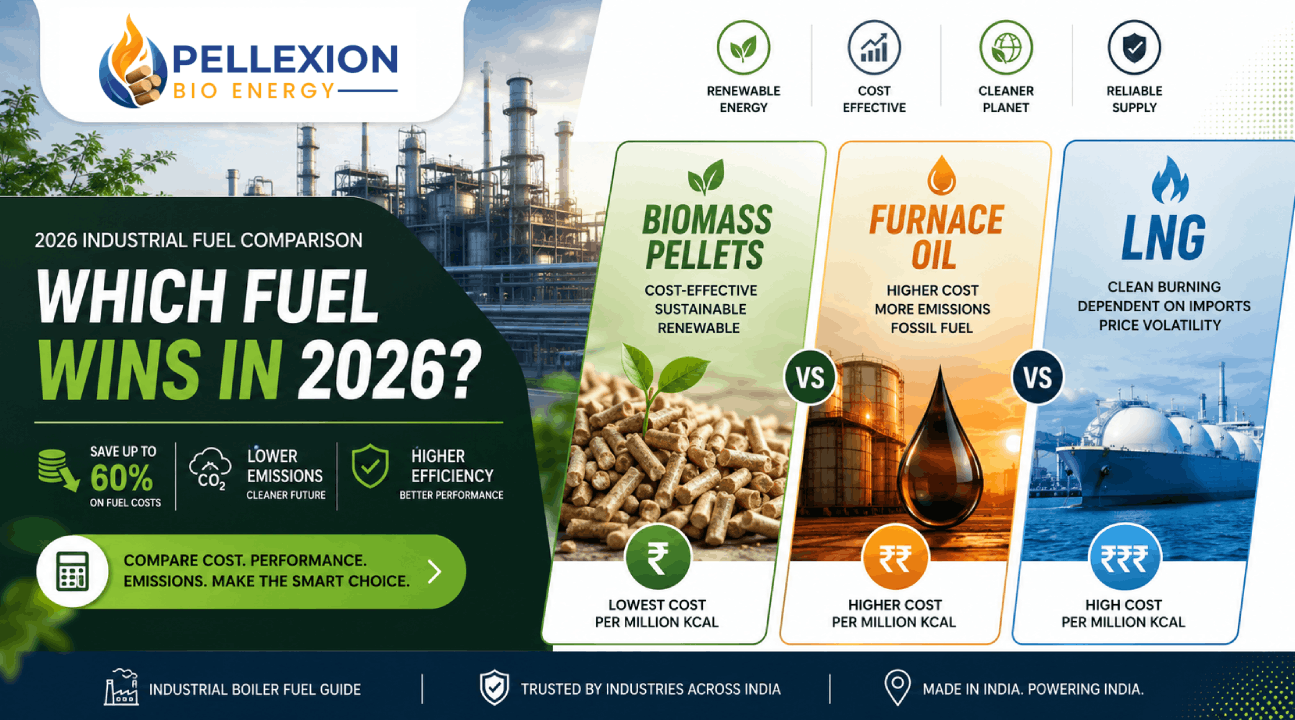
Biomass pellets offer several advantages over coal: lower ash content (less boiler maintenance), near-zero sulphur (lower emissions and regulatory compliance), carbon-neutral combustion (CO₂ absorbed during plant growth vs CO₂ released during combustion), and increasingly lower fuel cost in many Indian markets. The GCV of premium biomass pellets at 4200–4600 Kcal/kg is comparable to Indian sub-bituminous coal, making them a direct, drop-in substitute in many boiler configurations.
Pellexion Bio Energy primarily serves industrial clients with bulk requirements. Contact our sales team at pellexionbiomasspellet.com/contact to discuss your specific volume needs — we offer flexible arrangements from trial sample quantities for quality evaluation to large monthly contract supplies for industrial boilers and power plants.






 Total views : 6854