
Table of contents
How Saurashtra’s brick kiln operators are cutting ash, fuel cost, and emissions by switching from coal to agro-residue biomass pellets — with the performance data, compliance context, and a practical roadmap for making the change.
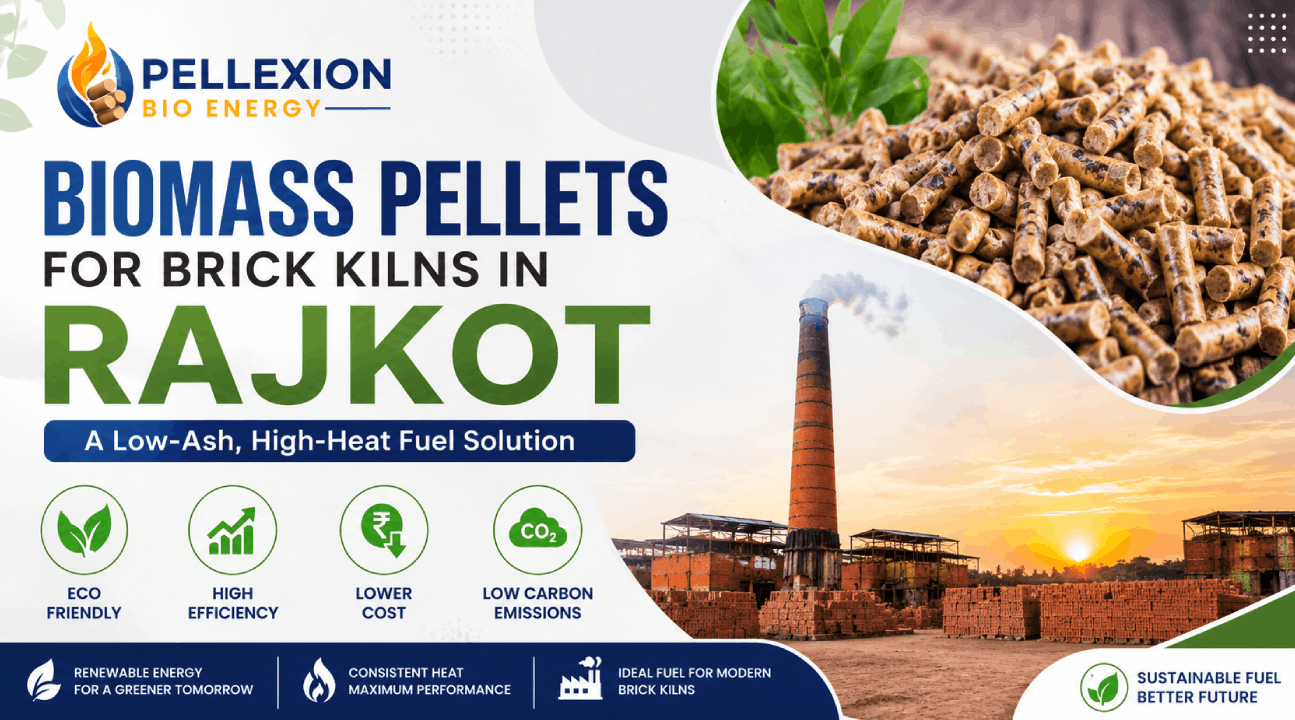
Drive through the brick kiln belt around Rajkot, Morbi, and Jamnagar during firing season and you will still see mountains of coal stacked beside the chimneys. But a quieter shift is underway. A growing number of kiln owners are replacing part or all of that coal with compressed biomass pellets — a fuel made from groundnut shell, cotton stalk, and other agricultural residue that Saurashtra produces in abundance. The reason is simple: biomass pellets burn hotter and more consistently than the coal grades typically available in the region, leave behind a fraction of the ash, and align directly with the pollution-control norms that brick kilns across Gujarat are now required to meet.
This guide walks through exactly what biomass pellets are, why their low-ash, high-heat profile matters specifically for brick firing, how the economics compare against coal and pet coke, and what a realistic transition looks like for a working kiln in and around Rajkot.
2–6%
Ash content in quality biomass pellets, vs 25–45% in common Indian coal
3800–4600
Kcal/kg calorific value of agro-residue biomass pellets
<10%
Moisture content maintained through controlled pelletizing
Why Rajkot’s brick kilns need a fuel rethink
Saurashtra’s brick industry runs on thin margins and tight firing schedules. Two pressures have converged on kiln owners in the last few years. First, coal supply and pricing have become less predictable, with landed cost swinging with rail and import logistics that are entirely outside a kiln owner’s control. Second, environmental enforcement has tightened. The National Green Tribunal and state pollution control boards have pushed brick kilns across Gujarat toward zigzag firing technology and cleaner fuel blends, with fixed chimney Bull’s Trench Kilns facing increasing scrutiny over particulate and sulfur emissions.
Biomass pellets sit at the intersection of both pressures. They are produced locally from agricultural residue that Saurashtra already generates in large volumes — groundnut shell from Rajkot and Junagadh, cotton stalk from the cotton belt, coriander and mustard waste from processing units nearby. That local sourcing insulates kiln owners from the price volatility of imported or interstate coal, while the fuel’s combustion profile helps meet stricter emission expectations without a full kiln rebuild.
What biomass pellets actually are
Biomass pellets are a densified solid fuel made by drying agricultural or wood residue, grinding it to a uniform particle size, and compressing it under high pressure into small, cylindrical pieces — typically 6 to 10 millimetres in diameter. No chemical binders are added; the natural lignin in the plant material holds the pellet together once compressed. The result is a fuel that is far denser and more energy-rich by volume than the loose husk, shell, or stalk it was made from.
For brick kilns specifically, the raw materials that make the most sense are the ones already available at scale around Rajkot: groundnut shell, mixed agricultural waste, coriander residue, and cotton stalk. Each has a slightly different calorific value and ash profile, which is why a reputable manufacturer blends and tests each batch rather than treating “biomass pellet” as a single generic product.
Pellets vs briquettes for kiln firing
Briquettes are a larger, denser version of the same idea, usually cylindrical or hexagonal blocks a few centimetres across, suited to manual feeding and longer, slower burns. Pellets are smaller, feed more evenly through mechanised or semi-mechanised systems, and are generally the better fit for continuous kiln firing where feed consistency directly affects brick quality. Many kilns in the Rajkot belt use a mix of both depending on the firing zone and feeding method.
The low-ash advantage, explained
Ash is not a minor inconvenience in brick firing — it is one of the biggest hidden costs of coal. Indian non-coking coal grades commonly used in brick kilns can leave 25 to 45 percent ash by weight after combustion. That ash has to be raked out, cooled, handled, and disposed of, and a meaningful share of it fuses into clinker on kiln walls and grates, which drives up maintenance shutdowns and labour.
Quality biomass pellets made from clean agro-residue typically leave only 2 to 6 percent ash. Over a full firing season, that difference compounds into fewer maintenance stoppages, less manual ash handling, and cleaner kiln walls, which in turn improves heat retention and firing consistency in the next cycle.
High-heat performance: the calorific value breakdown
Heat output is the other half of the equation, and this is where biomass pellets have historically been underestimated. Agro-residue biomass pellets typically deliver a gross calorific value in the 3,800 to 4,600 kcal/kg range, which sits comfortably in the same band as many grades of Indian non-coking coal used in brick kilns. Because moisture content in a well-manufactured pellet stays under 10 percent, that heat is released quickly and consistently rather than being lost evaporating trapped water — a common problem with poorly dried, informally sourced biomass.
Typical fuel properties — biomass pellets for industrial firing
| Property | Typical value | Why it matters for kiln firing |
|---|---|---|
| Calorific value | 3,800–4,600 kcal/kg | Comparable heat output to common coal grades |
| Ash content | 2–6% | Less residue, less clinker, fewer stoppages |
| Moisture content | <10% | Faster ignition, consistent burn rate |
| Pellet diameter | 6–10 mm | Even feed through mechanised systems |
| Density | 1.1–1.3 t/m³ | Lower storage and transport footprint per unit of heat |
| Sulfur content | Negligible | Reduces SOx emissions vs coal |
The practical outcome inside a kiln is a firing zone that reaches and holds its target temperature — typically 900–1000°C for well-fired common bricks — with fewer cold spots caused by uneven fuel combustion, which is one of the more common causes of underfired or overfired brick batches.
Biomass pellets vs coal vs pet coke: the full comparison
No single fuel wins on every metric, so the comparison below focuses on the factors that actually change a brick kiln’s operating cost and compliance position.
Fuel comparison for brick kiln operations
| Factor | Biomass pellets | Non-coking coal | Pet coke |
|---|---|---|---|
| Ash content | Low (2–6%) | High (25–45%) | Very low |
| Calorific value | 3,800–4,600 kcal/kg | 3,500–5,500 kcal/kg | Very high |
| Sulfur emissions | Negligible | Moderate | High |
| Renewability | Renewable | Non-renewable | Non-renewable |
| Price stability | Locally sourced, more stable | Fluctuates with logistics | Volatile, import-linked |
| Regulatory outlook | Favoured under emission norms | Increasingly restricted | Facing tightening restrictions |
Environmental compliance: NGT, CPCB, and zigzag kilns
Brick kilns across Gujarat, including those in the Rajkot and Morbi belt, have been under sustained direction from the National Green Tribunal and the Central and Gujarat Pollution Control Boards to adopt zigzag firing technology in place of older fixed chimney Bull’s Trench Kilns. Zigzag kilns improve combustion efficiency and reduce particulate emissions on their own, but the fuel burned inside them still determines the bulk of sulfur oxide and particulate output.
Biomass pellets support this compliance push in two concrete ways. Their negligible sulfur content sharply reduces SOx emissions compared with coal, and their low ash and moisture content mean more complete combustion with less unburnt particulate escaping through the chimney. For kiln owners who have already invested in zigzag conversion, adding biomass pellets to the fuel mix is often the next practical step toward staying within emission limits without further capital expenditure on flue gas treatment.
Cost economics: what brick kiln owners actually save
The honest answer is that per-tonne pricing for biomass pellets and coal can land close to each other depending on the season and the coal grade being compared against. The real savings show up elsewhere in the operation:
Taken together, most kiln operators who track their full-season cost per fired brick — not just cost per tonne of fuel — find the effective economics favour biomass pellets once ash handling, downtime, and compliance risk are factored in.
How Pellexion manufactures kiln-grade biomass pellets
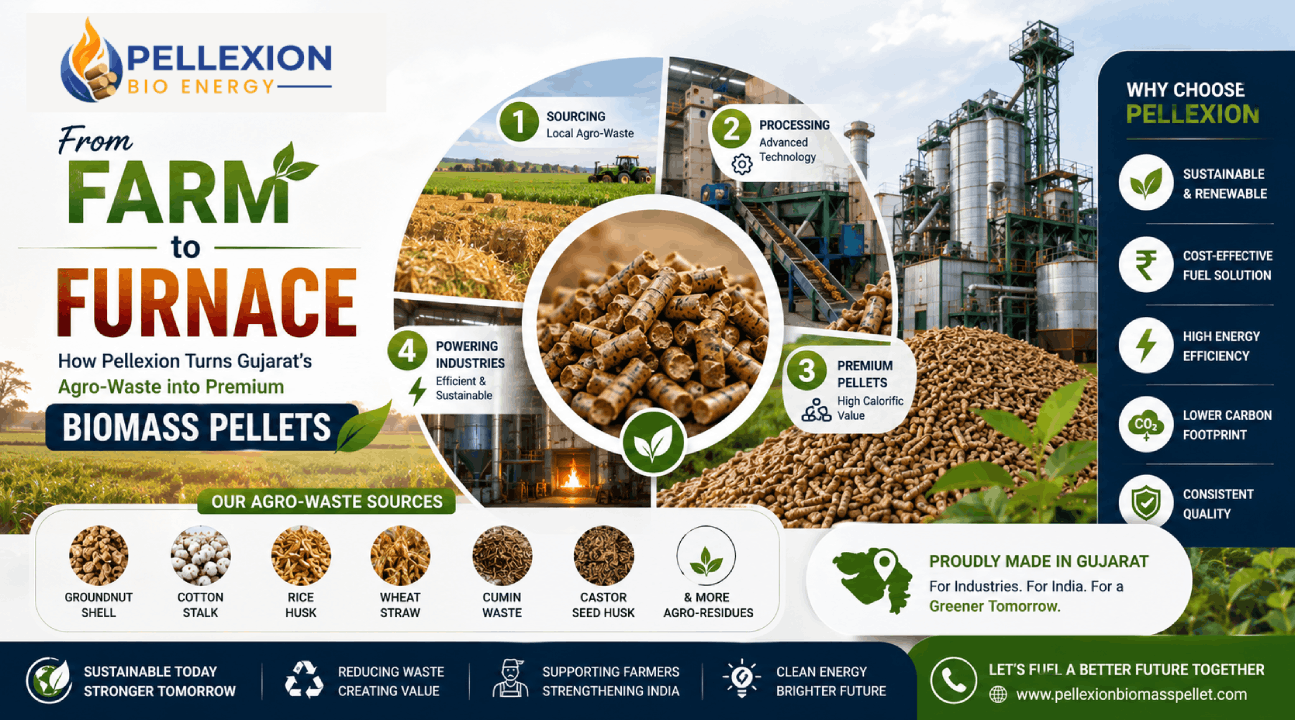
Fuel performance in the kiln starts with how consistently the pellet was made. At Pellexion Bio Energy, every batch goes through the same four-stage process before it is cleared for dispatch:
- 1
Raw material selection Groundnut shell, cotton stalk, coriander waste, and other agricultural residue sourced from across Saurashtra is inspected for moisture and contamination before it enters production.
- 2Crushing and grinding : Raw material is reduced to a uniform particle size, which is essential for a dense, evenly combusting pellet rather than a loose, inconsistent one.
- 3Pelletizing under high pressure : Ground material is compressed through industrial pellet mills, with natural lignin binding each pellet without any added chemicals.
- 4
Quality testing and dispatch : Each batch is checked for calorific value, ash content, and moisture before packaging, so every consignment delivered to a brick kiln meets the same fuel specification.
A practical roadmap for switching from coal to biomass pellets
Kiln owners rarely need to switch overnight, and a phased approach reduces the risk of disrupting a firing season. A realistic transition typically looks like this:
- 1Run a blended firing trial : Start by replacing 20–30 percent of coal by weight with biomass pellets in a single firing zone, keeping a close eye on temperature curves and brick output.
- 2Monitor ash and clinker build-up : Track how much less ash needs raking and whether clinker formation on the grate reduces — this is usually the first visible benefit.
- 3Adjust feed rate and scheduling : Because pellets combust differently than lump coal, firing teams typically fine-tune feed intervals over the first two to three firing cycles.
- 4Increase the biomass share : Once brick quality and firing temperature are confirmed stable, most operators increase the biomass ratio toward 50 percent or higher, and many move to full replacement over one to two seasons.
- 5
Lock in a seasonal supply contract : Agricultural residue availability varies by harvest season, so securing a standing supply agreement with a manufacturer like Pellexion Bio Energy avoids mid-season shortages.
Who else uses biomass pellets besides brick kilns
While this guide focuses on brick kilns, the same low-ash, high-heat fuel profile is why biomass pellets have found demand across several other industries operating in and around Rajkot and Saurashtra.





 Total views : 6873