
Table of contents
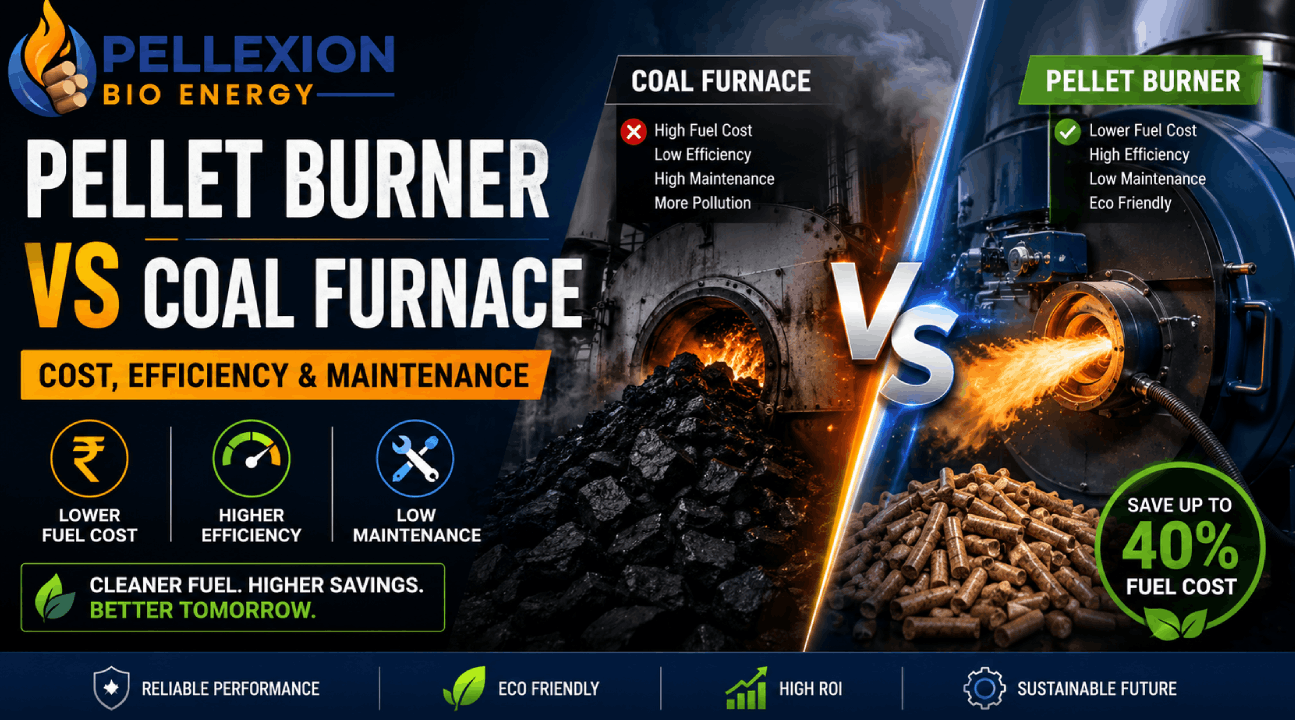
If you run a boiler, thermic fluid heater, or furnace on coal, you’ve probably done this math more than once: fuel is your biggest controllable cost, coal prices keep moving in the wrong direction, and every monsoon your ash disposal and downtime numbers get a little worse. The question isn’t whether to look at alternatives — it’s whether a pellet burner actually beats a coal furnace on the three things that matter to a plant manager: what it costs to run, how much usable heat you get per rupee, and how much labor and downtime it eats every month.
This guide walks through all three, with real formulas you can apply to your own boiler, a side-by-side comparison table, a step-by-step switching plan, and answers to the questions procurement officers and plant managers ask most often before they commit.
What Is a Pellet Burner?
A pellet burner is a combustion unit designed to burn compressed biomass pellets — made from agricultural residues like groundnut shell, cotton stalk, mustard husk, or mixed agro-waste — in a controlled, metered feed. Pellets are fed automatically from a hopper through a screw conveyor into the combustion chamber, where airflow and feed rate are tuned to keep the flame consistent. Because the fuel itself is uniform (fixed size, fixed moisture, fixed calorific value), the burner can hold a steady flame with far less manual adjustment than a solid-fuel furnace.
Pellet burners are increasingly used as retrofit units on existing coal-fired or wood-fired boilers, thermic fluid heaters, and furnaces — meaning many industries don’t need to replace their entire boiler, just the fuel feed and burner front end.
What Is a Coal Furnace?
A coal furnace burns raw coal — typically non-coking or imported coal in lump, crushed, or graded form — in a fixed or moving grate. Coal is manually or mechanically fed, and combustion depends heavily on lump size, moisture content, and how evenly the operator spreads the fuel bed. Because coal quality varies from batch to batch (ash content, sulphur, moisture), combustion efficiency swings from load to load, and the furnace typically needs an operator on hand to manage the fire, clean the grate, and remove clinker.
Coal furnaces are the default in most legacy Indian industrial setups — textile dyeing units, ceramic kilns, food processing boilers, brick kilns — largely because coal has historically been cheap, widely available, and the furnaces are simple to build and repair.
Pellet Burner vs Coal Furnace: Quick Comparison Table
| Parameter | Pellet Burner (Biomass) | Coal Furnace |
|---|---|---|
| Typical GCV (Gross Calorific Value) | 3,800–4,400 kcal/kg | 3,500–5,500 kcal/kg (highly variable) |
| Ash content | 2–8% | 15–35% |
| Moisture content | 8–12% | 5–20% (weather-dependent) |
| Combustion consistency | High — uniform fuel size | Low — depends on lump size & operator |
| Renewable | Yes | No |
| Price stability | Stable, domestically sourced | Volatile, import-linked |
| Feed system | Automated hopper + screw feed | Manual or semi-mechanical |
| Ash disposal | Low volume, often reusable | High volume, disposal cost |
| Emissions (SOx, particulate) | Low | High |
| Labor per shift | 1 operator (monitoring) | 2–3 operators (feeding, ash removal) |
| Storage footprint | Compact (pellets are dense) | Larger (coal + ash yard) |
| Retrofit possible | Yes, on most existing boilers | — |
Cost Comparison: Fuel Price, Per-Ton Heat, and ROI
Comparing fuel by price-per-kg is the single most common mistake plant managers make. A cheaper fuel with lower calorific value and lower combustion efficiency can cost more per unit of usable heat. The number that actually matters is cost per delivered kcal, not cost per kg.
The formula
Effective Fuel Cost per kcal = Fuel Price (₹/kg) ÷ (GCV in kcal/kg × Boiler Combustion Efficiency %)
Worked example
Say coal costs ₹9/kg with a GCV of 4,500 kcal/kg, and your furnace runs at roughly 65% combustion efficiency because of inconsistent lump size and manual firing.
Coal effective cost = 9 ÷ (4,500 × 0.65) = ₹0.00308 per kcal
Now take a biomass pellet at ₹8.5/kg with a GCV of 4,100 kcal/kg, burning at 82% efficiency in a pellet burner because feed and airflow are automated and consistent.
Pellet effective cost = 8.5 ÷ (4,100 × 0.82) = ₹0.00253 per kcal
Even though the pellet’s raw price per kg is lower and its GCV is lower than coal’s, the effective cost per kcal is roughly 18% lower — purely because combustion efficiency is higher and more consistent. Run this formula with your own boiler’s actual efficiency (from your last boiler efficiency test) and your local coal and pellet quotes before deciding; the gap narrows or widens depending on your specific numbers.
What drives the cost gap
Efficiency Comparison: Calorific Value, Combustion, and Boiler Output
Calorific value (GCV) tells you the fuel’s energy potential — but it’s combustion efficiency that tells you how much of that potential actually turns into steam or process heat. This is where the two fuels diverge most sharply.
Coal’s efficiency problem is variability.
Lump size, moisture, and ash content shift from delivery to delivery, and a furnace tuned for one batch is under- or over-fired for the next. Manual stoking means the fuel bed is rarely even, leading to cold spots, incomplete combustion, and higher stack losses. Boiler efficiency tests on coal-fired systems in Gujarat commonly show a working range of 55–70%, well below the fuel’s theoretical potential.
Pellet burners are engineered for consistency.
Because pellets are manufactured to a fixed diameter, fixed moisture band (8–12%), and tested GCV, the burner’s air-fuel ratio can be tuned once and held — automated feed keeps the flame steady instead of pulsing with each shovel-load. This typically pushes working combustion efficiency into the 78–85% range on a well-maintained system.
The practical effect: even when coal’s raw GCV number looks higher on paper, the delivered heat per kg of fuel purchased often favors pellets once real-world combustion efficiency is factored in — which is exactly why the cost-per-kcal calculation in Section 4 matters more than the cost-per-kg comparison most suppliers lead with.
Maintenance Comparison: Ash, Downtime, and Labor
Fuel cost gets the attention, but maintenance load is where many plant managers feel the difference first.
Coal furnace maintenance reality
Pellet burner maintenance reality
The net effect over a month: fewer labor-hours per ton of fuel burned, less unplanned downtime, and a smaller, easier-to-manage waste stream.
Emissions & Compliance
Gujarat Pollution Control Board (GPCB) and central emission norms have been tightening steadily, and coal-fired units are increasingly the ones flagged first during inspections. Coal combustion produces higher SOx, higher particulate matter, and higher ash-related pollution load than biomass. Biomass pellets, being a renewable, low-sulphur fuel, generally make it easier to stay within particulate and SOx limits without heavy investment in additional pollution control equipment — a factor that’s pushed a growing number of Rajkot, Morbi, and Ahmedabad industrial units toward biomass in the last two years, alongside the straightforward fuel cost case.
If your unit is facing a compliance deadline or an upgrade notice from GPCB, it’s worth getting your current stack emissions tested against biomass combustion benchmarks before you decide between a pollution-control retrofit for coal and a fuel switch to biomass — the second option often resolves the compliance issue and the cost issue at the same time.
Step-by-Step: How to Switch From a Coal Furnace to a Pellet Burner
Switching fuel isn’t an overnight decision, but it’s a far more contained project than most plant managers expect — especially as a retrofit rather than a full boiler replacement.
Step 1 — Get your current boiler efficiency tested.
Run a Direct Method or Indirect Method boiler efficiency test on your existing coal-fired system. This gives you the real baseline number to plug into the cost-per-kcal formula in Section 4, instead of relying on the boiler’s rated (nameplate) efficiency.
Step 2 — Check boiler and furnace compatibility.
Most coal-fired boilers, thermic fluid heaters, and furnaces can accept a pellet burner retrofit, but grate design, chamber size, and draft need a quick compatibility check by the supplier against your boiler’s make, model, and rated capacity.
Step 3 — Estimate your monthly pellet requirement.
Based on your current monthly coal consumption and the GCV/efficiency numbers from Steps 1 and the pellet supplier’s test certificate, calculate your expected monthly pellet tonnage. This is also the number your supplier needs to plan supply and pricing.
Step 4 — Request pellet samples and a quality test certificate.
Ask for GCV, ash content, and moisture test results on the specific batch you’ll be supplied — not generic brochure numbers. A credible supplier will provide this without hesitation.
Step 5 — Plan the retrofit and installation window.
Pellet burner installation on an existing boiler is typically a short shutdown window, not a full plant stoppage. Schedule it around a planned maintenance day to avoid production loss.
Step 6 — Set up storage and supply logistics.
Pellets are denser and cleaner to store than coal — plan a dry, covered storage area and confirm delivery frequency and minimum order quantities with your supplier, especially ahead of monsoon season when road logistics slow down.
Step 7 — Run a trial batch and re-test boiler efficiency.
Once installed, run the system for 1–2 weeks and re-test combustion efficiency. Compare the actual numbers against your Step 1 baseline and the projected savings — this is your real ROI figure, not the estimate.
Step 8 — Lock in a supply agreement.
Once trial results confirm the savings, move to a monthly or quarterly supply agreement with agreed volume, price, and quality specifications to protect against supply gaps.
Which One Should You Choose?
There isn’t a single right answer for every plant — but the pattern across most industrial users in Gujarat is consistent:
For most boilers, furnaces, and thermic fluid heaters running on a size that food processing, textile, ceramic, brick kiln, or chemical units typically use, the retrofit cost is recovered from fuel and ash-disposal savings well within the first year — which is why the switch has accelerated across Rajkot, Jamnagar, Morbi, and Ahmedabad’s industrial belts.
Real Numbers From Gujarat’s Industrial Belts
Numbers land differently when they come from the same industrial corridors you’re operating in, so here’s how the coal-to-pellet comparison typically plays out across the sectors most common in Rajkot, Jamnagar, Morbi, and Ahmedabad.
Ceramic and tile units (Morbi belt):
Ceramic kilns run near-continuously and are highly sensitive to fuel consistency, since uneven heat directly affects tile quality and reject rates. Coal’s variable lump size and moisture create the exact kind of heat inconsistency that shows up as batch-to-batch quality variation. Pellet burners’ steady combustion band is one of the main reasons ceramic units have been early adopters of biomass fuel switching.
Textile and dyeing units (Surat, Rajkot):
Dyeing and processing units need stable steam pressure for consistent dye uptake and fabric quality. Where these units previously ran on diesel or coal, the swing toward biomass pellets has been driven as much by price stability as by the efficiency argument — diesel and coal both carry import-linked volatility that pellets, sourced from regional agricultural residue, are largely insulated from.
Brick kilns:
Kilns are especially sensitive to ash content, since high-ash coal fouls the combustion zone and increases both fuel consumption and cleaning frequency. Low-ash biomass pellets reduce that fouling significantly, which is part of why brick kiln operators moving off coal often report the ash-and-cleaning-labor savings as being just as significant as the raw fuel cost savings.
Food processing and dairy plants:
These units typically run boilers for steam-heavy processes like pasteurization, sterilization, and drying, and are increasingly under buyer and export-compliance pressure to document a lower-emissions fuel source. Biomass pellets satisfy both the operational requirement (consistent steam) and the compliance requirement (lower SOx and particulate output) at once.
Chemical process units (Vatva, Naroda, Ankleshwar):
Continuous-process reactors and thermic fluid heaters need dependable, steady heat with minimal unplanned stoppages. The combustion consistency of pellet burners — no clinker, no cold spots from uneven coal lumps — reduces the kind of unplanned furnace stoppages that are expensive in a continuous chemical process.
None of these are guarantees — your own savings depend on your boiler’s actual efficiency, your current coal price, and your monthly consumption. But the pattern across sectors is the same: fuel consistency and lower ash load translate into fewer quality and downtime problems, on top of the direct cost savings.
Common Mistakes Plants Make When Comparing the Two Fuels
Comparing price-per-kg instead of cost-per-kcal.
As shown in Section 4, a fuel that looks cheaper per kilogram can be more expensive per unit of delivered heat once GCV and real combustion efficiency are factored in. Always run the full formula, not just the sticker price.
Using rated (nameplate) boiler efficiency instead of tested efficiency.
Nameplate efficiency assumes ideal conditions that most coal-fired systems rarely hit in daily operation. A proper Direct Method or Indirect Method boiler efficiency test gives you the real number to plug into your cost comparison — without it, any savings projection is a guess.
Skipping the pellet quality test certificate.
Not all biomass pellets are made to the same specification. GCV, ash, and moisture content vary by raw material and manufacturing process. Always request a test certificate for the specific batch you’ll receive, not a generic brochure figure.
Underestimating storage requirements.
Pellets need dry, covered storage to hold their moisture specification — pellets left exposed to monsoon humidity lose calorific performance. Plan storage before the first delivery, not after.
Not planning the trial period.
A short trial run with re-tested combustion efficiency (Step 7 in the switching plan above) is the only way to confirm real-world savings for your specific plant. Skipping this step means committing to a full supply agreement on projected numbers alone.
FAQs
Final Word
The coal-versus-pellet decision comes down to one honest question: what is your fuel actually costing you per unit of usable heat, once you account for real combustion efficiency, ash disposal, and labor — not just the price per kg on the delivery note. For most industrial boilers, furnaces, and thermic fluid heaters running across Gujarat’s textile, ceramic, food processing, chemical, and brick kiln sectors, that full comparison consistently favors a pellet burner retrofit.
If you want that comparison run against your own boiler’s real numbers rather than general estimates, our team can do it for you — free, with no obligation to switch.






 Total views : 6879