
Table of contents
If your factory, kitchen, kiln, or boiler is still running on firewood, you’re probably paying for a fuel that quietly wastes a large share of its own energy before it ever reaches your process. Firewood’s real cost isn’t the price per kilogram on the delivery slip — it’s the moisture you’re paying to burn off, the ash and soot cleanup, the storage losses, and the manpower it takes to keep feeding an inconsistent fuel. This guide walks through exactly where that money goes, what biomass pellets cost by comparison, and how to move your operation over without disrupting production.
The Hidden Cost of Firewood
Firewood has a reputation for being the “free” or “cheap” fuel — cut it, stack it, burn it. For a small household chulha, that reputation might hold up. For a boiler, furnace, kiln, or commercial kitchen running for hours every day, it rarely does, and here’s why.
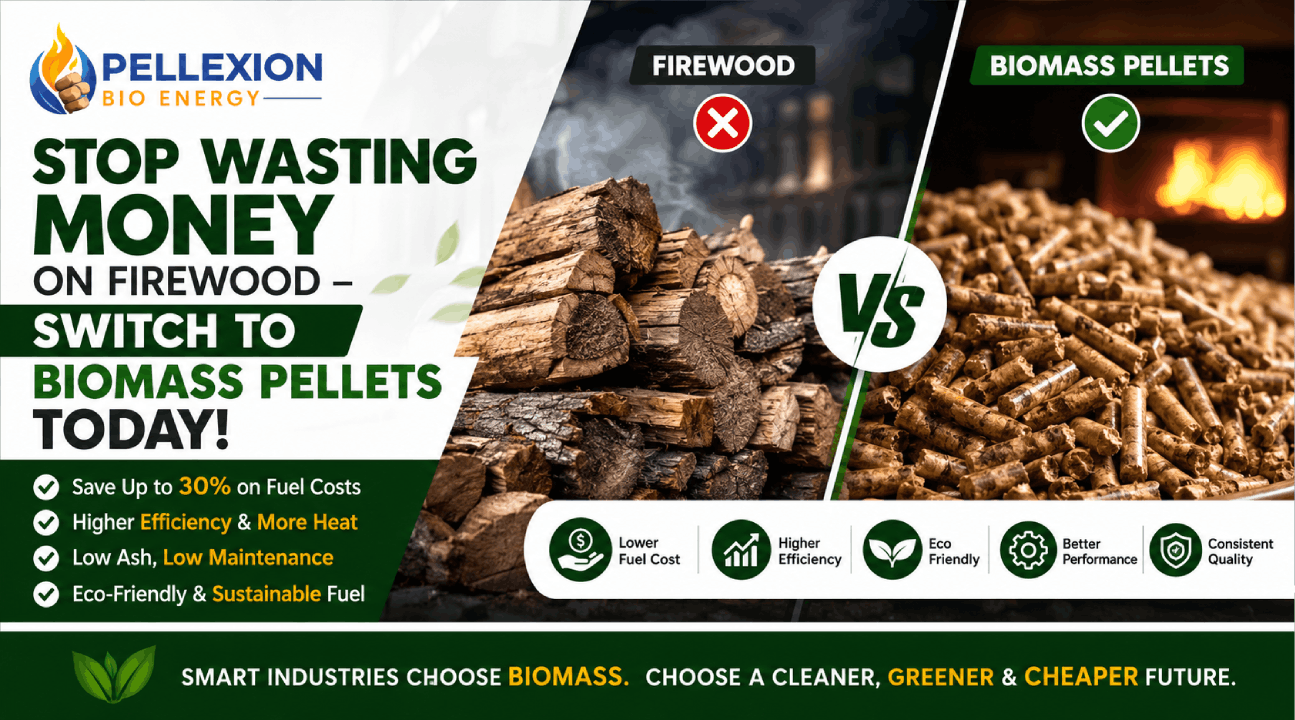
Fresh or poorly seasoned firewood typically holds anywhere from 30% to 45% moisture by weight. Before that wood produces a single unit of usable heat, a portion of the fuel’s own energy has to go into evaporating that trapped water. In practice, this means a meaningful share of every kilo of firewood you buy is spent drying itself, not heating your process. The wetter the log, the worse the trade.
Then there’s inconsistency. Firewood varies by species, cut, season, and supplier — one truckload burns hot and clean, the next is damp, uneven, and full of bark and offcuts. Operators end up over-feeding the furnace to compensate, which pushes up both fuel consumption and ash output.
Ash and soot are their own hidden line item. Firewood, especially unseasoned or mixed wood, tends to leave more residue than a processed fuel, which means more downtime for cleaning grates and flues, more wear on equipment, and more labour hours spent on housekeeping instead of production.
Finally, there’s storage and handling. Stacked firewood takes up significant yard space, reabsorbs moisture during monsoon, attracts pests, and needs manual loading that’s hard to standardize. None of this shows up on the fuel invoice — but it shows up in your operating costs every single month.
What Are Biomass Pellets?
Biomass pellets are a compressed, engineered fuel made from agricultural and wood residues — things like groundnut shell, cotton stalk, mustard husk, and other crop waste that would otherwise be burned in the field or discarded. The raw material is dried, ground to a fine, uniform particle size, and compressed under high pressure into small, dense cylinders, typically without any binding chemicals. The natural lignin in the biomass itself holds the pellet together.
The result is a fuel that behaves nothing like a stack of logs. Pellets are dried to below roughly 10% moisture during manufacturing, so almost all of their stored energy goes toward producing heat instead of evaporating water. They’re also uniform in size and density, which means a boiler or furnace burns them predictably, batch after batch — something firewood, by its very nature, can’t offer.
At Pellexion Bio Energy, biomass pellets are manufactured from responsibly sourced agricultural waste using a structured process — raw material selection, crushing and grinding, high-pressure pelletizing, and strict quality testing before dispatch — so every batch that leaves the facility meets a consistent calorific and moisture standard. You can read more about how the pellets are made on our manufacturing process.
Firewood vs Biomass Pellets: Full Comparison
Here’s how the two fuels stack up across the factors that actually determine your monthly fuel spend, not just the price tag on the delivery note.
| Factor | Firewood | Biomass Pellets |
|---|---|---|
| Moisture content | ~30–45% (fresh/poorly seasoned) | Below ~10% |
| Combustion consistency | Variable by species, cut, season | Uniform, batch-to-batch |
| Ash & soot output | Higher, more frequent cleanup | Low ash, cleaner burn |
| Storage footprint | Bulky, reabsorbs moisture | Compact, stable in dry storage |
| Handling & feeding | Manual, labour-heavy | Easier to automate/standardize |
| Supply consistency | Seasonal, deforestation-linked | Manufactured, year-round |
| Effective cost per unit of heat | Higher once moisture loss is factored in | Typically lower |
| Environmental impact | Tied to tree-cutting in many regions | Made from crop residue, reduces field burning |
The key column to focus on isn’t price per kilogram — it’s effective cost per unit of usable heat. That single number is what actually determines your fuel bill at the end of the month, and it’s the number firewood consistently loses on.
The Real Savings Math
To see why the “cheaper” fuel on paper often isn’t cheaper in practice, it helps to walk through the logic rather than just quoting a headline percentage.
Say a facility burns a fixed quantity of firewood every day to hold a boiler at a target temperature. A meaningful share of that firewood’s mass is water. That water has to be heated and evaporated before the wood fibre itself starts contributing usable heat — energy that is, in effect, spent and lost. To reach the same process temperature, the operator typically has to feed in more firewood than the “theoretical” fuel requirement would suggest, simply to cover this moisture penalty.
Biomass pellets, already dried to a low, stable moisture level, skip most of that penalty. A comparable quantity of pellets delivers more of its stored energy directly as heat, which means fewer kilograms are needed to hold the same temperature over the same run time.
Rule of thumb: when comparing fuels, always convert to cost per unit of delivered heat (for example, cost per lakh kcal), not cost per kilogram. A fuel that’s 10% cheaper per kilo but 30% wetter can easily end up costing more per unit of heat delivered to your process.
Add in the secondary savings — less time spent clearing ash, less warehouse space, more predictable procurement — and the total cost gap between firewood and biomass pellets tends to widen further once a facility has been running on pellets for a full billing cycle. For a detailed, numbers-first breakdown specific to biomass pellets versus firewood, see our companion analysis: How Much Can You Save Using Biomass Pellets vs Firewood?
7 Reasons Businesses Are Switching
1. Lower effective fuel cost
Once moisture loss, ash cleanup, and handling labour are factored in, pellets generally cost less per unit of usable heat than firewood — the single biggest driver behind most switches.
2. Predictable, budget-friendly pricing
Firewood pricing swings with season, local supply, and even monsoon disruptions. Manufactured biomass pellets come from a controlled supply chain, which makes monthly fuel budgeting far more predictable.
3. Consistent combustion, every batch
A boiler operator shouldn’t have to guess how a fuel load will burn. Uniform pellet size and moisture content mean consistent flame behaviour and consistent output, batch after batch.
4. Less labour, less downtime
Pellets are easier to store, transport, and feed than irregular logs, which reduces manual handling time and the frequency of ash and soot cleanup — freeing staff for higher-value work.
5. Smaller storage footprint
Dense, uniform pellets take up far less yard or warehouse space than an equivalent energy value in stacked firewood, which matters for facilities with limited real estate.
6. Cleaner combustion
Lower ash and moisture content mean less smoke and soot, which is easier on both equipment (less flue and grate wear) and the people working around the furnace.
7. A renewable fuel made from waste, not trees
Biomass pellets are manufactured from agricultural residue — material that would otherwise be burned in the field or discarded — rather than cut timber, making them a genuinely renewable substitute for firewood.
How to Switch: Step by Step
Moving an operation off firewood doesn’t need to be disruptive. Most facilities can complete the transition in a matter of weeks by following a structured process:
Industries Best Suited to Pellets
While almost any facility burning firewood for heat can benefit, some industries see the switch pay off especially fast:
You can see how pellets are already being used across these sectors on our industries.
Where to Buy Biomass Pellets Near You
Pellexion Bio Energy is headquartered in Gujarat, with the deepest supply coverage across cities like Ahmedabad, Surat, Vadodara, Rajkot, Bharuch, and Ankleshwar. Beyond Gujarat, dispatch support extends pan-India, covering Maharashtra, Rajasthan, Punjab, Haryana, Madhya Pradesh, Chhattisgarh, Karnataka, Tamil Nadu, Uttar Pradesh, and West Bengal. If your city isn’t on the list, that generally just means it hasn’t been added yet — supply can still be arranged. Check the full breakdown on the Our Locations, or reach out directly for a delivery quote to your facility.
Common Switching Mistakes to Avoid
Why Choose Pellexion Bio Energy
Pellexion Bio Energy manufactures biomass pellets and briquettes from responsibly sourced agricultural waste, using a structured process — raw material selection, crushing and grinding, high-pressure pelletizing, and batch-level quality testing — built to deliver consistent calorific value, low ash, and low moisture in every dispatch. That consistency is exactly what makes the switch from firewood worthwhile: a fuel you can plan around instead of one you have to compensate for.
The team also supports procurement planning, trial batches for new customers, and pan-India dispatch, so switching over doesn’t mean navigating the transition alone. Explore the full product range on the Products, or send over your monthly volume for a bulk quote.
Frequently Asked Questions
Firewood might still make sense for very small, occasional use. But for any operation running a boiler, furnace, or kiln day after day, the fuel that “looks” cheapest on the delivery note is rarely the one that’s cheapest on the monthly statement. Run the trial batch, do the cost-per-unit-of-heat math for your own numbers, and see where you land.





 Total views : 6806