
Table of contents
Coal is getting more expensive and harder to justify on paper. Here’s the real cost, compliance, and combustion case behind the shift happening across Vatva, Naroda, Odhav, and Narol.
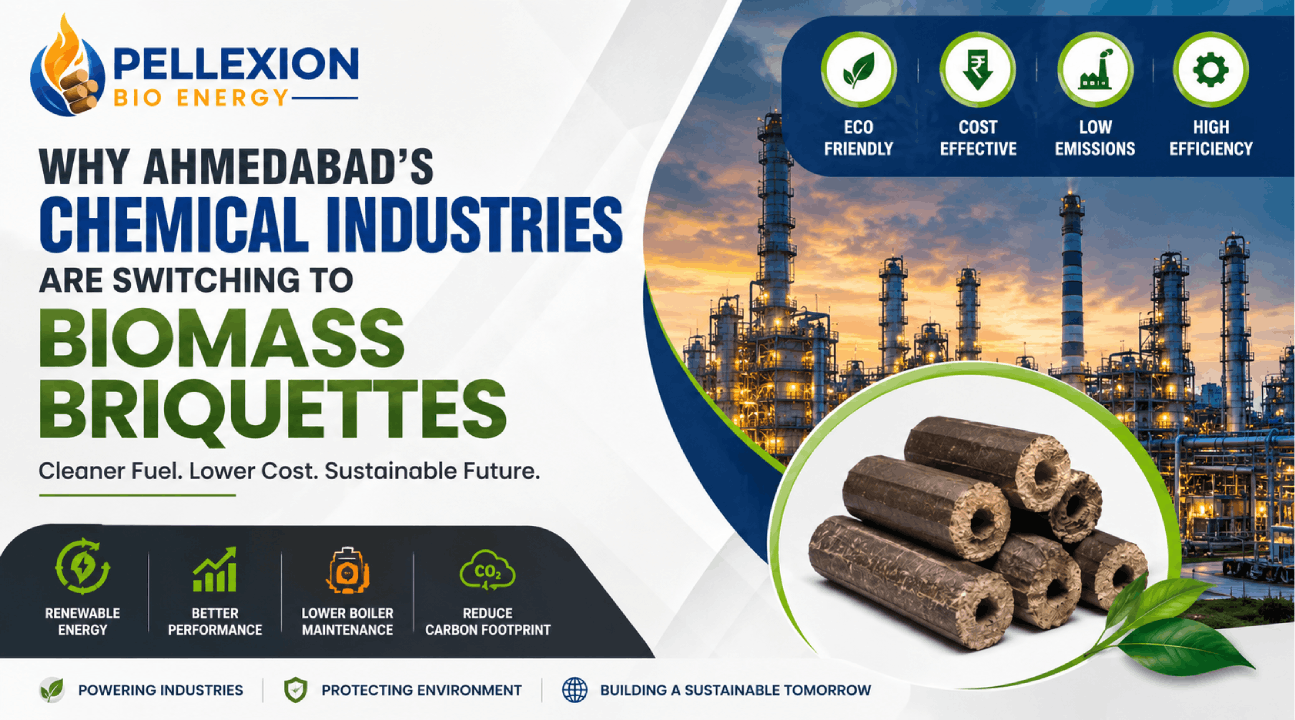
Drive through Vatva, Naroda, Odhav, or the Narol-Aslali stretch on any given morning and you’ll see the same thing you saw five years ago: rows of dye, pigment, pharma intermediate, and specialty chemical units, each with a boiler chimney doing the quiet, unglamorous work of turning fuel into steam. What has changed is what’s going into that firebox. Where coal trucks used to queue at the gate, a growing number of Ahmedabad’s chemical manufacturers are now taking delivery of something that looks nothing like coal at all — dense, cylindrical, biscuit-brown blocks made almost entirely from crushed agricultural waste. These are biomass briquettes, and they are quietly becoming the default industrial fuel for a large slice of Gujarat’s chemical belt.
This isn’t a sustainability trend borrowed from a corporate ESG slide. It’s a fuel-procurement decision being made by plant managers who are tired of coal price swings, tired of ash disposal headaches, and increasingly worried about GPCB emission compliance. This article walks through exactly why the switch is happening, what the real numbers look like, and what a chemical unit in Ahmedabad needs to know before making the change.
The Changing Energy Landscape for Gujarat’s Chemical Sector
Ahmedabad’s chemical industry runs on steam. Dyeing, distillation, reactor heating, drying, and effluent treatment all depend on a boiler that never really stops. For decades, imported and domestic coal was the default answer — cheap enough, widely available, and compatible with the fire-tube and water-tube boilers already installed across the industrial estates. That equation has been breaking down.
Coal prices out of Gujarat’s ports have grown noticeably less predictable over the past few years, tracking global shipping costs, import duties, and domestic supply constraints that a mid-sized chemical unit has no control over. At the same time, the Gujarat Pollution Control Board has been steadily tightening stack-emission and particulate norms for industrial boilers in and around Ahmedabad’s chemical clusters, several of which sit inside Critically Polluted Areas that already face closer scrutiny. A plant that could quietly run on high-ash coal a decade ago is now budgeting for emission control upgrades, consent-to-operate renewals, and the occasional show-cause notice.
Put those two pressures together — a fuel that costs more every quarter and a regulator that expects cleaner stacks every year — and biomass briquettes stop looking like an environmental nice-to-have. They start looking like the more rational fuel-procurement decision.
What Are Biomass Briquettes, Exactly?
Biomass briquettes are solid fuel blocks made by compressing agricultural and agro-industrial waste — groundnut shell, cotton stalk, mustard husk, sawdust, and general crop residue are the most common feedstocks in Gujarat — under extremely high pressure, typically in the range of 1,000 to 1,200 kg/cm² and elevated temperature. The pressure and heat cause the natural lignin in the plant material to soften and act as a binder, which means no chemical glue, resin, or additive is needed to hold the briquette together. The result is a dense, cylindrical block, usually around 90mm in diameter, with low moisture content and a calorific value that rivals many grades of commercial coal.
Because they’re made entirely from waste that would otherwise be burned in open fields, dumped, or left to decompose, briquettes are considered carbon-neutral: the carbon dioxide released during combustion is roughly equal to what the plant absorbed while growing. Combined with negligible sulphur content, that makes biomass briquettes a fundamentally cleaner-burning fuel than coal, without needing any exotic new burner technology to use them.
Briquettes aren’t a lab experiment or an emerging technology — they’re an established industrial fuel with a supply chain that already runs through Gujarat’s own agricultural belt. The switch is closer to changing a fuel supplier than adopting new equipment.
Eight Reasons Chemical Plants Are Making the Switch
No single factor explains the shift on its own. It’s the combination of cost, compliance, and operational reliability that’s tipping the decision for most Ahmedabad chemical units.
1. Fuel cost per unit of steam is genuinely lower
Gujarat biomass suppliers commonly report fuel-cost savings in the range of 30 to 40 percent compared to coal, once you account for the higher ash content and handling losses that come with lower-grade coal. Because briquettes burn more completely and leave far less residue, a chemical plant often gets more usable heat per rupee spent, even when the sticker price per kilogram looks similar.
2. Coal price volatility disappears from the budget
Coal pricing for Gujarat industries is exposed to import costs, freight rates, and national supply policy — none of which a plant finance team can forecast with confidence. Biomass briquettes are priced against a domestic agricultural residue market that tends to be far more stable year to year, which makes fuel-cost budgeting and quotation planning noticeably easier for chemical manufacturers working on tight margins.
3. GPCB compliance gets easier, not harder
Coal combustion produces sulphur dioxide, high particulate loads, and a meaningful volume of fly ash — all of which show up directly in stack-emission testing. Biomass briquettes contain near-zero sulphur and produce only 2 to 6 percent ash against coal’s much higher ash output, which reduces the load on existing pollution control equipment and makes it easier to stay comfortably inside GPCB emission limits without a capital-heavy retrofit.
4. Existing boilers barely need to change
This is the detail that convinces most reluctant plant engineers: briquettes are dimensioned to work in the same fire-tube and water-tube boilers already installed across Ahmedabad’s chemical units, typically in the 1 to 20 TPH range that dominates the sector. Most conversions require only minor adjustments to the fuel feeding and grate system rather than a new boiler purchase.
5. Ash disposal stops being a daily problem
Coal ash disposal is a recurring operational cost and, increasingly, a compliance liability — improperly stored fly ash draws regulatory attention fast. Because briquettes leave a fraction of the ash coal does, plants spend less time and money on ash handling, transport, and disposal documentation.
6. It closes the loop with Gujarat’s own agricultural belt
Groundnut shell, cotton stalk, and crop residue are produced in enormous volumes across Saurashtra and North Gujarat every harvest season. Historically, a large share of that residue was burned in open fields — a practice that contributes directly to regional air quality problems. Biomass briquetting converts that same waste into industrial fuel, which means every tonne a chemical plant burns is a tonne that didn’t go up in smoke in a farmer’s field. That’s a genuinely circular story, and it’s one that’s increasingly relevant for ESG reporting and export-buyer sustainability questionnaires.
7. Supply has caught up with demand
A few years ago, briquette supply in Gujarat was patchy enough that plants worried about running short mid-production. That’s changed. Established manufacturers now run dedicated briquetting lines with multi-tonne monthly capacity and structured quality testing, and industry reporting points to roughly 40 percent annual demand growth from the textile, chemical, and food-processing sectors combined — a sign that supply chains have matured enough to support continuous industrial use, not just occasional trial runs.
8. It’s a hedge against future regulation, not just current rules
Emission norms in industrial Gujarat have moved in one direction for the past decade — tighter. Chemical plants that switch to a fundamentally lower-emission fuel now are effectively future-proofing their consent-to-operate renewals, rather than scrambling to retrofit emission control systems every time the goalposts move.
The plants making the switch aren’t chasing a green label. They’re chasing a fuel bill and a compliance file that are both easier to defend next quarter, and the quarter after that.
Biomass Briquettes vs. Coal vs. Diesel
Laid out side by side, the operational case for biomass briquettes in a chemical-plant boiler room becomes easier to see at a glance.
Fuel comparison for industrial boiler use — Gujarat chemical sector
| Parameter | Biomass Briquette | Coal | Diesel |
|---|---|---|---|
| Calorific Value | 3,800–4,500 kcal/kg | 3,500–5,000 kcal/kg | ~10,700 kcal/kg |
| Ash Content | 2–6% | 15–40% | Negligible |
| Sulphur Content | Near zero | Moderate–High | Moderate |
| Price Stability | Stable, domestic supply | Volatile, import-linked | Highly volatile |
| Renewability | Yes — agro-waste | No — fossil | No — fossil |
| Boiler Compatibility | Existing boilers, minor tuning | Existing boilers | Existing boilers |
| GPCB Compliance Load | Low | High | Moderate |
| Typical Cost per Delivered kcal | Lowest | Mid, rising | Highest |
Diesel remains useful for standby or precision-heating applications where instant ignition matters more than cost, but for continuous, high-volume steam generation — which is exactly what most chemical process heating requires — biomass briquettes now sit in a genuinely competitive position against coal on almost every axis except raw calorific ceiling, and ahead of it on cost, compliance, and ash handling.
What the Savings Actually Look Like
Numbers convince plant finance teams faster than sustainability language does, so here’s a simplified way to think about it. A mid-sized chemical unit running a 5 TPH boiler on coal typically burns several tonnes of fuel per day depending on load and boiler efficiency. If briquettes deliver a comparable calorific value at a lower and more stable per-kilogram cost, while also cutting ash-handling and disposal costs, the combined effect compounds over a full production year rather than showing up as a one-time saving.
The ash-content gap alone is worth pausing on. A plant burning 3 tonnes of coal a day at 25% ash is generating close to 750kg of ash to handle, store, and dispose of daily. At 4% ash, the same tonnage of briquettes generates a small fraction of that — fewer trips for the disposal contractor, less time lost to ash-pit cleaning, and one less line item for the environmental compliance file.
Where GPCB Norms Fit Into the Decision
Several of Ahmedabad’s chemical clusters — Vatva and Naroda among them — have long carried extra regulatory attention because of their industrial density and historical pollution load. Consent-to-operate renewals for units in these zones increasingly come with closer review of fuel type and stack-emission data, and plants that keep showing high particulate or sulphur readings face longer approval cycles and a higher chance of enforcement action.
Switching the primary boiler fuel to biomass briquettes doesn’t eliminate the need for proper stack monitoring or emission control equipment, but it does materially reduce the baseline pollutant load the plant has to manage in the first place. For plants that are already running electrostatic precipitators or bag filters designed for a certain ash loading, burning a lower-ash fuel also extends equipment life and reduces maintenance frequency — a second-order saving that rarely makes it onto the initial cost comparison sheet, but shows up clearly in the annual maintenance budget.
How a Chemical Plant Actually Transitions to Briquettes
The switch is far more operational than technical. Most plants move through the same sequence:
- 1Fuel audit. Calculate current daily coal consumption, boiler load pattern, and existing ash-handling cost so there’s a real baseline to compare against.
- 2Sample trial. Run a small batch of briquettes — most established Gujarat suppliers provide free samples with test reports — through the boiler on a low-risk shift to observe combustion behaviour and ash output firsthand.
- 3Feed and grate check. Assess whether the existing fuel-feeding mechanism and grate need minor adjustment for briquette size and burn rate; this is typically a small workshop job, not a boiler replacement.
- 4Supplier qualification. Lock in a manufacturer who can guarantee consistent moisture content, calorific value, and ash percentage batch to batch — inconsistent briquettes are the single biggest cause of a disappointing trial.
- 5Storage setup. Set aside a dry, ventilated storage area, since briquettes lose efficiency if they absorb ambient moisture; properly stored stock holds quality for one to two years.
- 6Phased ramp-up. Move from a partial fuel blend to full replacement over a few weeks, tracking steam output, fuel consumption, and stack readings at each stage.
Plants that follow this sequence typically reach full replacement within four to eight weeks, with minimal disruption to production schedules.
What to Look for in a Biomass Briquette Supplier in Ahmedabad
Not every supplier delivers the same product, and for a chemical plant running continuous shifts, an inconsistent fuel batch is far more disruptive than it would be for a smaller commercial boiler. When evaluating a biomass briquette manufacturer for industrial supply in and around Ahmedabad, it’s worth checking for:
Pellexion Bio Energy manufactures and supplies biomass pellets and briquettes from its Jamnagar facility to industrial and commercial buyers across Gujarat, including chemical, textile, ceramic, and food-processing plants. Every batch is tested for calorific value, moisture, and ash content before dispatch, and the team works directly with plant engineers during the trial and conversion phase to make the transition as low-friction as possible.
The Direction of Travel
None of this suggests coal disappears from Ahmedabad’s industrial estates overnight — plenty of units will keep it as a backup fuel for years. But the direction is clear enough to plan around: fuel costs are trending toward whichever option offers price stability, regulation is trending toward whichever option burns cleaner, and Gujarat’s own agricultural residue supply is trending toward exactly the feedstock that makes biomass briquettes work. Chemical manufacturers that make the switch early aren’t just cutting a fuel bill — they’re building a compliance and cost position that gets more valuable, not less, as norms keep tightening.





 Total views : 6879
Ahmedabad’s chemical shift to biomass briquettes is a brilliant strategy to reduce carbon tax liability while tackling volatile fossil fuel costs. The high calorific value and lower ash content make them viable for heating processes. This transition supports circular economy principles by effectively utilizing agricultural waste streams.
Thank you for sharing your valuable insights. We truly appreciate your perspective on how biomass briquettes can help Ahmedabad’s chemical industries reduce fossil fuel dependency, manage energy costs, and support a more sustainable circular economy. Your feedback is greatly appreciated!