
Table of contents
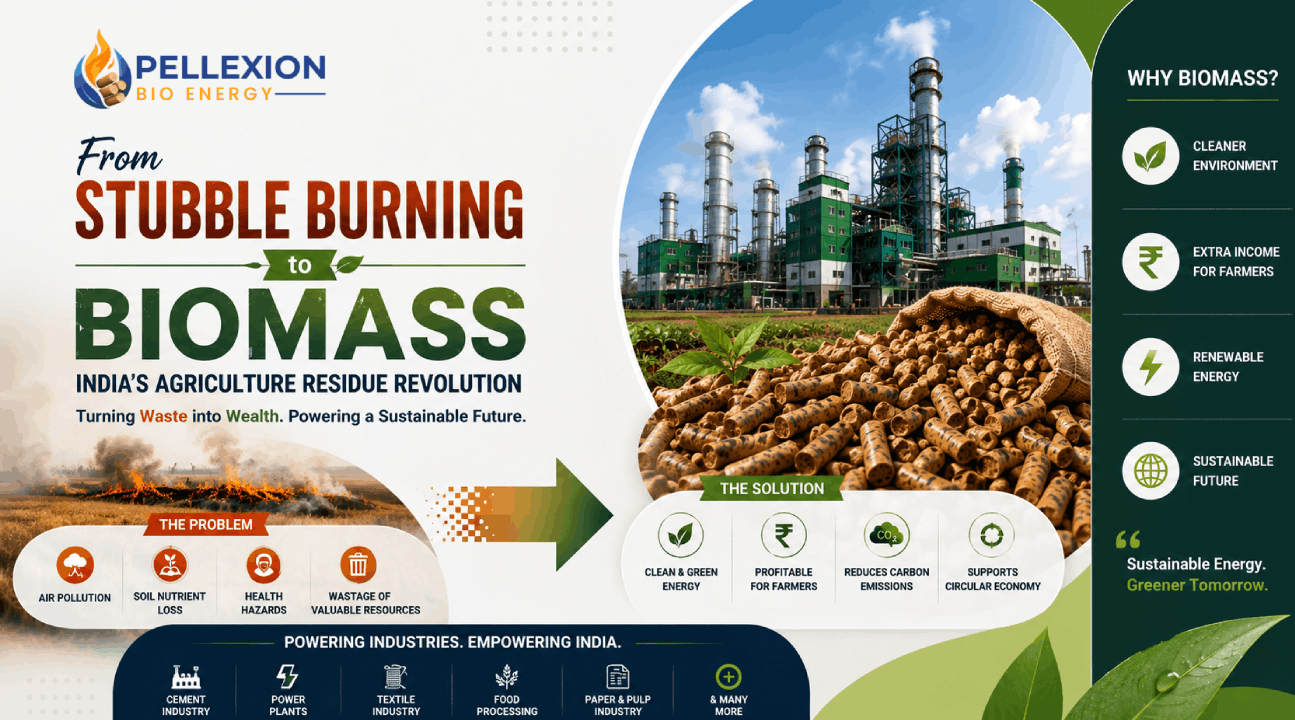
Every post-harvest season across India, millions of acres of farmland turn orange at night — not from sunsets, but from the flames of burning crop stubble. In Punjab, Haryana, Gujarat, and Madhya Pradesh, farmers burn leftover agricultural residue after harvest, a practice locally known as “parali” burning. The result? Delhi’s AQI spikes to “severe” levels for weeks. Hospitals fill up. Schools close. The economic and health cost runs into thousands of crores of rupees every year.
But there is a better way — and it starts right here in Gujarat.
At Pellexion Bio Energy, we convert this agricultural waste into premium-quality biomass pellets and briquettes that power industrial boilers across India. What was once a liability for farmers becomes a valuable raw material for clean energy. This is India’s Agriculture Residue Revolution — and you can be part of it.
🚜 What is Stubble Burning?
Stubble burning is the practice of setting fire to crop residues (like rice and wheat straw) left in the field after harvesting.
📌 Why Farmers Burn Crop Residue:
🌍 Environmental Impact of Stubble Burning
Stubble burning releases harmful pollutants and greenhouse gases.
🚨 Major Impacts:
Every tonne of agricultural residue burned in the open emits roughly 2.5–3 tonnes of CO₂ equivalent into the atmosphere. Multiply that by 140 million tonnes annually, and the scale of the environmental damage becomes clear.
Converting this waste into biomass fuel does not just solve a pollution problem — it creates an economic opportunity.
👉 Burning residue is not just wasteful—it’s destroying a valuable energy resource.
♻️ The Solution: Biomass Energy Revolution
Instead of burning, crop residues can be converted into:
🌱 Biomass Products:
These are clean, renewable, and cost-effective fuels for industries.
👉 Agricultural residue is now being recognized as a valuable raw material for energy production and industrial use.
The Economic Case for Farmers
When farmers sell their crop residue to biomass manufacturers instead of burning it, they create a new income stream from waste that had zero value before. Approximate market rates for agro-residue in Gujarat:
| Crop Residue | Column 2 |
|---|---|
| Cotton Stalks | ₹800 – ₹1,200 |
| Groundnut Shells | ₹600 – ₹900 |
| Coriander Waste | ₹700 – ₹1,000 |
| Mustard Stalk | ₹700 – ₹1,000 |
| Sawdust / Wood Chips | ₹1,200 – ₹1,800 |
For a medium-sized farmer with 5 acres under cotton cultivation, this represents ₹15,000–₹25,000 of additional income per harvest cycle — income that previously went up in smoke.
This isn’t charity. This is a genuine market-based solution where farmers, manufacturers, and industries all benefit.
⚡ How Biomass Pellets Are Changing India
Biomass pellets are made by compressing agricultural waste into high-density fuel.
Key Benefits:
🔥 Replaces coal and fossil fuels
💰 Reduces industrial fuel costs
🌿 Low carbon emissions
🚜 Creates extra income for farmers
♻️ Supports circular economyYour Content Goes Here
India is rapidly adopting biomass solutions through:
👉 This shift is transforming waste into wealth.
The Scale of India’s Agro-Waste Problem
India generates approximately 683 million tonnes of agricultural residue every single year. Of this massive volume, around 140–160 million tonnes are burned openly in fields. The primary contributors include:
Why do farmers burn this residue? Simple economics. They have a narrow window of just 2–3 weeks between harvesting one crop and sowing the next. Burning is the fastest and cheapest way to clear fields. Without a viable market for their crop residue, burning remains the default choice.
This is the problem that biomass manufacturers like Pellexion Bio Energy are solving at scale.
Government Support: From Punishment to Partnership
For years, the Indian government responded to stubble burning with fines and legal action — an approach that largely failed. Farmers still burned because they had no practical alternative. The policy has now shifted to an incentive-based model:
Central Government Initiatives:
Gujarat State Incentives:
These policies create the infrastructure for a viable biomass supply chain — connecting farmers, manufacturers, and industrial energy consumers.
🇮🇳 Government & Industry Initiatives
India is actively promoting biomass adoption:
🚀 Key Initiatives:
Recent developments show:
💼 Business Opportunity in Biomass Industry
The biomass sector is booming and offers huge opportunities:
📊 Market Opportunities:
👉 Companies like yours (Pellexion Biomass Pellet) play a key role in:
🔮 Future of India’s Bioenergy Sector
India is moving towards a green energy economy.
🌟 Future Trends:
The future is clear:
From pollution to profit—biomass is the next big revolution.
How Pellexion Bio Energy Converts Waste into Premium Fuel
At our facility in Kharedi, Kalavad, Jamnagar (Gujarat), we run a precision-driven manufacturing process:
Step 1
Raw Material Sourcing We source agricultural residue — groundnut shells, cotton stalks, coriander waste, and mixed agro-waste — directly from farmer networks and local cooperatives in Gujarat.
Step 2
Drying & Moisture Control Raw materials are dried to achieve the optimal moisture content (below 10%), which is critical for high-efficiency combustion.
Step 3
Crushing & Grinding Residue is processed through advanced crushing systems to achieve the ideal particle size for pelletization and briquetting.
Step 4
High-Pressure Pelletizing / Briquetting Materials are compressed under high pressure without any chemical binders, forming dense, uniform pellets and briquettes with high calorific value.
Step 5
Quality Testing & Dispatch Every batch is tested for GCV (Gross Calorific Value), ash content, moisture, and density before packaging and dispatch to industrial clients.
Our Biomass Pellet Specifications:
| Parameter | Column 2 |
|---|---|
| Gross Calorific Value (GCV) | 3,800 – 4,200 Kcal/kg |
| Ash Content | < 5% |
| Moisture Content | < 10% |
| Diameter | 6 mm / 8 mm |
| Density | > 600 kg/m³ |
The Circular Economy: Zero Waste, Maximum Value
The Pellexion Bio Energy model creates a true circular economy for Gujarat’s agriculture sector:
Gujarat farmers grow crops → Harvested crops feed people and industries → Crop residue is collected by Pellexion → Residue becomes premium biomass fuel → Fuel powers Gujarat’s factories → Combustion ash returns to farms as soil amendment
Every tonne of biomass pellets we produce prevents approximately 1 tonne of agro-waste from being burned in fields — and prevents 2.5–3 tonnes of CO₂ equivalent from entering the atmosphere.
Industries Powered by Pellexion Biomass Pellets
Our biomass pellets and briquettes serve industries across Gujarat and India that require reliable, cost-effective thermal energy:
🏭 Food Processing Industry
🧵 Textile Industry
💊 Pharmaceutical Industry
🧪 Chemical Industry
🏗️ Ceramic & Tile Industry
📄 Paper & Pulp Industry
🧱 Brick Kilns
🥛 Dairy Industry
🔩 Steel Re-Rolling Mills
🏨 Hotels & Restaurants
⚡ Power Generation Plants
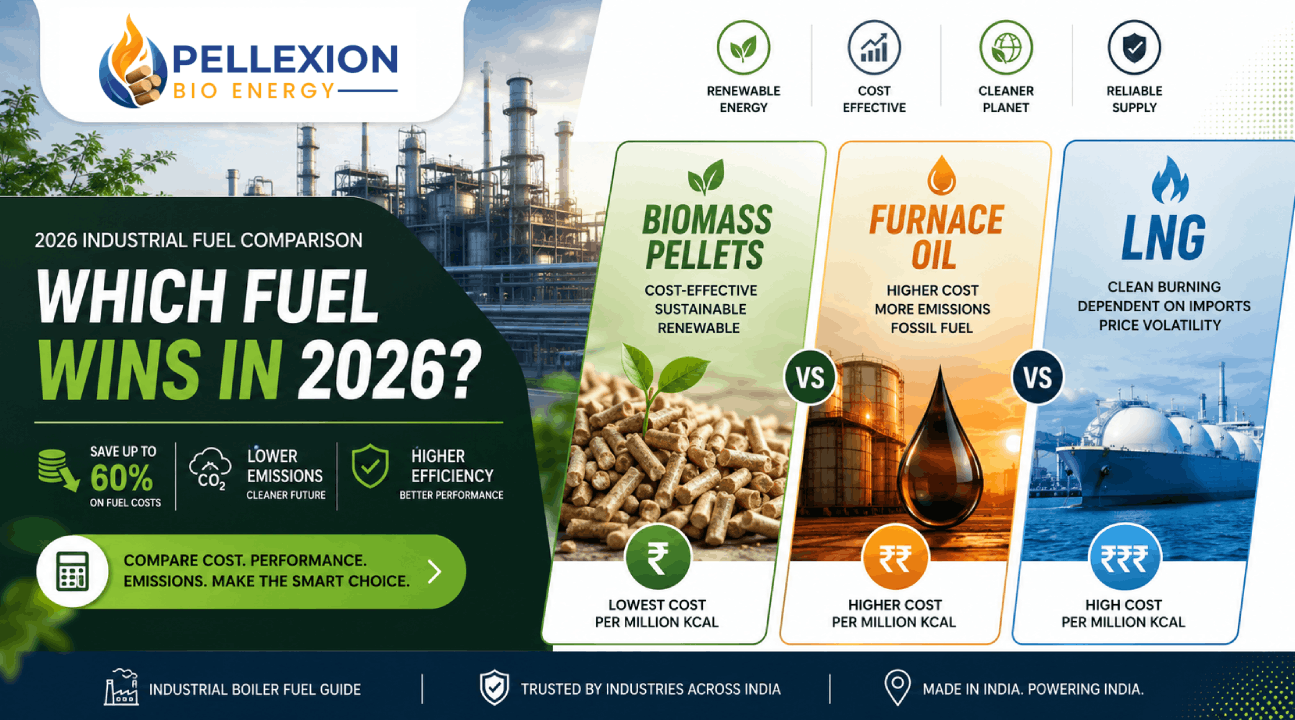
Why Biomass Pellets Are Better Than Coal
| Feature | Biomass Pellets (Pellexion) | Column 3 | Column 4 |
|---|---|---|---|
| Renewable | ✅ Yes | ❌ No | ❌ No |
| Emissions | ✅ Low | ❌ High | ❌ High |
| Ash Content | ✅ Low (< 5%) | ❌ High (15–40%) | – |
| Price Stability | ✅ More Stable | ⚠️ Fluctuating | ❌ Highly Volatile |
| Environmental Impact | ✅ Eco-Friendly | ❌ Polluting | ❌ Polluting |
| Carbon Footprint | ✅ Near Carbon-Neutral | ❌ High | ❌ Very High |
| Import Dependency | ✅ None (domestic) | ⚠️ Partially Imported | ❌ Mostly Imported |
Conclusion: The Revolution Has Begun
India’s agriculture residue problem is massive — but so is the opportunity. Every tonne of crop waste that is collected, processed, and converted into biomass fuel is one less fire on India’s farmlands, one less hospital visit, and one step closer to India’s clean energy targets.
Pellexion Bio Energy is proud to be part of this revolution — from the farms of Jamnagar and Gujarat to the boiler rooms of India’s industries.
If you are an industrial buyer looking for a reliable biomass fuel supplier, or a farmer cooperative interested in supplying agricultural residue, we would love to hear from you.





 Total views : 6794