
Table of contents
As industries increasingly adopt renewable energy solutions, biomass briquettes have become a reliable and sustainable fuel option for industrial heating systems. Many manufacturing plants, processing industries, and energy facilities are now using industrial biomass briquettes as an alternative to conventional fossil fuels.
Biomass briquettes are produced by compressing agricultural residues and organic biomass materials into dense fuel blocks. These briquettes provide consistent heat output and efficient combustion, making them suitable for industrial boilers and furnaces.
Because of their durability, energy density, and long burning cycle, biomass briquette fuel is widely used in industries seeking cost-effective and sustainable energy solutions.
What Are Biomass Briquettes?
Biomass briquettes are compressed blocks of organic biomass materials designed for use as industrial fuel. They are typically produced in cylindrical forms, such as 90mm briquettes, which allow steady combustion and long burning duration.
Unlike loose agricultural waste, briquettes are compact and easier to transport, store, and use in heating systems.
Key characteristics of biomass briquettes include:
These qualities make biomass briquette fuel a reliable energy source for many industrial applications.
Raw Materials Used for Biomass Briquettes
Biomass briquettes are manufactured using agricultural and organic biomass materials that are available in large quantities. These materials are considered renewable and help convert agricultural waste into useful energy.
Common raw materials used in industrial biomass briquettes include:
Using these materials allows industries to transform waste into efficient biomass briquette fuel while supporting sustainable resource utilization.
Biomass Briquette Production Process
The production of biomass briquettes involves several processing steps to ensure proper density and combustion efficiency.
1. Raw Material Collection
Agricultural residues and biomass waste are collected from farms and agro-processing industries.
2. Crushing and Grinding
The raw materials are crushed to achieve a uniform particle size suitable for briquetting.
3. Drying Process
Moisture content is reduced to improve the briquette quality and combustion performance.
4. Briquette Compression
The processed biomass is compressed under high pressure using briquetting machines to produce industrial biomass briquettes.
5. Cooling and Packaging
The briquettes are cooled and packed for safe storage and transportation.
This process converts raw biomass materials into high-density biomass briquette fuel for industrial energy use.
Industrial Applications of Biomass Briquettes
Biomass briquettes are widely used in industries that require consistent and long-duration heat generation.
Industries that commonly use industrial biomass briquettes include:
These industries rely on biomass briquettes to support thermal energy generation and industrial heating operations.
Advantages of Using Biomass Briquette Fuel
Many industries prefer briquettes because they provide a stable and renewable fuel solution.
Key advantages include:
As renewable energy adoption increases, biomass briquette fuel is becoming an important part of sustainable industrial energy systems.
Conclusion
Biomass briquettes are a practical and efficient renewable fuel option for industries that require reliable heat generation. Produced from compressed agricultural residues and organic materials, industrial biomass briquettes offer consistent combustion performance and long burning cycles.
By converting agricultural waste into biomass briquette fuel, industries can reduce dependence on fossil fuels while supporting sustainable energy practices.
As industries continue moving toward renewable energy solutions, biomass briquettes will play an important role in the future of industrial energy systems.





 Total views : 6794
We operate textile boilers in Surat. Can Pellexion supply groundnut shell briquettes in bulk? This guide helped us understand why biomass is better than coal for our production process.
This article clearly explains how biomass briquettes work for industrial use. Very helpful for companies looking to reduce coal dependency and shift to sustainable fuel in India. Great content, Pellexion!
Switching to biomass briquettes reduced our fuel costs significantly. This guide explains everything factories need to know about industrial biomass energy. Pellexion Bio Energy is clearly a reliable supplier from Gujarat.
Using agricultural waste as industrial fuel is a brilliant step toward sustainability. Biomass briquettes from Pellexion help reduce carbon emissions while providing consistent energy output. Highly recommended for eco-conscious industries across India.
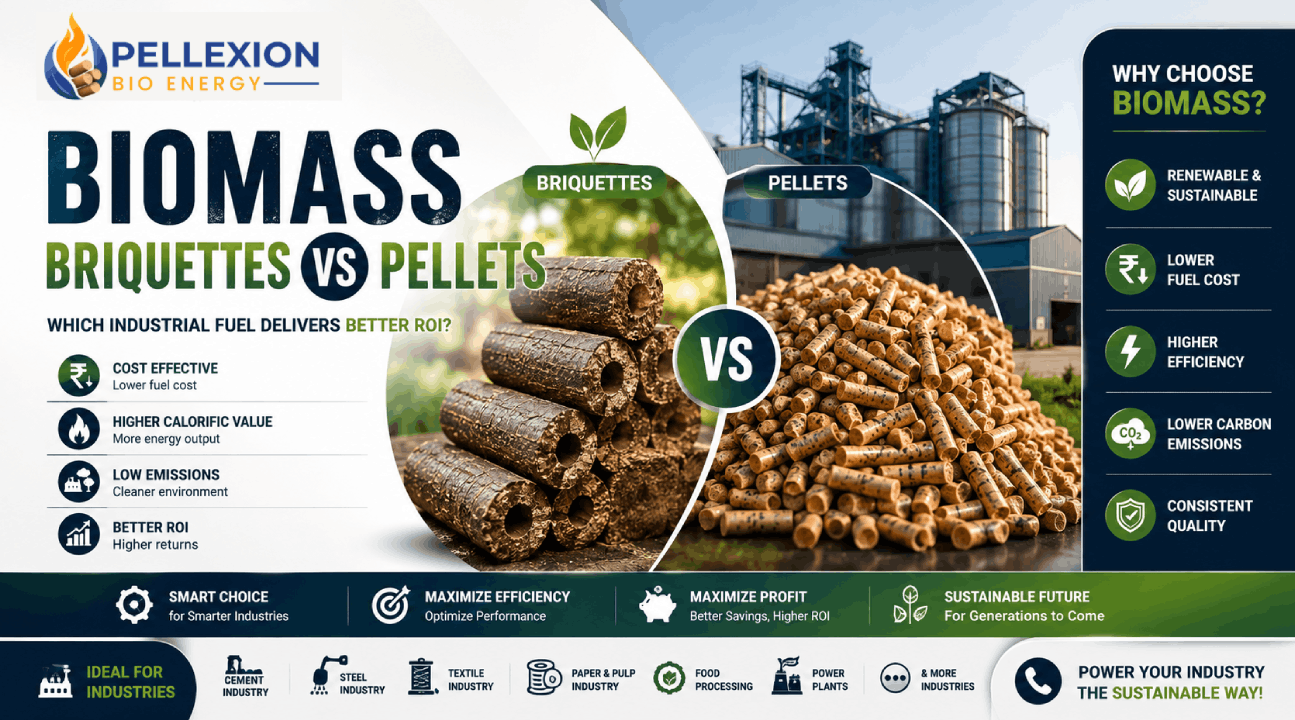
Would love a comparison blog between biomass pellets and briquettes next. Our food processing plant uses both and understanding the efficiency difference would really help us optimize costs. Great article overall!
Very informative article about biomass briquettes. We are a ceramic industry in Rajkot looking for reliable biomass fuel suppliers in Gujarat. Can you share pricing details for bulk industrial orders from Pellexion?