

Table of contents
If you’ve typed “biomass pellet manufacturer near me” into Google, you’re probably staring at a boiler that’s burning through your fuel budget, a procurement deadline, or a sustainability target you need to hit this quarter. You’re not alone — and you’re asking the right question. In India’s biomass fuel market, where your pellets come from matters almost as much as what they’re made of.
A manufacturer three states away might quote you a lower ex-factory price, but by the time freight, transit delays, and inconsistent batch quality are factored in, a local biomass pellet supplier is very often the smarter, cheaper, and more dependable choice. This guide walks you through exactly how to evaluate one — step by step, with the questions to ask, the red flags to avoid, and the numbers that actually matter.
Why “Near Me” Matters for Biomass Pellet Buyers
When plant managers search for a biomass pellet manufacturer near me, they’re usually optimizing for three things without realizing it: cost, consistency, and continuity of supply. Here’s why proximity affects all three directly.
Freight Is a Bigger Line Item Than Most Buyers Expect
Biomass pellets are bulky and relatively low-value per kilogram compared to their transport cost. A supplier 600 km away might quote ₹2 to ₹4 less per kg ex-factory, but once you add freight for a 20-25 MT truckload, that “discount” often disappears — or turns into a premium. A local biomass pellet manufacturer within a 150-300 km radius keeps your landed cost predictable and usually lower.
Consistency Depends on Raw Material Familiarity
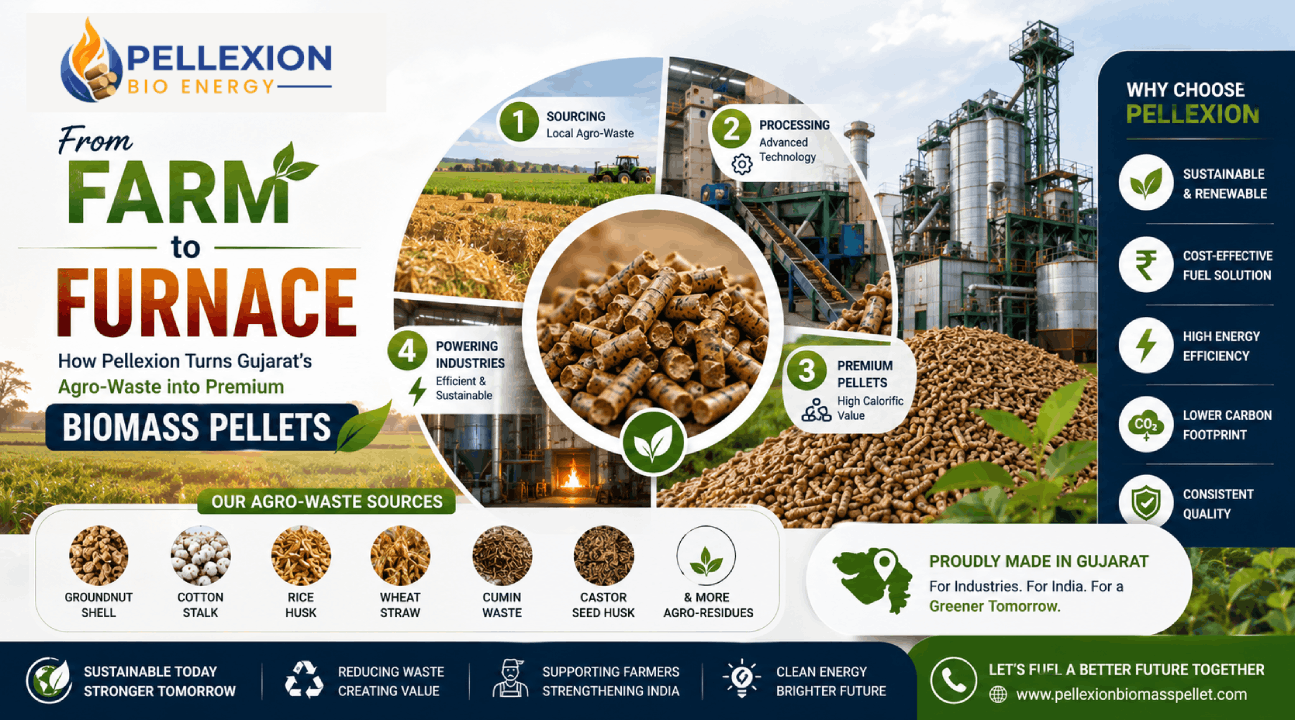
Every biomass pellet manufacturer sources from the agricultural residue available in their region — groundnut shell in Saurashtra, cotton stalk and agro-waste around Ahmedabad, coriander residue in parts of Gujarat’s belt. A local biomass pellet supplier near me search usually surfaces manufacturers who have refined their process around regionally available raw material, which tends to produce more batch-to-batch consistency than a distant plant sourcing unfamiliar residues to fulfil your order.
Continuity of Supply During Monsoon and Peak Season
Long-haul biomass logistics are vulnerable to monsoon delays, highway disruptions, and seasonal raw-material shortages. A nearby manufacturer can usually get a replacement batch to your boiler within hours, not days — which matters enormously if your furnace or boiler cannot afford downtime.
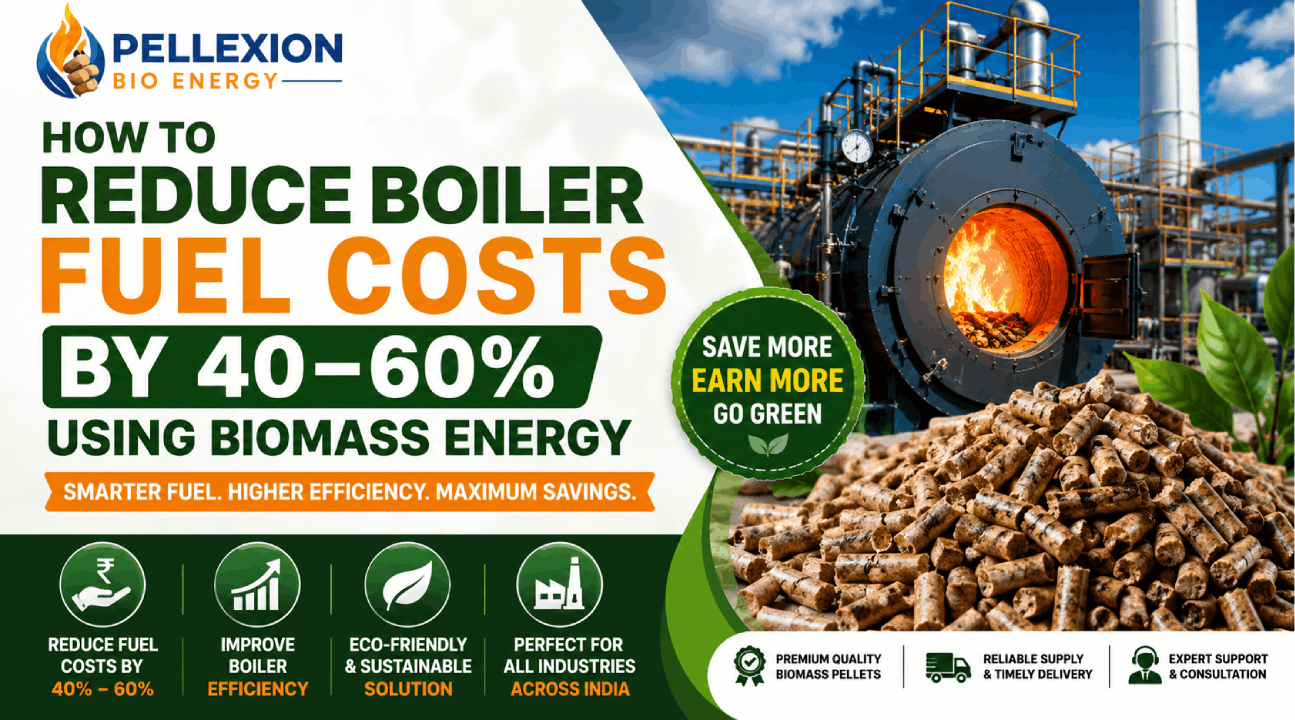
Read next: How to Reduce Boiler Fuel Costs by 40–60% Using Biomass Energy
What “Reliable” Actually Means: The 7-Point Checklist
“Reliable” gets thrown around a lot in supplier marketing. Here’s what it should actually mean when you’re evaluating a local biomass pellet manufacturer:
| # | Reliability Factor | Why It Matters | What to Check |
|---|---|---|---|
| 1 | Consistent GCV (Gross Calorific Value) | Determines actual heat output and fuel cost per unit of energy | Ask for lab-tested GCV reports, batch to batch |
| 2 | Low & Stable Ash Content | High ash increases furnace cleaning frequency and maintenance cost | Request ash content percentage in writing |
| 3 | Low Moisture Content | Wet pellets burn inefficiently and can jam feeders | Ask for moisture % — ideally under 10-12% |
| 4 | Proven Delivery Track Record | Prevents boiler downtime from missed dispatches | Ask for references from existing industrial clients |
| 5 | Production Capacity vs Your Volume | A supplier under-capacity for your order will short you during peak demand | Ask about monthly production tonnage |
| 6 | Proper Documentation (GST, quality certs) | Needed for your own compliance and audit trail | Request GST invoice and any BIS IS 17225 compliance data |
| 7 | Willingness to Provide a Trial Batch | Confidence in product quality shows in willingness to sample | Ask for a small trial order before committing to a bulk contract |
If a manufacturer can’t answer questions on even two or three of these points confidently, that’s worth noting before you sign a purchase order.
Step-by-Step: How to Find a Biomass Pellet Manufacturer Near You
Step 1: Map Your Delivery Radius First
Before searching, decide your acceptable delivery radius based on your factory’s fuel consumption rate. A high-consumption boiler (50+ MT/month) can usually justify a wider radius because bulk freight is more cost-efficient per tonne; a smaller unit should prioritize suppliers within 100-150 km.
Step 2: Search With Location-Specific Terms
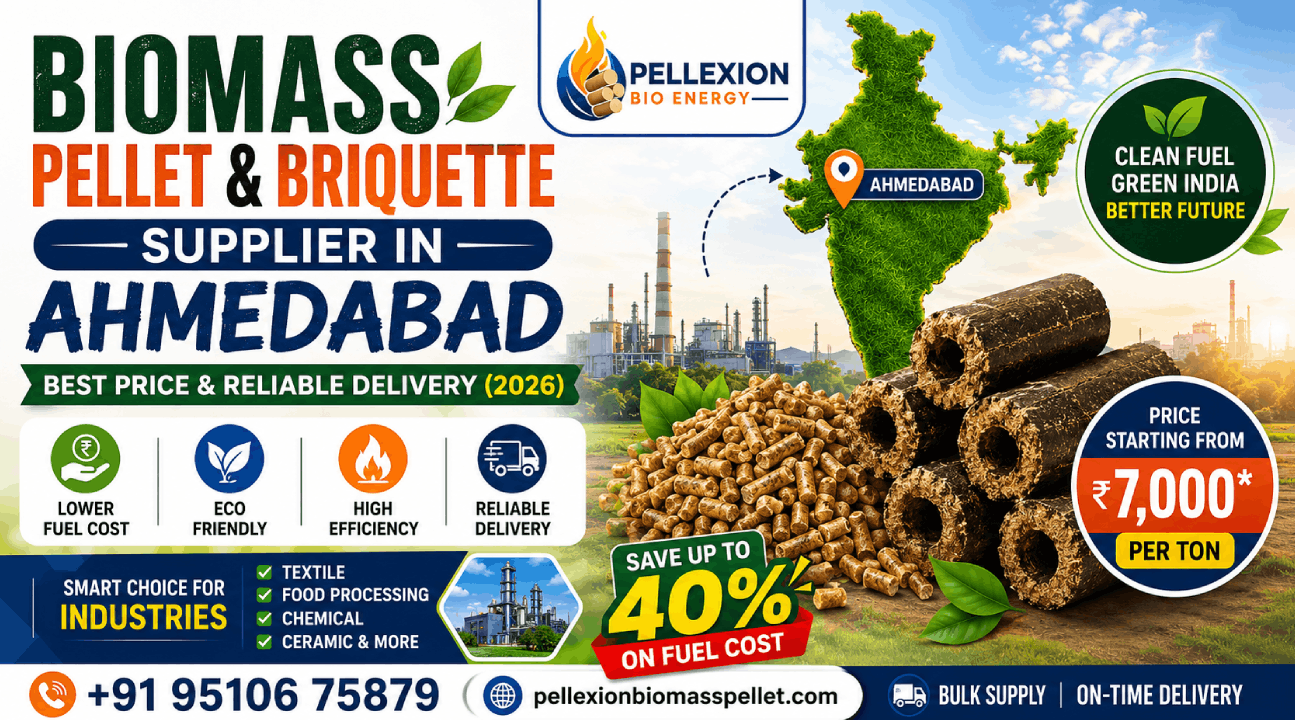
Instead of a generic search, use terms that match your actual need — for example, “biomass pellets supplier Ahmedabad near me,” “biomass pellet supplier in GIDC area near me,” or “biomass fuel suppliers Ahmedabad.” This surfaces manufacturers actively serving your industrial cluster, not just the biggest national brand.
Step 3: Shortlist 3-4 Manufacturers and Compare on Paper
Build a simple comparison sheet with GCV, ash %, moisture %, delivered price per ton, and MOQ for each shortlisted supplier. Avoid comparing on ex-factory price alone — it hides the real cost difference.
Step 4: Request Lab Reports, Not Just Verbal Assurances
A trustworthy industrial biomass pellets supplier in India will have third-party or in-house lab data for GCV, ash, and moisture readily available. If a manufacturer is reluctant to share this, treat it as a signal to look elsewhere.
Step 5: Order a Trial Batch Before Committing Long-Term
Run the trial batch through your actual boiler or furnace rather than judging on appearance. Track fuel consumption, ash residue, and combustion behavior over a few days before scaling to a full contract.
Step 6: Confirm Delivery SLAs in Writing
Ask for a written response-time commitment — for example, “quote within X business hours” and “dispatch within X days of confirmed order.” This becomes your reference point if delivery slips later.
Step 7: Set Up a Recurring Supply Agreement
Once you’re satisfied with quality and delivery, negotiate a monthly or quarterly volume agreement. This typically secures better per-ton pricing and priority dispatch during high-demand seasons.
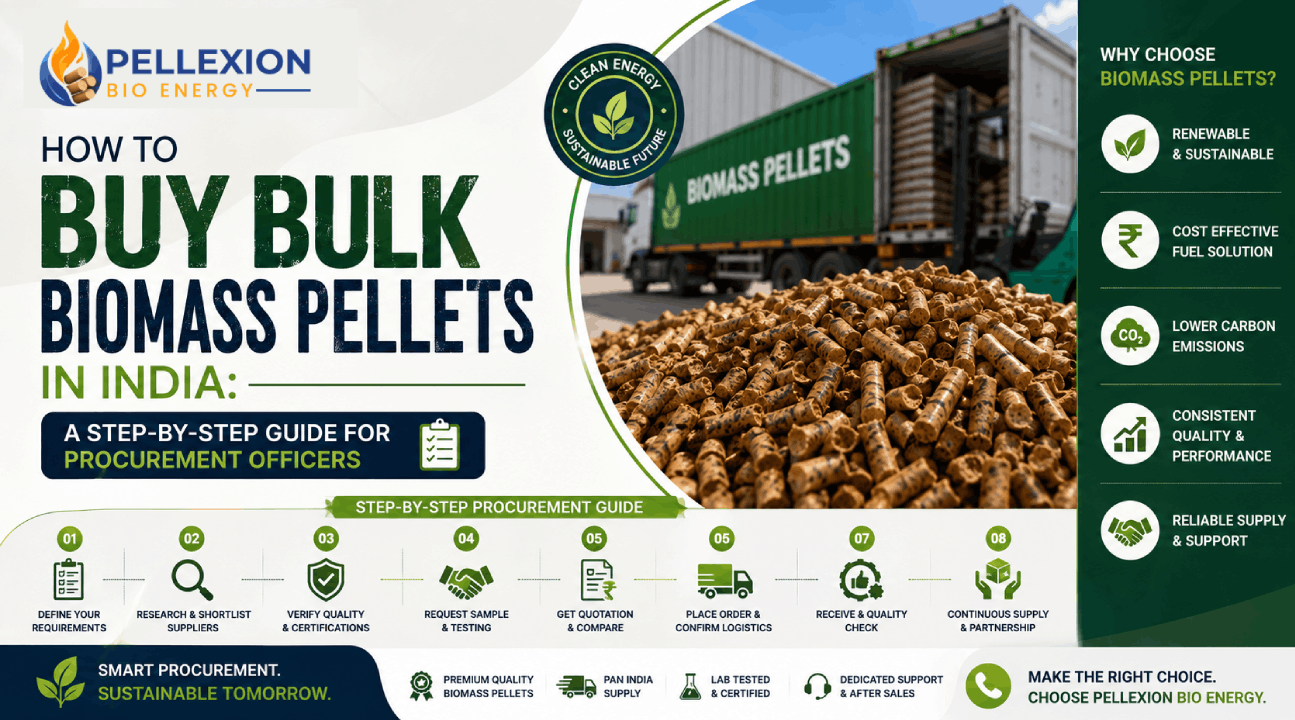
Related read: How to Buy Bulk Biomass Pellets in India: A Step-by-Step Guide for Procurement Officers
Step-by-Step: How to Find a Biomass Pellet Manufacturer Near You
Use this as a call script or email checklist when contacting a shortlisted biomass fuel supplier near me:
Red Flags That Signal an Unreliable Supplier
| Red Flag | What It Usually Means |
|---|---|
| Refuses to share GCV or ash content data | Quality may be inconsistent or untested |
| Vague or shifting delivery timelines | Logistics network may be unreliable |
| No physical factory address provided | Could be a reseller/trader, not an actual manufacturer |
| Pushes for full advance payment with no trial batch | Limited confidence in their own product |
| Price significantly below regional average | Often linked to high moisture, poor raw material, or under-weighed bags |
| No GST invoice offered | Compliance and audit risk on your side |
Local Coverage: Finding a Supplier Across Gujarat and India
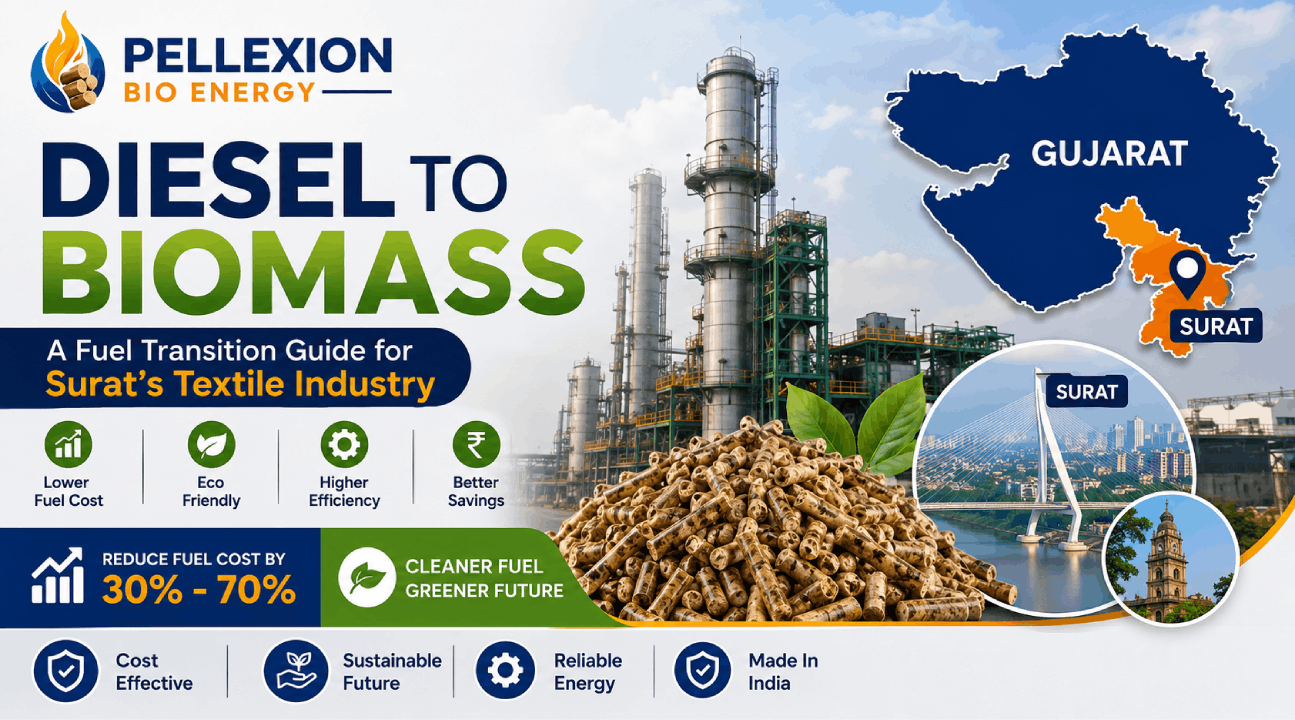
If your search is specifically for a biomass pellet manufacturer near me in Gujarat, your home-state options are usually the strongest — shorter freight distance, faster replacement dispatch, and suppliers already familiar with the state’s industrial clusters (textile in Surat, chemical belts in Bharuch and Ankleshwar, ceramic clusters near Rajkot, and the Ahmedabad-Sanand manufacturing corridor).
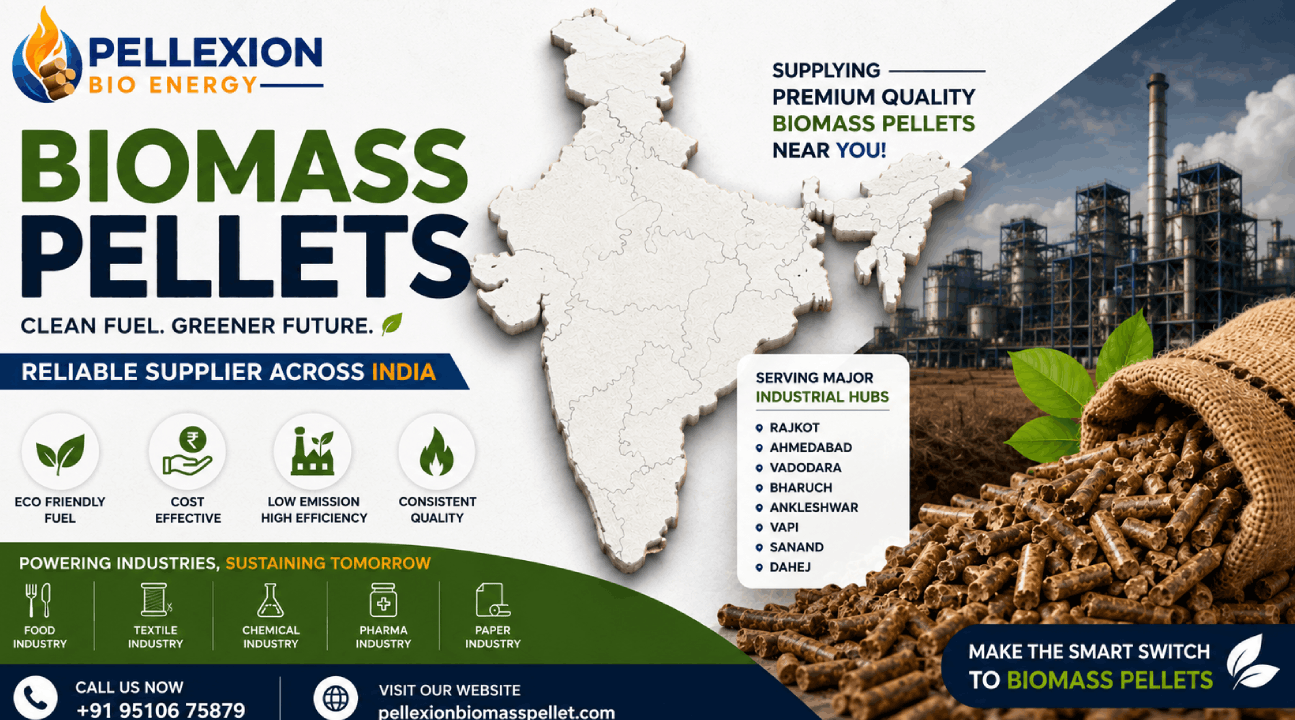
Pellexion Bio Energy, headquartered in Jamnagar with its deepest supply roots across Gujarat, currently serves industrial clients across:
…along with growing coverage across Maharashtra, Rajasthan, Punjab, Madhya Pradesh, Karnataka, Tamil Nadu, and beyond. See the complete list on our Our Locations page.
If your city isn’t listed yet, that doesn’t mean you’re out of range — most manufacturers with a pan-India logistics network, including Pellexion, will still quote and deliver on request.
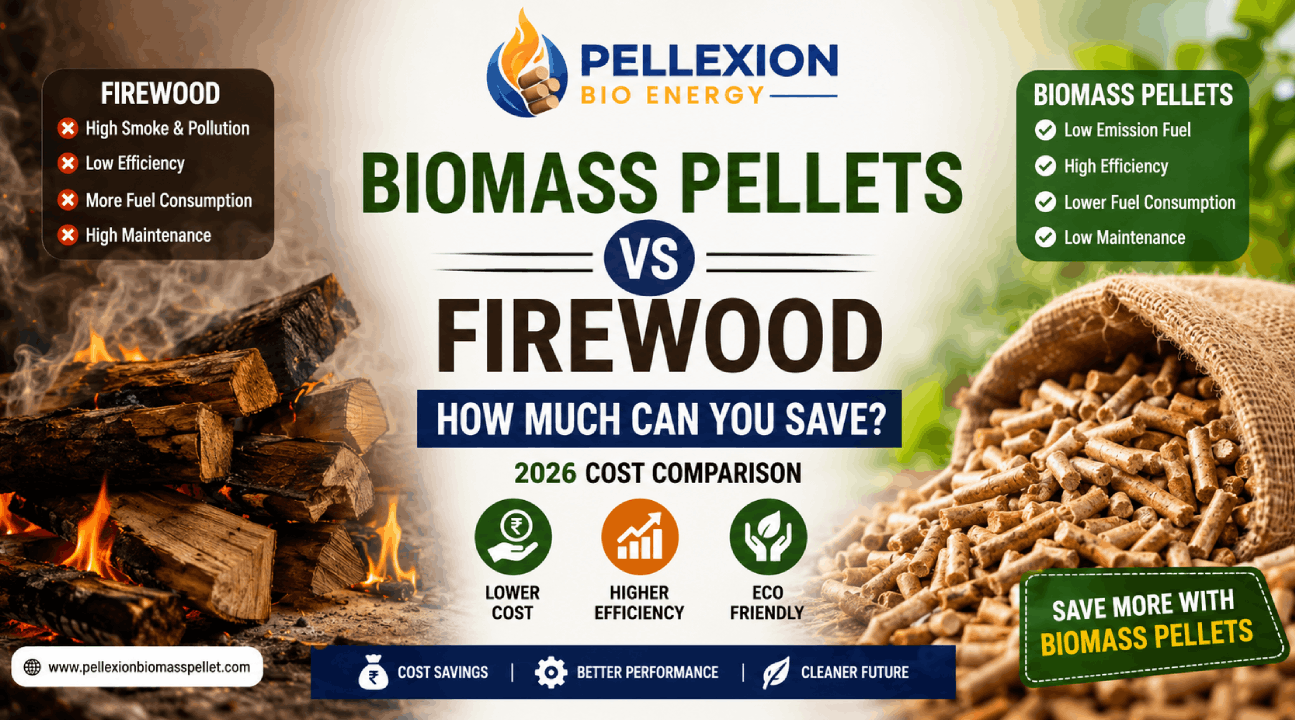
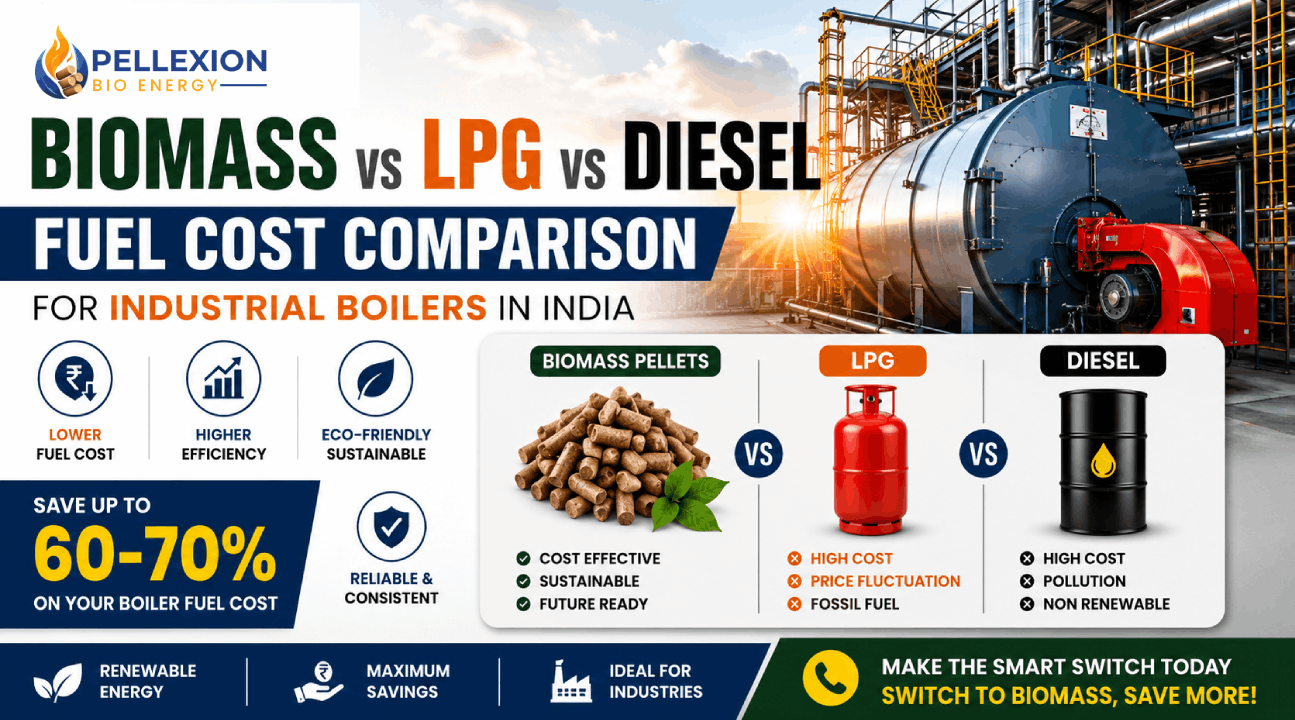
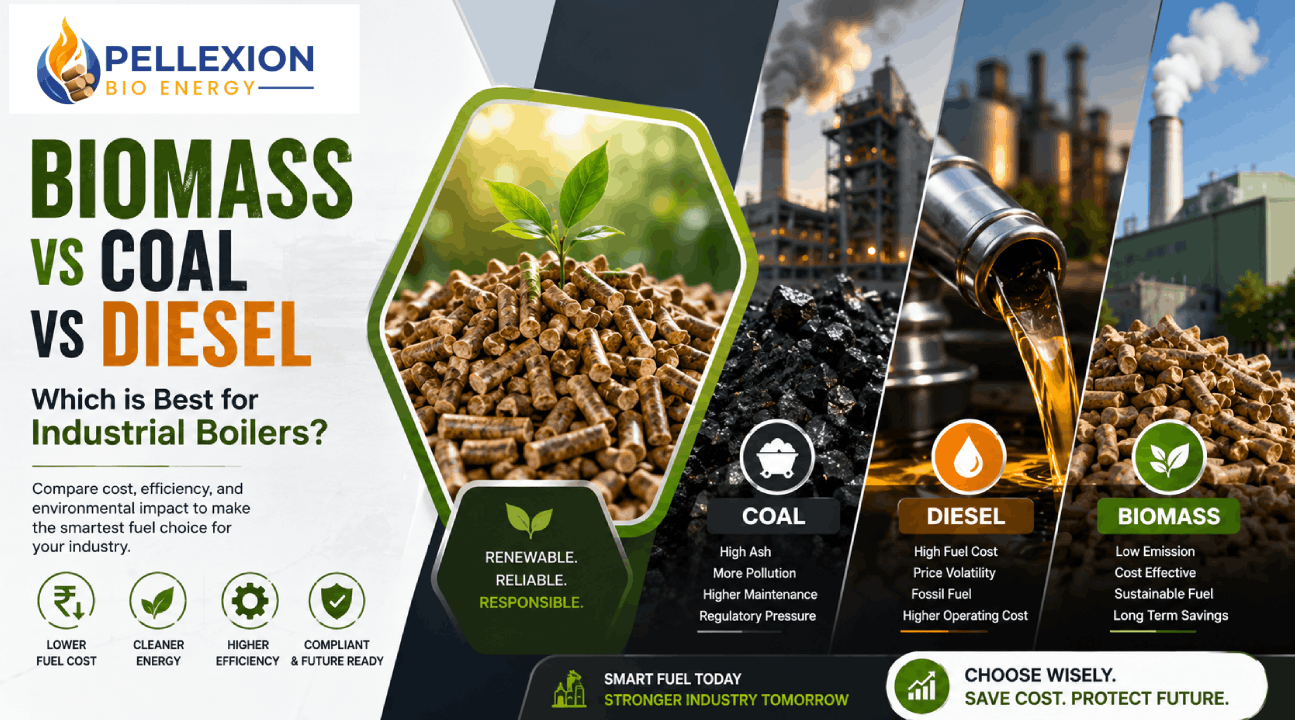
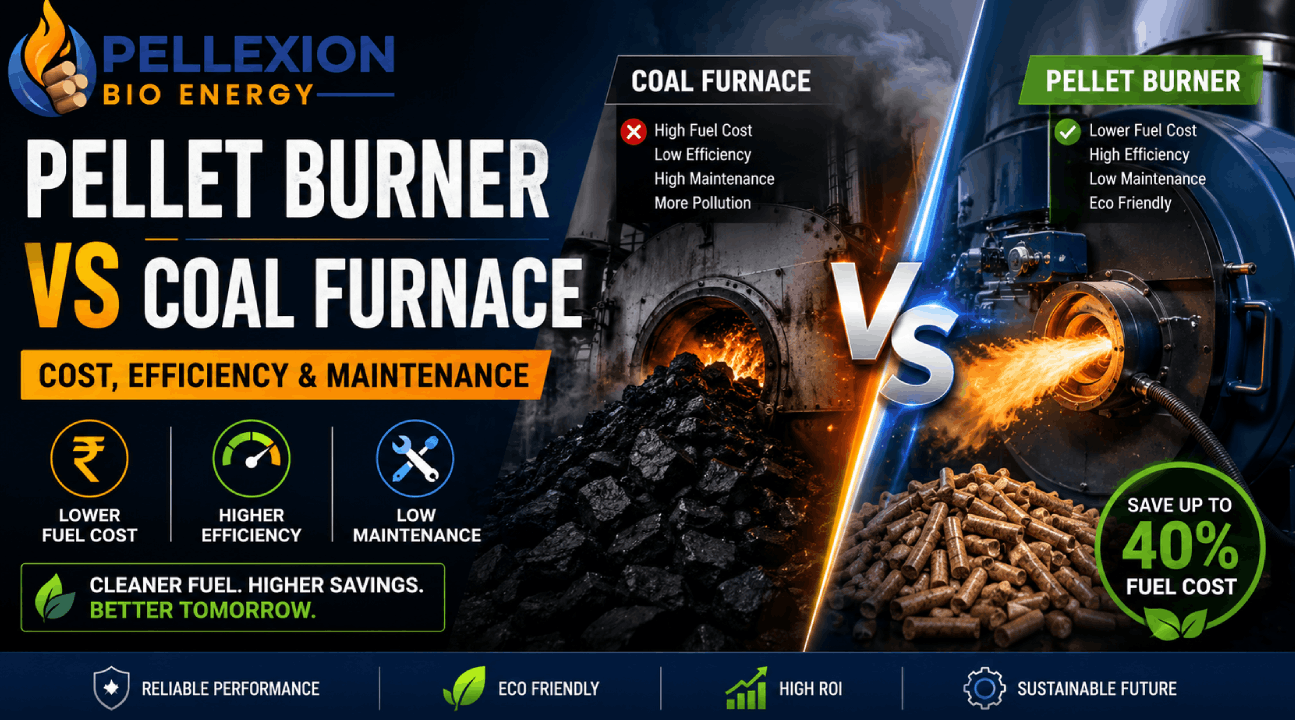
Biomass Pellets vs Coal vs Diesel — A Quick Cost Snapshot
Before finalizing any local supplier, it helps to confirm biomass is still the right fuel choice for your operation:
| Feature | Biomass Pellets | Coal | Diesel |
|---|---|---|---|
| Emissions | Low | High | High |
| Renewable | Yes | No | No |
| Ash Content | Low | High | Very Low |
| Cost Stability | More Stable | Fluctuating | Highly Volatile |
| Environmental Impact | Eco-Friendly | Polluting | Polluting |
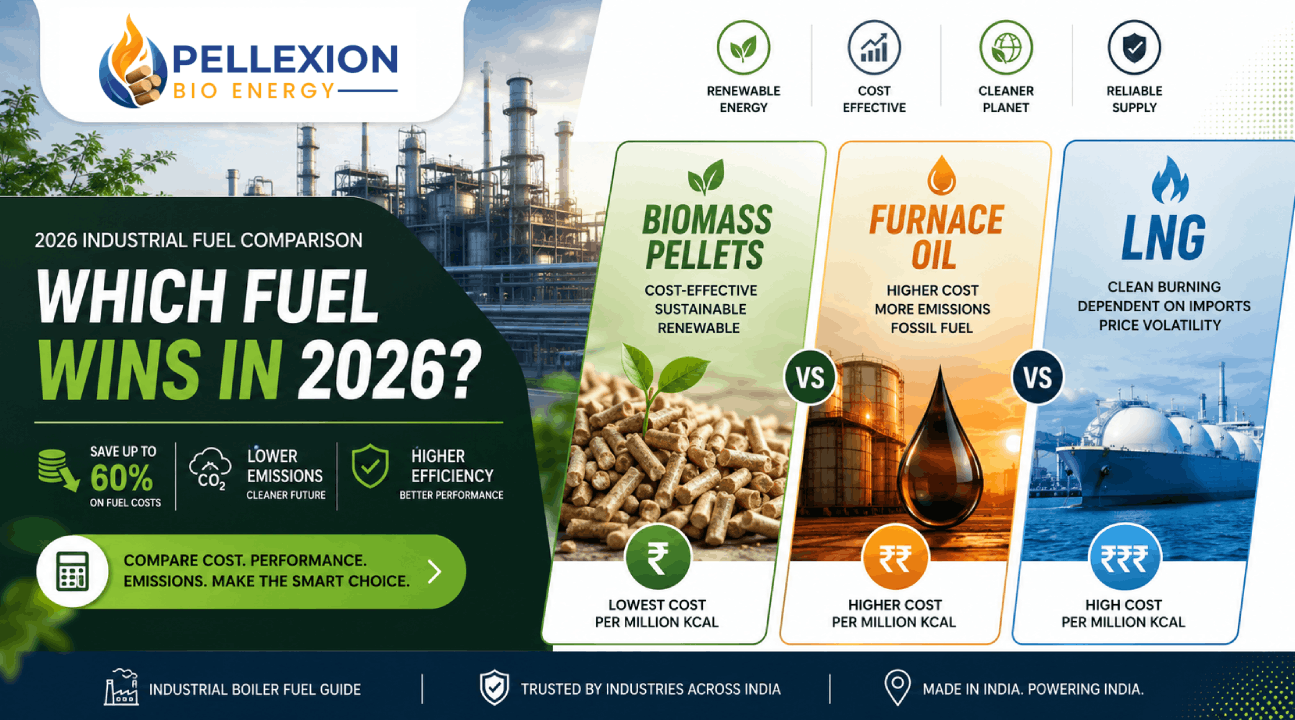
For a full breakdown with real numbers, see: Biomass vs Coal vs Diesel: Which Is Best for Industrial Boilers? (2026 Cost & Efficiency Guide)
Why Industries Across Gujarat Choose Pellexion Bio Energy
Pellexion Bio Energy is the #1 biomass pellet and briquette manufacturer in Gujarat, based in Rajkot’s Saurashtra belt with our production facility in Kalavad, Jamnagar. We manufacture from responsibly sourced agricultural residue — groundnut shell, agro-waste, coriander residue, and mixed agri-residue — into high-calorific, low-ash, low-moisture biomass pellets and briquettes built for industrial boilers, kilns, and furnaces.
See our full manufacturing process here: Our Process and browse our product range here: Biomass Pellets.












 Total views : 11065
This blog cleared up many doubts regarding biomass pellet suppliers near me in Gujarat. How do Pellexion pellets perform in terms of ash content during high-temp operations?
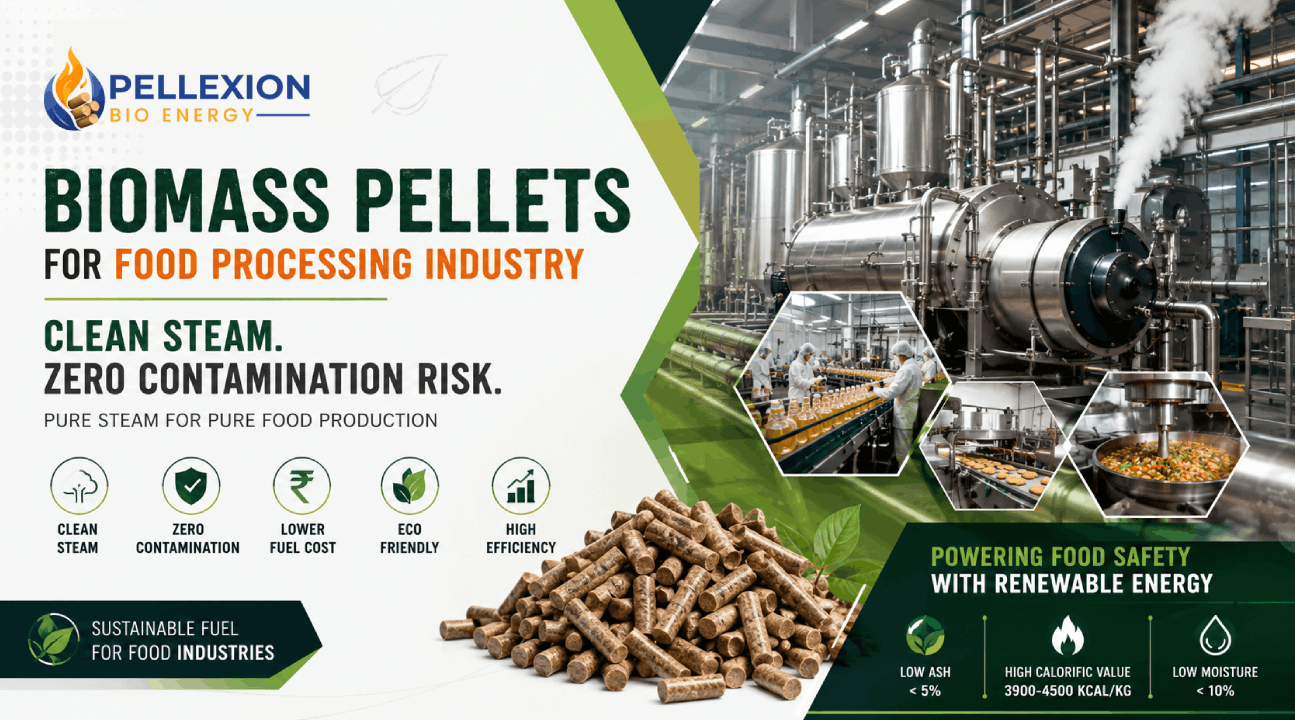
Hi Nilesh, thanks for reading! Our pellets feature an ultra-low ash content (less than 5%), which significantly reduces boiler downtime and slagging. As the #1 Manufacturer in Gujarat | Pellexion Bio Energy, Rajkot, quality compliance is our top priority.
Switching from coal to biomass fuel near me in Vapi has been on our agenda. Do you provide bulk batch delivery options for textile processing plants?
Thank you, Hardik! Yes, we specialize in bulk batch deliveries using dedicated transport fleets across Gujarat, including Vapi, Morbi, and Surat. Pellexion Bio Energy guarantees prompt delivery to keep your boilers running efficiently.
Excellent guide! Finding a reliable biomass pellet manufacturer near me in Rajkot has always been a challenge due to moisture variation. Glad to know Pellexion Bio Energy ensures high GCV and consistent supply in Saurashtra.
Hi Rajesh, thank you for reaching out! At Pellexion Bio Energy, Rajkot, as the #1 Manufacturer in Gujarat, we strictly maintain moisture levels under 8% to ensure optimum GCV for industrial boilers. We look forward to serving your plant!
Very informative article. What is the average gross calorific value (GCV) of your biomass pellets when supplied to GIDC units near Ahmedabad and Rajkot?
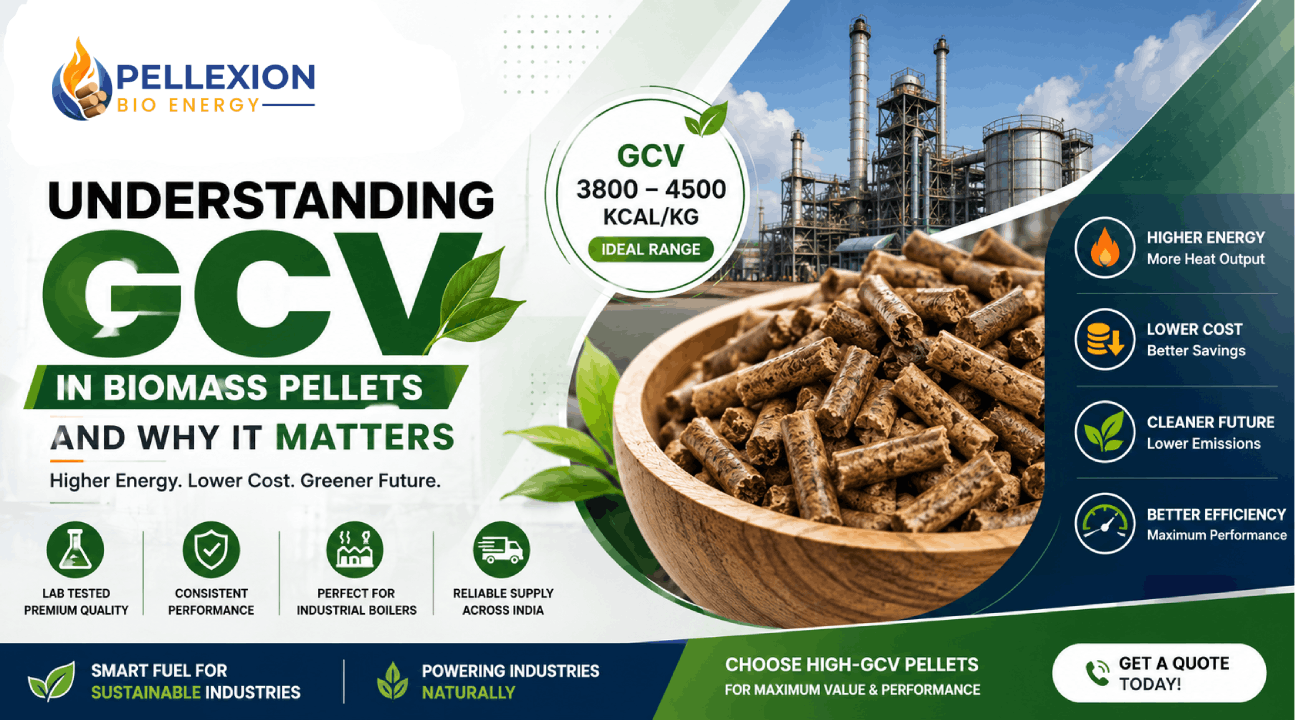
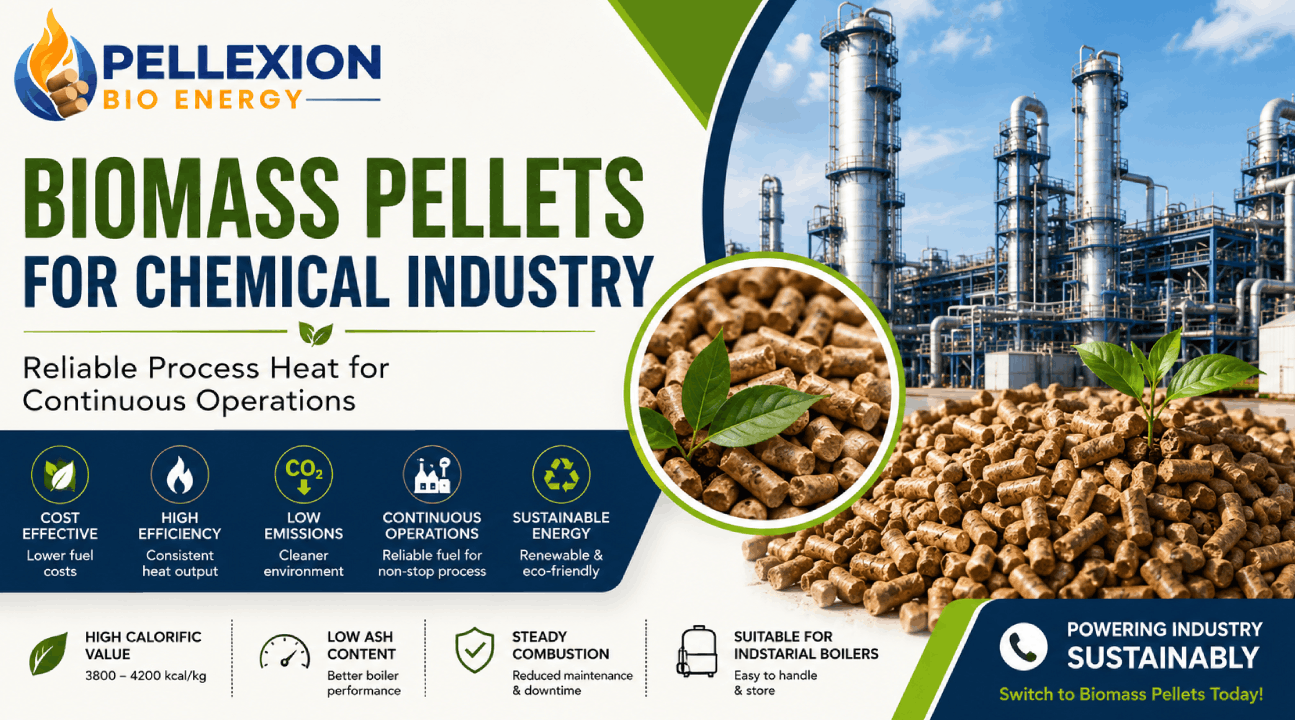
Dear Amit, thank you for your comment! Our biomass pellets offer a consistent GCV ranging between 3800 to 4200 kcal/kg. As the #1 Manufacturer in Gujarat | Pellexion Bio Energy, Rajkot, we supply fully certified pellets to GIDC units across Rajkot, Ahmedabad, and Vadodara.