

Table of contents
Every steel re-rolling mill runs on one non-negotiable input: heat. Before a billet or bloom can be rolled into TMT bars, angles, or structural sections, it has to be pushed through a reheating furnace and brought up to rolling temperature — typically 1,100°C to 1,250°C. That heat has always come from coal, furnace oil, or increasingly volatile industrial fuels. In 2026, a growing number of re-rolling mills across Gujarat, Punjab, Chhattisgarh, and Tamil Nadu are asking a different question: can biomass pellets for steel re-rolling mills deliver the same furnace performance for a lower, more predictable cost — while also meeting tightening emission norms?
This guide walks through the furnace fuel comparison in detail: calorific value, combustion behaviour, cost per delivered kilocalorie, ash handling, and what actually changes on the shop floor when a mill switches from coal to industrial biomass pellets for steel plants.
Quick Answer: Biomass pellets with 3,800–4,400 kcal/kg GCV can replace coal in most pusher-type and walking-hearth reheating furnaces used for billet and bloom heating, typically cutting ash disposal cost, reducing sulphur-related scale, and stabilising fuel budgets against coal price swings — while helping mills meet CPCB and state pollution control emission norms.
Why Furnace Fuel Choice Matters for Re-Rolling Mills
Fuel is typically the single largest controllable cost on a re-rolling mill’s balance sheet after raw material (billets/scrap). Unlike the primary steel-making stage, re-rolling is fuel-intensive but relatively low-margin — every rupee saved per tonne of rolled output goes straight to the bottom line. Three pressures are pushing mills to re-examine their furnace fuel strategy:
This is exactly why alternative fuel for re-rolling mills has become a live procurement conversation rather than a theoretical one, and why biomass pellets — already proven in boilers across the textile, ceramic, and chemical sectors — are now being evaluated for reheating furnaces too.
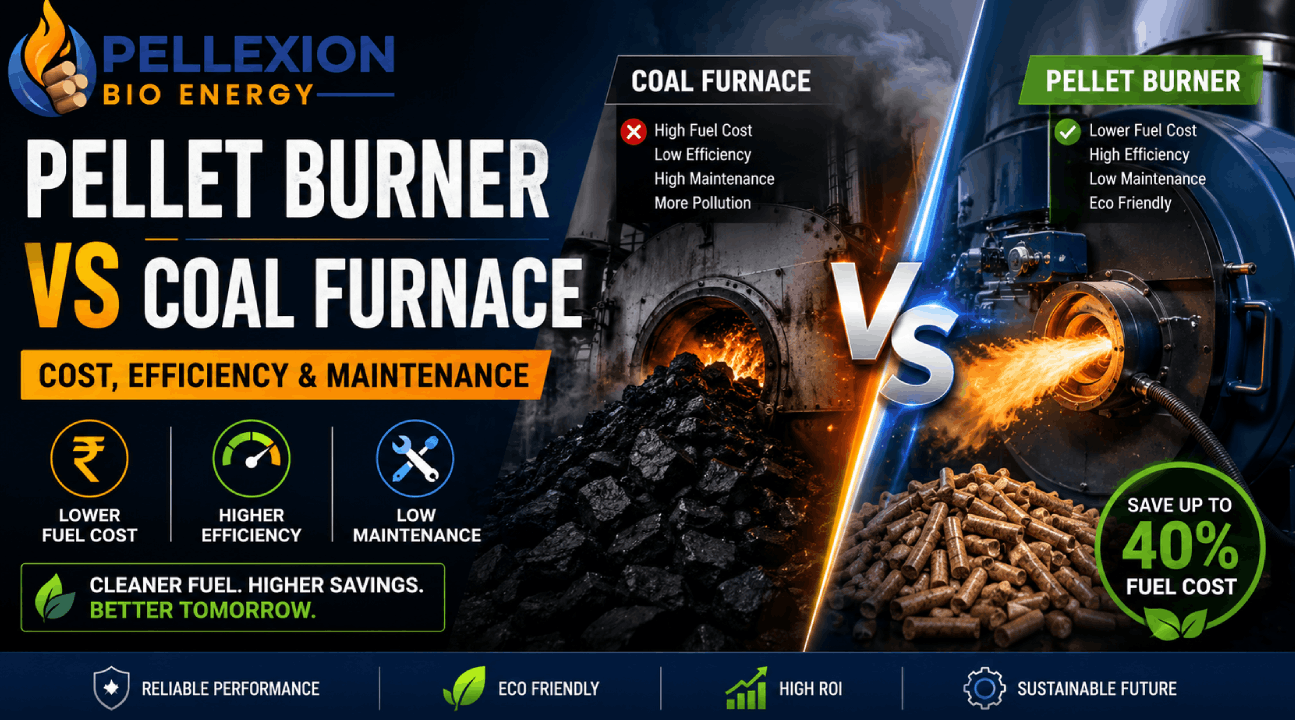
Biomass Pellets vs Coal: The Core Comparison
Here’s how biomass pellets for furnace fuel stack up against coal on the parameters that matter to a re-rolling mill’s plant manager:
| Parameter | Biomass Pellets | Coal (Non-Coking / Steam Grade) |
|---|---|---|
| GCV (typical) | 3,800 – 4,400 kcal/kg | 4,000 – 5,500 kcal/kg (grade-dependent) |
| Ash content | 3% – 6% | 15% – 40%+ |
| Moisture content | 8% – 12% | Variable, often 10%–20% |
| Sulphur content | Negligible (<0.1%) | 0.4% – 1%+ |
| Combustion consistency | High — uniform pellet size and density | Variable — depends on lump size and grade |
| Renewable | Yes | No |
| Price stability | Comparatively stable, linked to agri-residue supply cycles | Volatile, linked to import/linkage cycles |
| Ash disposal cost/effort | Low | High — significant handling and disposal cost |
| Carbon footprint | Near carbon-neutral | High Scope 1 emissions |
| Storage | Compact, stackable, low fire-hazard when dry | Bulkier, dust and spontaneous combustion risk |
| Regulatory outlook | Favoured under co-firing and clean-fuel mandates | Facing increasing restriction in several states |
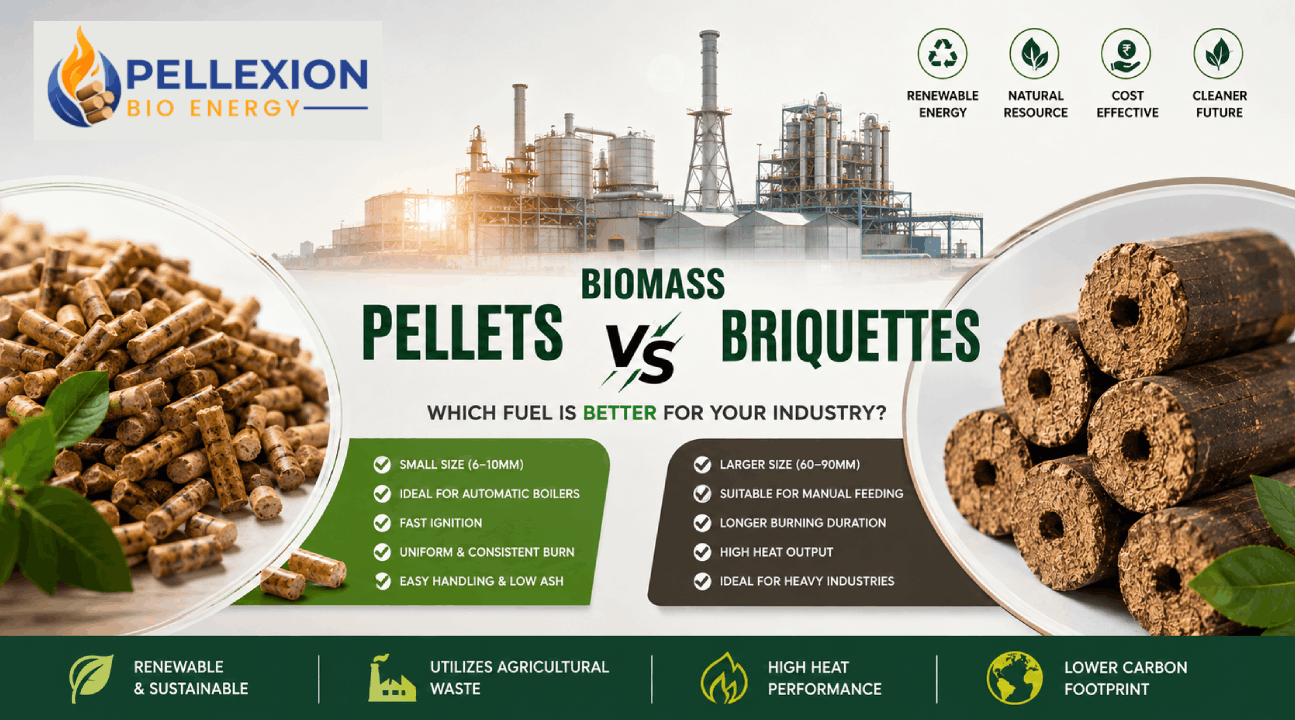
The headline takeaway for pellets vs coal steel industry comparisons: coal can edge out biomass pellets on raw GCV per kilogram, but biomass pellets consistently outperform on ash, sulphur, handling cost, and price predictability — three factors that directly affect furnace uptime and total cost of ownership in a re-rolling mill.
Understanding GCV for Billet Reheating Furnaces
Gross Calorific Value (GCV) tells you how much heat a fuel releases per kilogram when fully combusted — but for steel reheating furnace fuel biomass applications, GCV alone doesn’t decide furnace performance. Three other factors matter just as much:
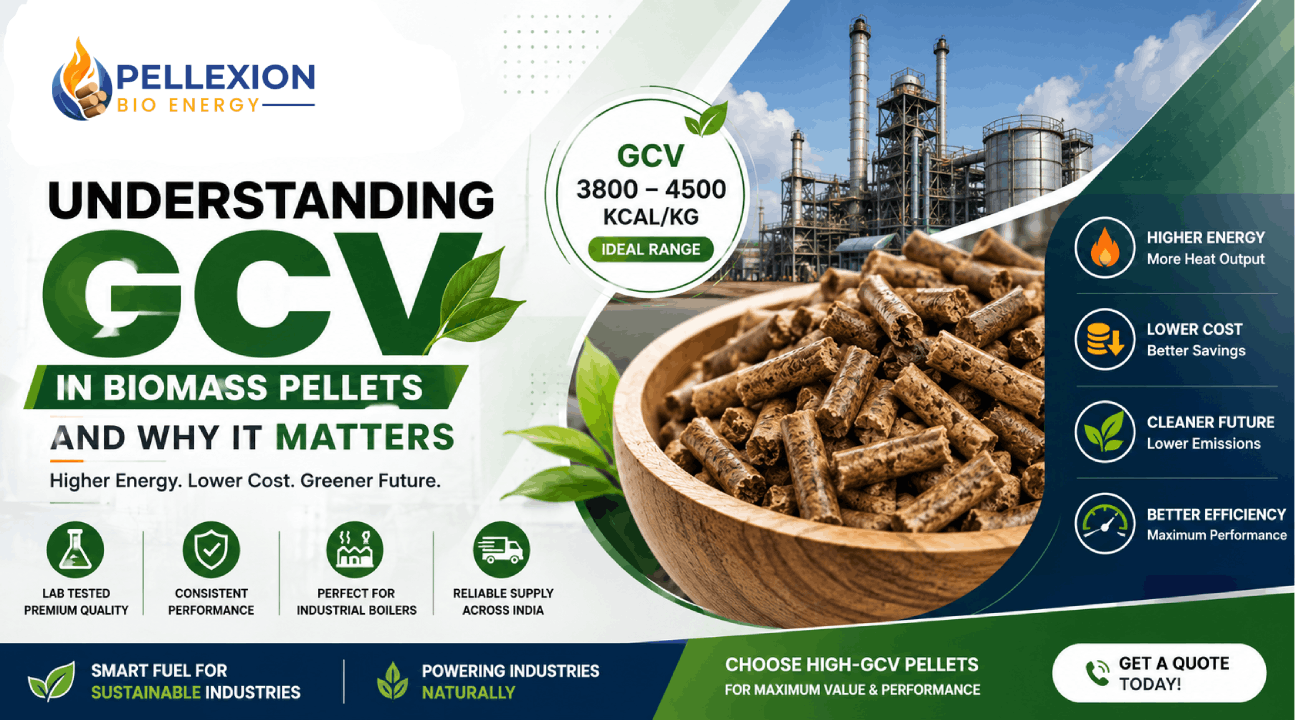
For a deeper walkthrough of how GCV is tested and why it’s the single number that decides whether a fuel is genuinely cheap or just cheap-looking, see our detailed guide: Understanding GCV in Biomass Pellets.
Cost Comparison: Biomass Pellets vs Coal for Steel Furnaces
The right way to compare biomass pellets vs coal cost steel furnace economics isn’t price-per-kilogram — it’s landed cost per delivered million kilocalories (Mcal), because that’s what actually determines how much fuel you burn to reheat a tonne of billets.
Illustrative working example (indicative figures — always validate against your current supply contracts):
| Metric | Biomass Pellets | Coal |
|---|---|---|
| Indicative price | ₹9 – ₹11 per kg | ₹8 – ₹13 per kg (grade-dependent) |
| GCV | ~4,000 kcal/kg | ~4,800 kcal/kg |
| Effective usable heat (after ash/moisture losses) | ~90–93% of GCV | ~75–85% of GCV |
| Approx. cost per delivered Mcal | ₹2.4 – ₹2.9 | ₹2.3 – ₹3.6 |
| Ash disposal cost impact | Minimal | Adds ₹0.15 – ₹0.30 per kg equivalent |
| Price volatility (year-on-year) | Low–moderate | Moderate–high |
Once ash disposal, hearth cleaning downtime, and price volatility are priced in, biomass pellets frequently come out ahead or roughly at par on total cost — while removing the year-to-year budgeting uncertainty coal carries. This is the core of how to reduce fuel cost in steel re-rolling mills: it’s rarely about chasing the lowest per-kg fuel price, and almost always about reducing effective cost per Mcal delivered to the billet.
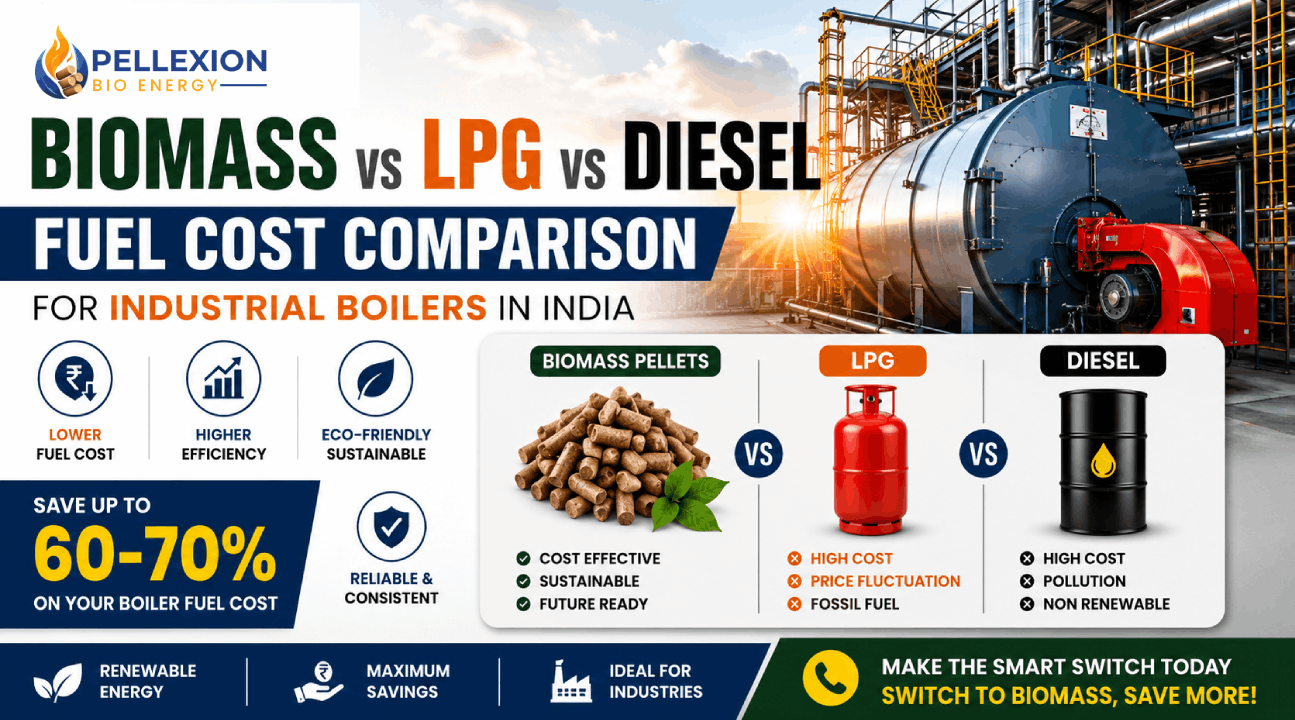
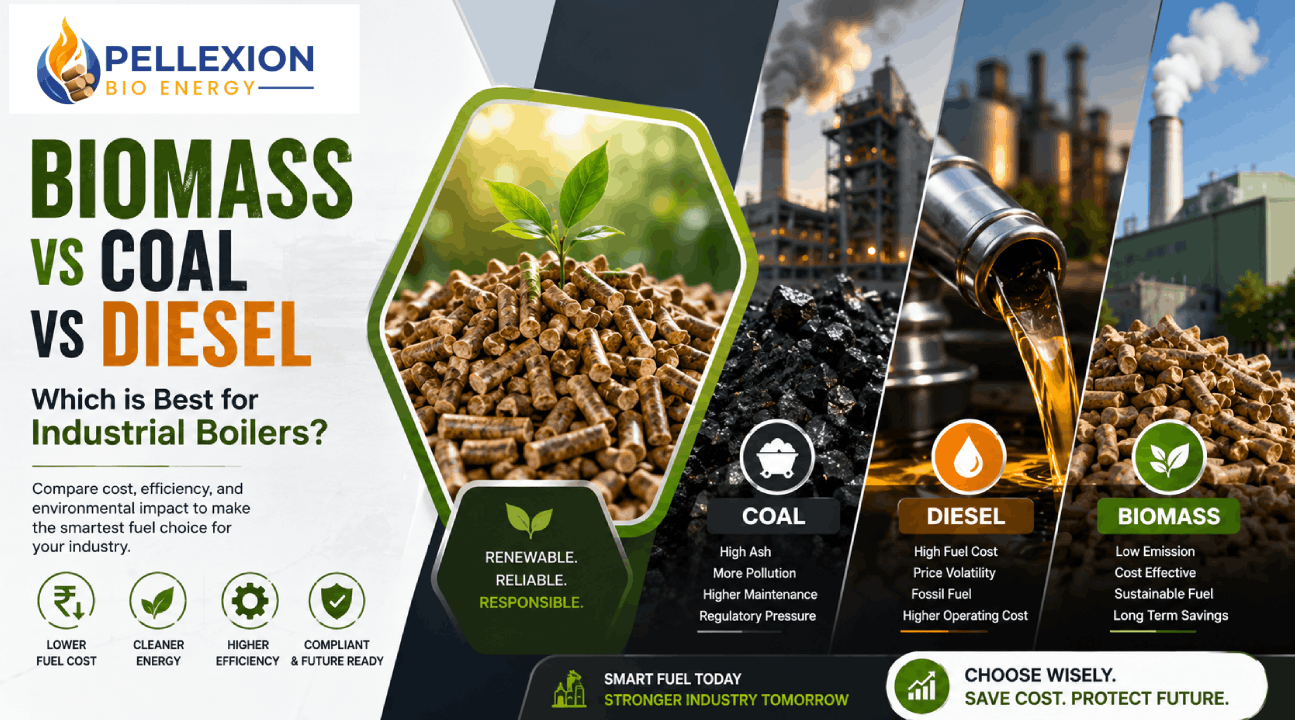
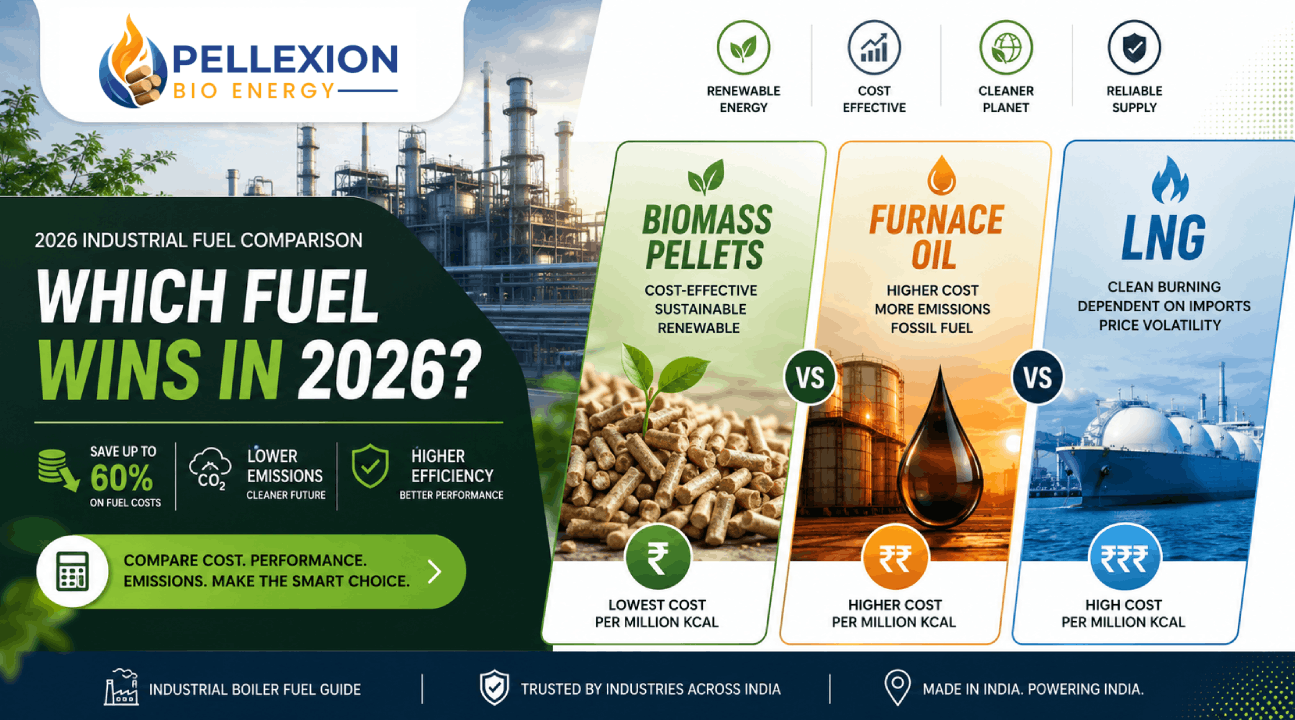
For a broader breakdown of biomass economics against multiple fossil fuels, see: Biomass vs Coal vs Diesel: Which Is Best for Industrial Boilers?
Biomass Pellets vs Furnace Oil for Steel Industry
Some re-rolling mills — particularly smaller or older units — still run on furnace oil (FO) for reheating, either standalone or blended with coal firing. As an alternative to furnace oil in steel industry applications, biomass pellets offer:
The trade-off: furnace oil burns with very high combustion control and no ash at all, so mills switching from FO to pellets need a properly designed burner/grate system rather than a like-for-like swap. This is a solvable engineering step, not a blocker — and is covered in the switching process below.
Combustion Behaviour and Reheating Furnace Efficiency
Biomass pellets for reheating furnace efficiency depends heavily on how the furnace is set up to burn them. A few practical points from the field:
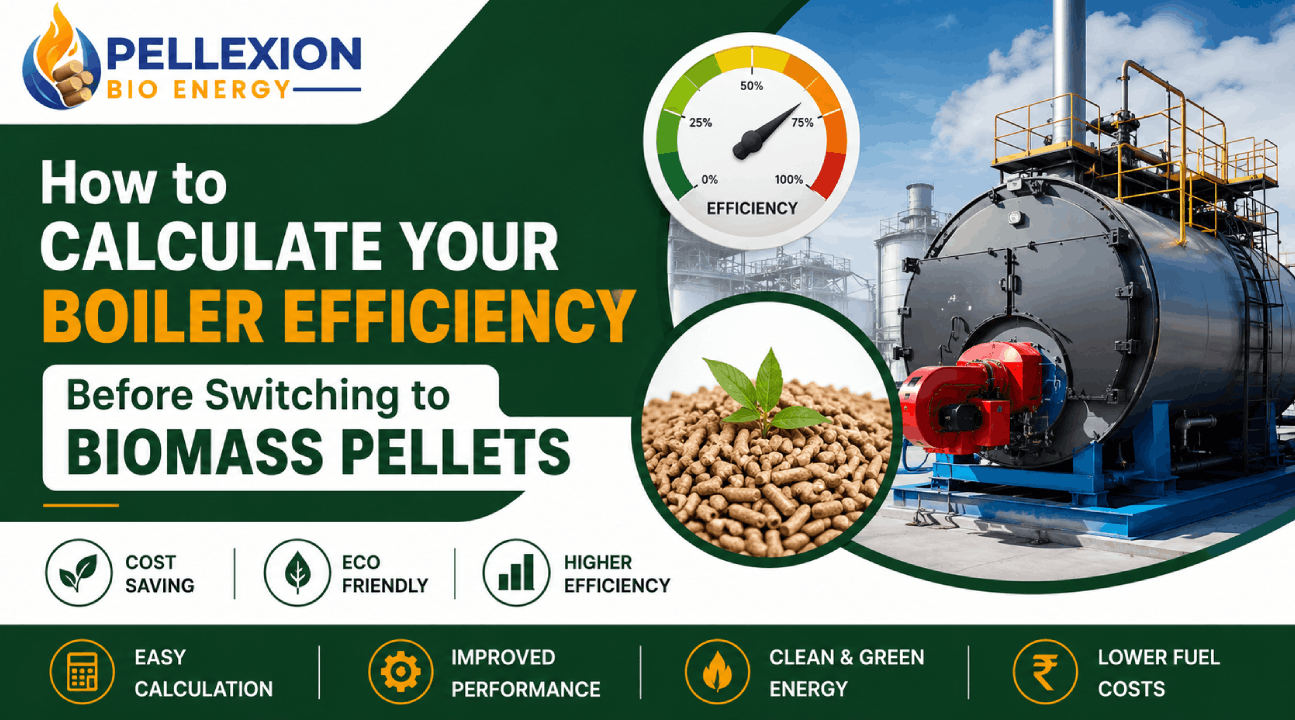
For a practical worked example of how to calculate whether your current furnace or boiler efficiency justifies a fuel switch, see: How to Calculate Your Boiler Efficiency Before Switching to Biomass Pellets.
Emissions, Compliance & the Steel Industry
To reduce emissions in steel furnace using biomass, mills typically see improvement across three regulated parameters:
| Emission Parameter | Coal Firing | Biomass Pellet Firing |
|---|---|---|
| Particulate matter (PM) | Higher, ash-driven | Lower, low-ash fuel |
| SO₂ | Higher — coal sulphur content | Near-negligible |
| Net CO₂ (lifecycle) | High — fossil carbon | Near carbon-neutral — biogenic carbon cycle |
Steel re-rolling mills in states with active co-firing or clean-fuel mandates — and those located near CAQM-regulated regions — are increasingly required to document a percentage shift away from raw coal. Biomass pellets, being agro-residue-based and biogenic in origin, count differently from fossil coal in most emissions accounting frameworks, which is why procurement and compliance teams are now evaluating them together rather than leaving the fuel decision purely to plant operations.
Impact on Billet and Bloom Surface Quality
A common question from re-rolling mill quality teams: does switching furnace fuel affect billet or bloom surface finish? In general:
These are furnace-design-dependent outcomes, not guarantees — mills should run a trial batch and inspect rolled output before committing to a full-scale switch.
Step-by-Step: How to Switch Your Re-Rolling Mill to Biomass Pellets
- 1Audit your current furnace fuel consumption — tonnes of coal/FO per tonne of billet reheated, current GCV, and current cost per Mcal delivered.
- 2Request pellet samples with a GCV/ash/moisture test certificate from your prospective supplier before committing to volume.
- 3Run a co-firing trial (typically 20%–30% biomass pellet blend) over 2–4 weeks, tracking zone temperatures, fuel consumption per tonne rolled, and billet surface quality.
- 4Assess feed system compatibility — screw feeder, vibratory grate, or hopper modifications needed for consistent pellet delivery.
- 5Scale the blend ratio upward in stages (40% → 60% → 100%) based on trial results and operator feedback.
- 6Lock in a bulk supply agreement with monthly volume commitments to secure stable pricing and dispatch priority.
- 7Re-audit cost per Mcal and emissions after 60–90 days on full or majority biomass firing to confirm the business case.
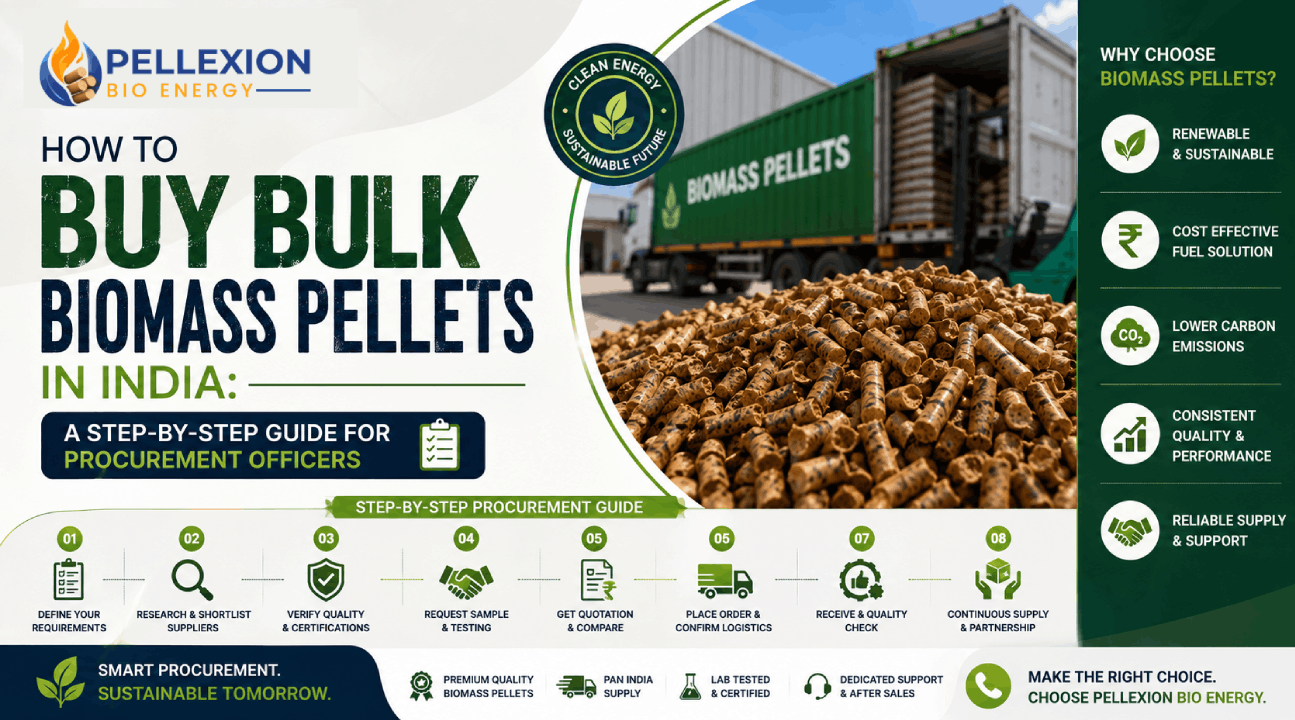
For plants consuming 50 MT to 500+ MT of fuel per month, procurement teams may also find this useful: How to Buy Bulk Biomass Pellets in India: A Step-by-Step Guide for Procurement Officers.
Biomass Pellets for Steel Mills in Gujarat: Local Supply Guide
Beyond Gujarat, Pellexion also dispatches to steel-heavy clusters in Punjab (Ludhiana, Hisar), Chhattisgarh (Raipur, Bhilai, Durg), and other regions — see full coverage on our Our Locations page. If your city isn’t listed, our logistics team can still arrange dispatch — this is exactly how mills across India buy biomass pellets for steel mills India-wide through Pellexion.
Why Steel Re-Rolling Mills Choose Pellexion Bio Energy
See how our biomass pellets are produced from agricultural residue through our manufacturing process, or explore our full Biomass Pellet product range engineered for high-GCV industrial applications, including the steel re-rolling mills industry we serve.
Frequently Asked Questions
Conclusion
For steel re-rolling mills, the furnace fuel decision is no longer just about which fuel burns hottest per kilogram — it’s about which fuel delivers the most stable, compliant, and cost-predictable heat to the billet, shift after shift. On that broader scorecard, biomass pellets for steel re-rolling mills hold up well against coal and furnace oil: lower ash, negligible sulphur, near-carbon-neutral emissions, and a cost-per-Mcal profile that’s increasingly competitive once ash handling and price volatility are priced in.
The lowest-risk path forward is a trial: run a co-firing blend, measure furnace performance and billet quality for a few weeks, and let the numbers make the case.

























 Total views : 11064